How advanced fuel technologies are delivering measurable emissions reductions and operational efficiency across hard-to-electrify industries
Industrial Sustainability Group (ISG), doing business as The Fuel Ox, develops advanced fuel enhancing technologies designed to improve combustion efficiency, reduce emissions, and extend engine performance in demanding, high-intensity applications. Headquartered in Asbury, New Jersey, the company serves sectors ranging from defense and heavy transport to agriculture, construction, and municipal operations.
In this interview, Co-Founder and CEO Rand Taylor discusses the role of certified fuel technologies in delivering measurable sustainability outcomes today, the importance of third-party validation, how clean fuel initiatives support near-term decarbonisation in hard-to-electrify industries, and the global demand shaping The Fuel Ox’s expansion and future plans.
Please introduce yourself to our readers and tell us a bit about your role at Industrial Sustainability Group and The Fuel Ox.
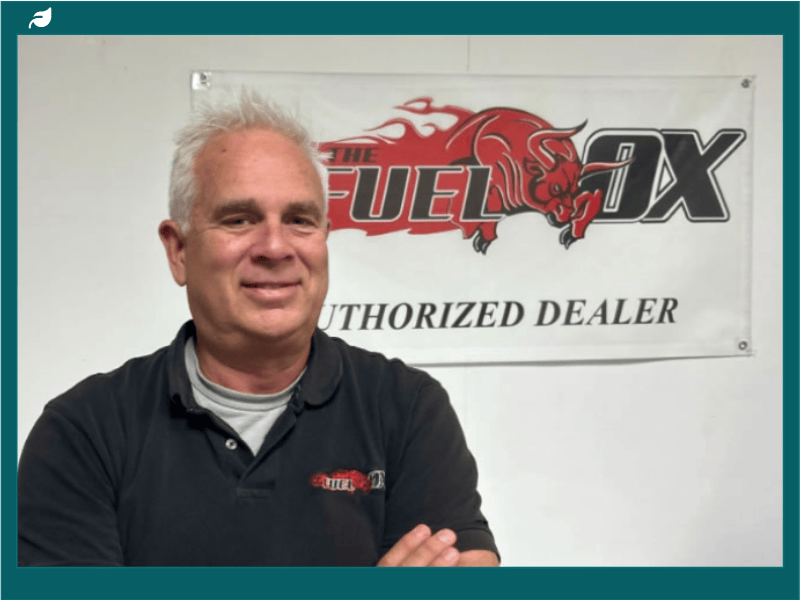
My name is Rand Taylor, and I am the Co-Founder and CEO of Industrial Sustainability Group (ISG), doing business as The Fuel Ox, headquartered in Asbury, New Jersey. Since 2014, our mission has been to transform the fuel industry by delivering high-performance, environmentally responsible fuel enhancing technologies that outperform conventional additives both technically and economically.
Our flagship products, including Fuel Ox with Combustion Catalyst, were developed for ultra-high-intensity applications, including use by the United States Department of Defense. Through this work, we have demonstrated that fuel efficiency and sustainability can coexist.
Today, our products are used by construction and trucking companies, farmers, municipalities, and independent operators across multiple sectors. We call this philosophy PROFITABLE SUSTAINABILITY – the belief that environmental responsibility, operational efficiency, and economic performance should reinforce one another.
We call this philosophy PROFITABLE SUSTAINABILITY – the belief that environmental responsibility, operational efficiency, and economic performance should reinforce one another.
Fuel additives are often misunderstood in sustainability discussions. How do certified fuel technologies contribute to measurable emissions reduction and efficiency gains today?
Fuel is often viewed as a fixed commodity, yet fuel quality and combustion efficiency vary significantly, even within the same specifications. Over time, fuels degrade, carry contaminants, and burn incompletely, leading to higher emissions, wasted energy, and increased engine wear.
Certified fuel technologies like ours address these issues directly, while most conventional additives treat only one or two factors. Through independent laboratory testing and real-world field evaluations, our products are compared side-by-side with conventional additives, consistently showing more complete combustion, fewer engine deposits, and a more stable, uniform burn.
In practical terms, this means lower emissions per unit of work, not just theoretical improvements. Field testing has also shown measurable reductions in fuel consumption on a per-mile basis, delivering fewer refueling events, less fuel used, and cleaner engines with immediate sustainability and operational benefits.
In practical terms, this means lower emissions per unit of work, not just theoretical improvements.
Your products have achieved NSF, USDA, and EPA Title 40 CFR certifications. Why is third-party validation critical in building trust and credibility in clean fuel solutions?
It is easy for products to claim environmental benefits; actually proving those claims is far more important. Third-party certification provides independent verification, removing subjectivity and ensuring credibility.
Certifications such as NSF, USDA, and EPA Title 40 CFR confirm that our products meet strict standards for safety, environmental compatibility, and regulatory compliance. In an industry where certifications of this depth are uncommon, they demonstrate our commitment to transparency, accountability, and scientific integrity.
If we are serious about advancing sustainability, we must be able to substantiate our claims with objective, verifiable data.
Third-party certification provides independent verification, removing subjectivity and ensuring credibility.
How do clean fuel initiatives fit into broader decarbonisation strategies for industries that cannot electrify quickly or fully?
Industries such as heavy transport, mining, marine, agriculture, and aviation cannot realistically electrify in the near term. These sectors depend on high-energy-density fossil fuels to operate reliably.
For these industries, decarbonisation is about reducing emissions today, not waiting for future infrastructure changes. Clean fuel initiatives enable immediate improvements in efficiency and emissions without requiring new equipment or system redesigns.
By improving combustion quality and reducing fuel consumption, advanced fuel technologies support meaningful emissions reductions while preserving operational reliability and economic viability.
For these industries, decarbonisation is about reducing emissions today, not waiting for future infrastructure changes.
With The Fuel Ox expanding globally into markets such as Africa and Asia, what regional sustainability challenges are shaping demand for these solutions?
Globally, we see a strong demand to reduce pollution without constraining economic growth. Rapid industrialization in many regions has placed heavy pressure on air quality, fuel systems, and public health.
Governments and businesses are seeking solutions that improve efficiency while maintaining productivity. Our recent engagements with the government of Mongolia and regional industrial partners reflect this demand.
Adoption takes time, but as performance data accumulates, the value of cleaner, more efficient fuel technologies becomes clear.
Governments and businesses are seeking solutions that improve efficiency while maintaining productivity.
What exciting plans and goals do you have for the next few years?
Our growth will continue through regional expansion, with dedicated teams focused on local market needs. We are also preparing to introduce new products in North America, responding to renewed interest in practical, science-based sustainability solutions.
Equally important is our commitment to education and transparency, helping customers understand what truly drives efficiency, emissions reduction, and long-term performance.
Our goal is to help shape the next generation of sustainable fuel standards through proven technology and real-world results.
Our goal is to help shape the next generation of sustainable fuel standards through proven technology and real-world results.