Electronics are one of the fastest-growing product categories in e-commerce – and one of the most carbon-intensive to ship. Heavy devices, complex packaging, short product lifecycles, and high return rates stack up to a real environmental problem.
The supply chain accounts for more than 90% of the total environmental impact of a typical e-commerce business. For electronics brands, that number stings more than most. Every oversize box, every foam-padded return, every last-mile delivery that could have been batched adds weight to an already heavy footprint.
The good news: brands don’t have to choose between fast fulfillment and responsible operations. Targeted changes across packaging, shipping methods, and returns handling can cut emissions meaningfully – without gutting margins.
Green Logistics Is Now a Market Force – Not a Nice-to-Have
The scale of the shift is worth stating plainly. The green logistics market is estimated at USD 1.4 trillion in 2025 and is projected to reach USD 3.4 trillion by 2035, according to Future Market Insights. Green logistics now accounts for 21.5% of total global logistics expenditure. That’s not a fringe movement – it’s a structural change in how goods move.
And supply chain leaders know it. Roughly 84% of them plan to invest in climate adaptation and mitigation within the next 18 months, according to a 2025 WareIQ report. Electronics brands that delay will find themselves behind retail partners, big-box buyers, and B2B clients who are already setting supplier sustainability requirements.
The good news is that purpose-built electronics fulfillment operations now factor environmental impact into every step – from inbound receiving through warehouse energy use to last-mile carrier selection. The operational decisions made at the fulfillment level have an outsized effect compared to anything happening upstream.
Pairing that with sustainable packaging strategies at the warehouse level is where most brands find their fastest, most visible wins.
Rethinking the Box: Packaging That Doesn’t Cost the Planet

Electronics packaging is notoriously over-engineered. Thick foam liners, oversized outer boxes, layers of plastic bubble wrap – it’s protective, but it’s wasteful and expensive. There’s a better way to do it.
Right-sizing is the first lever. Dell reduced packaging volume by 10% through cube-optimized box design. The principle scales down to any volume. Smaller boxes mean less material per unit, more units per truck, and lower emissions per shipment. It also reduces dimensional weight charges, which adds up fast when you’re shipping thousands of units a month.
Material swaps matter too. Molded pulp trays, corrugated cardboard inserts, and paper void fill can replace foam and bubble wrap in most consumer electronics applications. These alternatives are curbside recyclable, increasingly available at competitive prices, and – critically – what a growing share of customers expect to see when they open their orders.
For a closer look at how packaging choices ripple through online retail operations, the packaging choices for online retail coverage on this site goes deep on the tradeoffs.
Shipping Smarter: Cutting Emissions in Last-Mile Delivery
Shipping is where emissions become visible – to customers, to partners, and increasingly to regulators. It’s also where operational decisions have immediate, measurable impact.
Route optimization software using AI-assisted planning can reduce per-shipment emissions by up to 20%, according to Xeneta data from June 2025. That kind of gain doesn’t require switching carriers or renegotiating contracts – it requires better data and routing logic.
Carbon-neutral shipping programs offer another path. Several major carriers now offer verified offset options or green fuel alternatives on select lanes. Etsy offset 100% of its platform shipping emissions starting in 2019 – and sustained it for years – proving the model works at real scale, not just in pilot programs.
For B2B electronics shipments, intermodal logistics – combining rail and truck for long-haul freight – can cut emissions by up to 75% compared to all-road trucking. It’s slower, but for non-urgent stock replenishment, that tradeoff is usually worth it.
The case for carbon-neutral shipping is practical as well as environmental, and this Inbound Logistics overview of carbon-neutral shipping programs breaks down the mechanics and benefits in straightforward terms.
E-Waste and the Returns Problem
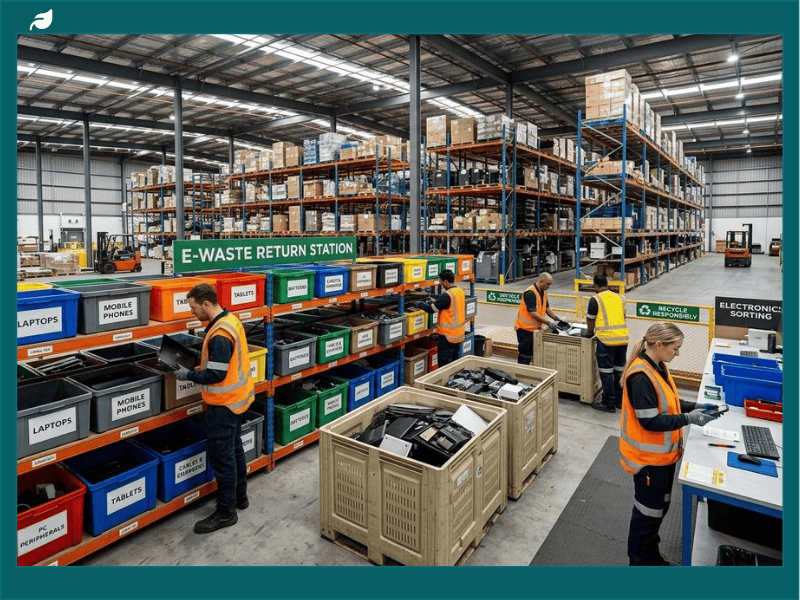
Returns are where electronics brands often lose control of their sustainability story. A customer sends back a device, and if there’s no structured process on the other end, it ends up in a landfill.
The scale of the problem is hard to overstate. Only 17.4% of global e-waste generated in 2019 was formally documented as recycled, according to the Global E-Waste Monitor published by the United Nations University. Global e-waste volumes are projected to hit 74 million metric tons annually by 2030. Electronics brands aren’t the only contributors, but they’re a meaningful part of the equation.
The infrastructure to handle this responsibly is growing fast. The e-waste management market was valued at USD 88.8 billion in 2025, with a projected CAGR of 10.56% through 2034, according to IMARC Group (2025). That means brands can route returned or end-of-life devices to certified third-party recyclers without building their own programs.
The EPA’s electronics stewardship programs provide a credible framework for building take-back and recycling commitments – including the Sustainable Materials Management Electronics Challenge, which sets recognized benchmarks for responsible electronics disposition.
It’s also worth noting that 25 U.S. states plus D.C. now have electronics recycling laws. Compliance is increasingly non-optional. Getting ahead of it – and communicating that commitment clearly to customers – is a better position than scrambling to react.
The sustainable packaging trends shaping 2026 point the same direction: customers and regulators are converging on expectations that brands didn’t face five years ago.
Small Shifts, Measurable Impact
Greening fulfillment doesn’t require an operational overhaul. It starts with material swaps in packaging, better carrier selection, and a returns policy that treats old devices as assets instead of waste.
The green logistics sector is on track to exceed USD 3.4 trillion by 2035. Brands that build sustainability into fulfillment now are positioning for a market where it won’t be a differentiator – it’ll be a baseline expectation. Starting early is the only version of this that makes sense.