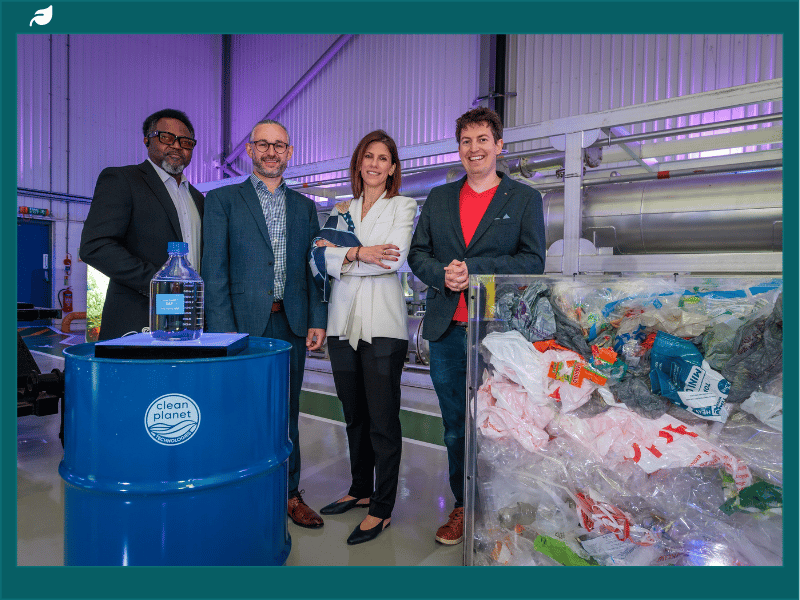
A pilot facility in Kent has begun converting hard-to-recycle waste plastics into Sustainable Aviation Fuel, marking a development that connects waste management with aviation decarbonisation. Operated by Clean Planet Technologies, the site is positioned as the first of its kind and is intended to support testing and validation of fuel derived from non-recyclable plastics.
The Sustainability Innovation Centre, located at Discovery Park in Sandwich, has been established to process materials such as carrier bags and food packaging film that are typically excluded from conventional recycling systems. In the UK, around 5 million tonnes of waste plastics are produced each year, with an estimated 80% treated as waste rather than recycled.
At the same time, aviation remains heavily reliant on fossil fuels. Global commercial aircraft consume between 7 and 8 million barrels of jet fuel each day, representing a notable share of oil demand, while less than 1% of aviation fuel currently comes from sustainable sources. The facility aims to address both issues by converting waste into a fuel suitable for aviation use.
Dr Andrew Odjo, Chief Executive Officer at Clean Planet Technologies, said:
“Our process first heats the waste plastic with a chemical reaction to turn it into a liquid, rather than burning it. This is then treated with our patented process to remove impurities and create SAF that meets stringent commercial aviation specifications.
“Every day, around 100,000 commercial flights operate globally while approximately 30,000 tonnes of plastic enters the ocean. That’s the equivalent of us dumping 2,000 garbage trucks full of plastic into the world’s oceans, rivers, and lakes every single day. Our pilot facility will demonstrate this waste can be turned into a premium product with a quantifiable commercial demand, as well as reducing the lifecycle carbon footprint of the aviation industry. We monitor how much energy the process uses, and overall, it cuts the lifecycle greenhouse gas emissions by more than 70% compared to traditional fossil jet fuel.
“With currently less than 1% of global aviation fuel produced from sustainable sources, the scale of the environmental opportunity presented by our technology means the opening of our facility is an important step towards the UK’s ambition to support sustainable aviation.”
The facility integrates several established industrial processes into a single system. Waste plastics are first shredded, then processed through pyrolysis in an oxygen-free environment to produce a synthetic crude oil. This oil is purified, distilled into fractions, and then upgraded using hydroprocessing with hydrogen to meet aviation fuel standards.
Each of these stages exists at commercial scale in other applications, which the company states reduces barriers to scaling the combined process. The pilot is designed to bring these elements together in a controlled setting, enabling consistent testing of both feedstocks and resulting fuels.
The site also supports progression through the American Society for Testing and Materials qualification pathway, a requirement for fuels to be approved for aviation use. Financial backing for this stage has been provided through the UK SAF Clearing House, funded by the Department for Transport.
Dr. Katerina Garyfalou, Chief Operating Officer at Clean Planet Technologies, said:
“The Sustainability Innovation Centre is set up to demonstrate our patented waste-plastics-to-SAF process at pilot scale, supporting fuel testing, validation and progression.
“The important thing is that our pilot facility will support the growth of others, helping the UK to meet its SAF mandate. UK government policy to decarbonise aviation fuel states that 2% of UK jet fuel demand must be SAF, increasing to 10% in 2030 and 22% in 2040.”
Policy targets for SAF in the UK are part of a broader effort to reduce emissions from aviation, a sector that is harder to decarbonise than road transport due to energy density requirements. Alternative feedstocks for SAF have included used cooking oil and energy crops, though supply constraints have prompted interest in waste-based sources.
Clean Planet Technologies positions waste plastics as an additional feedstock that could complement existing pathways. Materials that would otherwise be sent to landfill or incineration are instead processed into a liquid fuel, aligning with circular economy approaches that seek to retain value within waste streams.
The pilot facility has a processing capacity of up to one tonne of plastic per day in its largest pyrolysis unit. While relatively small in scale, the site is intended to provide operational data and technical validation needed for larger commercial plants.
CEO Bertie Stephens said:
“Our pilot facility addresses two strategic challenges simultaneously: plastic waste management and aviation decarbonisation. By converting non-recyclable plastics – materials that would otherwise have gone to landfill or been incinerated – into low-carbon aviation fuel, the facility supports both circular economy objectives and the reduction of lifecycle greenhouse gas emissions.
“This pilot opens up new ways to make sustainable aviation fuel, just as existing feedstocks such as energy crops are becoming harder to secure. It also positions the UK as a leader in turning waste plastics into SAF, supports UK and European SAF targets and is helping clear the path to commercial scale plants later this decade, and remove plastic waste from the environment.”
The development reflects ongoing efforts across the aviation and waste sectors to identify viable pathways for reducing emissions and managing materials that are difficult to recycle. The pilot phase will determine how effectively the integrated process can be scaled, as well as its role within wider SAF supply chains.