John Jaddou answers questions for the Sustainable Business Magazine regarding his role as the Global Director of New Business Development for next generation battery materials. Orbia Fluor and Energy Materials has developed a graphite recycling technology that supports the circular economy, sustainably producing EV battery materials. This technology has a higher efficiency than traditional recycling methods, enabling the reutilization of waste graphite at lower cost, and facilitating scaling up for commercial production.
Could you provide a brief overview of your organization’s history and your current role?
Orbia is a purpose driven company with 70+ years of history advancing life around the world through materials innovation. Across our five business groups, Polymer Solutions, Building & Infrastructure (Wavin), Precision Agriculture (Netafim), Connectivity Solutions (Dura-Line) and Fluor & Energy Materials, we develop solutions that address the world’s most pressing challenges, from decarbonization to food and water security and the future of connectivity.
Orbia’s Fluor & Energy Materials business is a global leader in fluoroproducts, owning the world’s largest mine and using its supply chain to secure the production of advanced battery materials. The business has deep expertise in producing high-purity materials for energy storage, including electrolytes and key salts used in lithium-ion batteries. Building on this foundation, we’ve expanded our work across the battery materials value chain, including the development of a proprietary graphite recycling technology that supports a more sustainable, circular EV ecosystem.
As the Global Director of New Business Development for Next Generation Battery Materials, I lead the creation and development of new global businesses focused on next generation battery materials and semiconductors for Orbia.

How does Orbia compare in economic viability to previous graphite recycling technologies?
Orbia has developed flexible, modular manufacturing and hydrogen fluoride (HF) purification technologies capable of processing both natural graphite and waste graphite to produce high performance graphite anode materials. Building on Orbia’s advanced purification capabilities, these processes support the conversion of mined flake graphite into battery grade anode material as well as the recovery of graphite from spent batteries, electrode scrap, manufacturing rejects or end of life cells and return it to anode grade quality or other applications.
Graphite recycling is not new, but historically it has struggled to reach commercial scale because conventional processes are costly, energy-intensive and inconsistent in output quality. Traditional methods often require high temperature treatments or intensive chemical purification steps that erode margins and make it difficult for recycled graphite to compete with mined material.
Orbia’s approach is designed to address these barriers directly. By leveraging our Fluor & Energy Materials team’s capabilities in chemical processing and purification, we have developed a process that can recover waste graphite from spent batteries at lower cost and with improved resource efficiency. The result is a more economically viable pathway that reduces dependency on natural graphite, one of the most supply constrained materials in the battery industry, while also reducing waste.
Compared with legacy recycling technologies, our process aims to deliver:
- Higher material recovery rates, improving yield and lowering the cost per ton of recycled graphite.
- Fewer processing steps, reducing both energy consumption and operational expenditures.
- Consistent quality output, enabling recycled graphite to meet battery grade and other applications specifications without the variability seen in older technologies.
These improvements make recycled graphite more competitive with mined and synthetic graphite and more attractive to battery manufacturers facing volatility in global supply chains.

What impact will recyclable graphite have in the energy storage space?
Recycled graphite has the potential to reshape the energy storage sector in three meaningful ways.
First, it strengthens supply chain resiliency. Graphite is one of the highest volume materials in a lithium-ion battery, and demand is increasing as EV adoption accelerates. Yet natural graphite supply is concentrated geographically, making automakers and battery producers vulnerable to price swings and geopolitical risk. Recycled graphite can provide an alternative, domestically sourced feedstock that supports a more stable supply.
Second, it significantly reduces the environmental footprint of battery production. Mining and processing natural graphite require substantial energy and water, and waste streams are difficult to manage. Producing synthetic graphite is highly energy intensive, requiring graphitization temperatures close to 3000°C. Recycling graphite from spent batteries keeps valuable materials in circulation and lowers lifecycle emissions, aligning with automakers’ goals for more sustainable EV supply chains. Orbia’s sustainability team has estimated that Orbia’s recycled graphite may produce up to 4x less CO₂ than synthetic graphite and up to 2x less CO₂ than mined natural graphite.
Finally, it supports the development of a fully circular battery ecosystem. By closing the loop on battery materials, the industry can reduce reliance on virgin extraction, enable better end-of-life management and support long-term cost competitiveness. As energy storage applications, from EVs to grid scale batteries, continue to expand, circularity will become a cornerstone of responsible growth.
‘We have developed a process that can recover waste graphite from spent batteries at lower cost and with improved resource efficiency. The result is a more economically viable pathway that reduces dependency on natural graphite, one of the most supply constrained materials in the battery industry, while also reducing waste.’
What collaborations have you had with local and international supply chains?
Orbia’s Fluor & Energy Materials business works closely with partners across the battery value chain, from automakers and cell manufacturers to recyclers and raw material suppliers. Our collaborations focus on advancing sustainable solutions and building dependable supply pathways for critical materials.
On the local side, we engage with local recycling partners and battery manufacturers to integrate our graphite recovery technology into domestic circularity programs. This includes pilot-scale work and process development aimed at enabling reliable access to recovered materials for gigafactories.
Internationally, we leverage Orbia’s global footprint and long-standing relationships to collaborate with partners across Europe, Asia and Latin America. This includes technical exchanges, joint research efforts and supply agreements connected to fluorochemicals and high purity battery materials.
Across all regions, our approach is to engage in partnerships that help reduce environmental impact, improve material circularity and support the scaling of clean energy technologies.
What future projects or goals do you have planned?
Our future projects focus on scaling Orbia’s flexible manufacturing platform for both natural and recycled graphite to commercial production levels. We are advancing modular purification, shaping, and coating technologies, expanding our ability to process graphite waste streams, and supporting multiple OEM and cell maker qualification programs. The team is also progressing several funded development initiatives aimed at accelerating U.S. and EU based graphite anode materials production and demonstrating next generation recycling capabilities. Together, these efforts position Orbia to deliver a fully domestic, vertically integrated supply of high performance graphite anode materials.
How can Battery Gigafactories and Vehicle OEMs work with you?
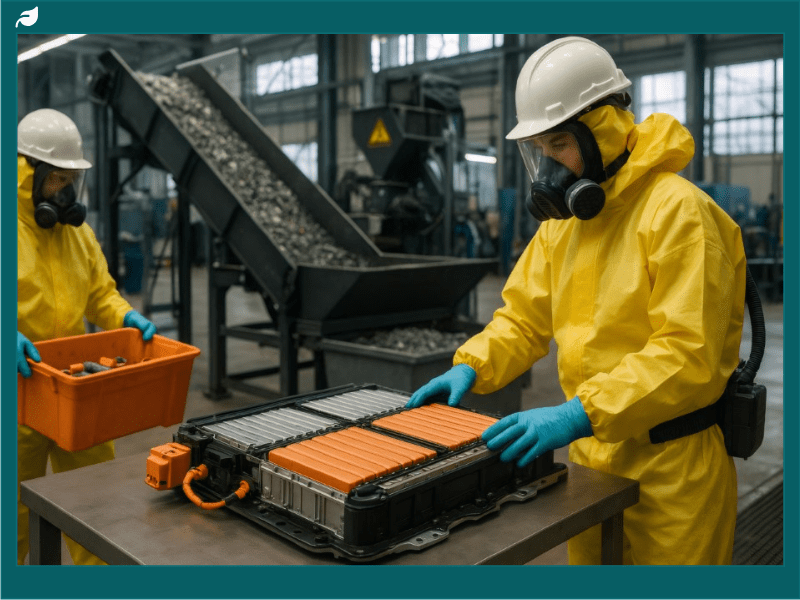
Battery Gigafactories and Vehicle OEMs can work with Orbia through direct technical collaboration, material qualification programs and integration of our graphite technologies into their production and recycling ecosystems. Orbia partners with automakers, cell makers and recyclers across the battery value chain to validate both natural and recycled graphite in customer specific formats and performance requirements. These engagements include supplying graphite samples, supporting cell level testing with OEM teams and demonstrating closed loop pathways where anode electrode scrap, EOL modules and manufacturing rejects are recovered and regenerated into high purity anode material or used in other applications to avoid landfilling. Gigafactories and OEMs can also work with us through joint development projects, pilotscale demonstrations and early integration of graphite into qualification pipelines, an approach that helps reduce Scope 3 emissions, strengthen supply chain resilience and accelerate adoption of a domestic, circular graphite supply.
To learn more, you can reach Orbia by email at fem.batteries@orbia.com