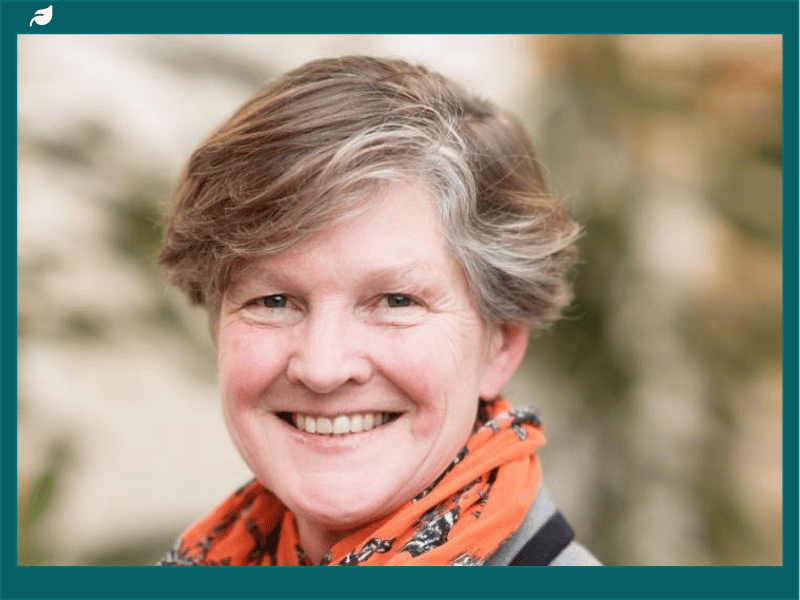
I’ve been with the company as Chief Nature Strategist for nearly four years. As part of the executive team, I help guide the overall company strategy. I run the consulting arm of the business, which focuses on advising clients on their nature strategies, ranging from local landowners and farmers to multinational companies managing nature impact across global supply chains.
I lead a team that supports companies in understanding and managing their relationship with nature, breaking down their associated risks, impacts, and dependencies. We help them navigate nature-related challenges and develop roadmaps and action plans that translate big-picture strategy into on-the-ground implementation.
NatureMetrics as a whole is designed to collect data that monitors, evaluates and describes the state of nature. We combine eDNA with other data layers such as bioacoustics and satellite geospatial data, with AI modeling capabilities to assess and predict the health, function and resilience of ecosystems.
The importance of understanding the state of nature is underscored by the fact that over 55% of global GDP is highly or moderately dependent on the health of ecosystems, that is equivalent to $58 trillion of economic activity solely impacted by the functional state of nature.
NatureMetrics has positioned itself as a global leader in nature intelligence – what gap in the market were you originally trying to solve?
As a company, we began our journey in science, not software. We started 12 years ago with the goal of creating the gold standard for environmental DNA (eDNA), delivering high-fidelity biodiversity data beyond its original academic use.
However, this innovation needed to scale to create real impact. Our next step was to industrialise our process, building the efficiencies and scalability to enable a global commercial application. This is when we shifted our offering from being science-only and built a “translation layer” that converts raw biodiversity data into decision-ready metrics and insights.
We’ve built high-integrity eDNA foundations capable of generating large volumes of forensic-level data at scale. This ensures that anything we build on top will be robust and as accurate as it possibly can be. We tackled the hard part first, and now these datasets are the foundation of our nature intelligence infrastructure.
Our platform gives clients the scale, speed and ground-truthed data required to manage nature-related risk strategically. Beyond eDNA, we can layer bioacoustics, geospatial and other third-party data across portfolios, translating it into business-specific metrics that reveal trends and priorities at both portfolio and site level. We want to build a home for nature intelligence where organisations can access, easily understand and act on nature data, supported by our expert strategy teams.
For readers unfamiliar with the concept, how does environmental DNA (eDNA) work, and why is it such a powerful tool for biodiversity monitoring?
eDNA is a highly scalable, cost-efficient, and accurate technology that detects the traces of genetic material that organisms leave behind in environments such as in water, soil, or sediment. These samples are then processed using a technique called metabarcoding, where DNA is sequenced and compared to reference libraries to identify which species are present.
This technology can identify up to 70% more species than conventional survey methods. We’ve spent years optimising the workflows in our labs to scale throughput while maintaining the rigorous scientific standards that are the cornerstone of the business.
This robust foundation of eDNA data enables us to integrate high-resolution geospatial and bioacoustic datasets into predictive and machine-learning models. This means we’re not only monitoring biodiversity but tracking trends, predicting future behaviour and assessing risks.
How do you combine eDNA with earth observation and AI to deliver actionable insights for businesses?
We layer this ground-truthed eDNA intelligence with geospatial and bioacoustic information, and feed it through AI models that are trained to generate simple-to-understand ecosystem health metrics that inform businesses’ practical decision-making on the ground. The result is robust predictive models built on verified, high-resolution data rather than estimates or proxies.
AI models are only as good as the data they are trained on, which is why our approach is built on eDNA technology. For executives making investment decisions, this ensures there is no compromise on data quality when the stakes are high — the same principle they apply to financial decision-making. When leaders are committing capital to major infrastructure projects or assessing portfolio-wide risk, you need data you can trust at the same level of integrity as any other business-critical decision.
Can you tell us more about your Nature Intelligence Platform and what makes it a “world-first” solution?
The NatureMetrics platform is pioneering the use of ground-truthed biodiversity data at a site level as the foundation for a nature monitoring solution. Other platforms take data from third parties, satellite imagery or rely on proxy indicators that are likely not as specific or accurate.
Our solution uses data from eDNA that has recently been collected in the exact location required by the client, so it provides an accurate and comprehensive view of sites of interest. This eDNA data is then converted into a set of simple metrics, which provide easy-to-understand indications of the state of health of different environments.
The metrics are integrated into our platform, equipped with Earth observation, advanced modelling, and AI to build cutting-edge models to assess and manage nature-related impacts, risks and dependencies.
What types of industries or businesses are currently using your platform, and how are they applying these insights in decision-making?
We’re currently servicing over 600 companies across 110 countries, but what’s key isn’t the volume but the range of sectors represented. In terms of industries, the most significant uptake has been in energy, extractives, and heavy infrastructure. These industries don’t just gather data to build a brand story or for reputation purposes. They are gathering it because they have stringent regulatory backdrops and they’ve realised that environmental volatility is now a material threat to their operational and business continuity.
In terms of how these insights are applied, our platform provides indicators of nature-related risk and performance across both habitats and species distribution. This enables clients to understand performance at a portfolio level — in some cases going back seven years — while also drilling down into site-level detail to identify specific risks, such as invasive or endangered species. With this insight our nature strategy team can help develop nature roadmaps and advise on the priority sites that require immediate action.
How are your predictive models helping organisations anticipate biodiversity shifts such as invasive or protected species movements?
We are currently building predicting models to develop our scenario analysis capabilities. For example, if an infrastructure company is scoping the build of a new bridge, we want to be able to model what the potential impact would be on nature ahead of work commencing. Innovations like Google Alpha Earth incorporate massive satellite data layers to create foundation models that we can combine with our eDNA data on the ground that can take a quick snapshot of any invasive or protected species present in the site of interest. With this AI-powered biodiversity tracking, we’re able to anticipate how healthy the ecosystem is and predict how invasive or protected species are likely to be affected by the intervention of infrastructure in that ecosystem.
This allows organisations to move from reactive to proactive management. Instead of just monitoring after the fact, companies could run different scenarios, and make better-informed decisions upfront. Global leaders can’t focus on every site, so they need to know where to invest their time and energy to have a truly positive impact on nature and their business. We’re creating dynamic models that can predict how biodiversity changes ripple through ecosystems.
Biodiversity loss is now recognised as a top global risk – how are you seeing corporate attitudes shift in response to this?
The shift we are seeing is that sustainability is no longer about reputation; it’s about resilience. If you are a mining company or a food producer, your business is physically dependent on functional ecosystems. If the water runs out or the soil degrades, you don’t just have a sustainability problem; your business model is no longer viable.
Our own growth as a company reflects how the market is responding to the reality of nature dependency. What is key is that leaders choosing to act now are making decisions that are beyond their own tenure. The average CEO term lasts about five years, yet degraded ecosystems take decades to restore.
We are increasingly seeing that leaders and corporations recognise that failing to build the infrastructure to measure and manage natural capital today means operating blindly in the face of escalating risk. It’s no longer about ‘doing good’ but a matter of staying in business.
Your new soil Ecosystem Condition Index (ECI) is a major development – what does it measure, and why is it particularly relevant right now?
Our soil Ecosystem Condition Index (ECI) provides a single, standardised score that reflects the health of the soil microbial ecosystem by combining data from three key biological communities, which are integrated into a single site-level score. With a methodology accredited by Accounting for Nature®, this is the first soil microbial assessment applicable on a global scale.
Traditionally, biodiversity data has been fragmented and difficult to interpret at scale. This metric translates high-resolution ecological data into a format that aligns with business decision-making, enabling organisations to assess performance consistently across sites and portfolios.
Healthy soil is a powerful indication of the state of an entire ecosystem. Our goal is to bridge the gap between scientific complexity and operational clarity, allowing businesses to track progress, prioritise interventions, and demonstrate measurable outcomes in nature restoration.
What role do regulation and policy play in driving adoption of nature intelligence tools?
Regulation and policy are playing an increasingly important role in accelerating adoption, despite some markets stepping back on sustainability commitments. Frameworks such as TNFD (Taskforce on Nature-related Financial Disclosures) and evolving biodiversity regulations are contributing to the shift from seeing nature as a voluntary consideration to a core business requirement.
As governments and regulators introduce more stringent targets —like Biodiversity Net Gain (BNG) in England which mandates a minimum 10% increase in biodiversity for most new projects — and as global 2030 biodiversity targets approach, organisations are facing increasing pressure to improve reporting and disclosure.
Sector-specific policy also is helping standardise how nature is measured and reported, which reduces ambiguity and increases confidence in the data. In the UK water sector, for example, water companies are bound by the Water Industry National Environment Programme to improve water quality and ecological status, focusing on restoring protected sites and protecting chalk streams. This creates stronger requirements for the integration of biodiversity into financial systems, risk management, and investment decisions of water companies, which have equivalent policies in other sectors. Together, regulation and policy are acting as a catalyst and a framework to accelerate action while ensuring that it is grounded in credible, science-based data.
Ultimately, what does success look like for NatureMetrics in terms of impact on ecosystems and biodiversity worldwide?
The global economy is facing a fundamental challenge: how to generate long-term economic growth without depleting the natural resources that enable it. We believe that businesses won’t have to choose between profit and planet if they have the right data.
For us, success looks like integration. We want to see a world where nature intelligence is so embedded in business operations that it becomes a routine part of decision-making rather than an exception.
Success will be when a CFO won’t sign off on a capital project without seeing the biodiversity risk report, just as they wouldn’t proceed without financial due diligence. When financial-grade nature data is consistently used to inform investment decisions, pricing risk into loans and valuing assets correctly, we will have achieved our goal.
At that point, we won’t just have built a scalable company; we will have helped establish a new layer of accountability within the global economy.