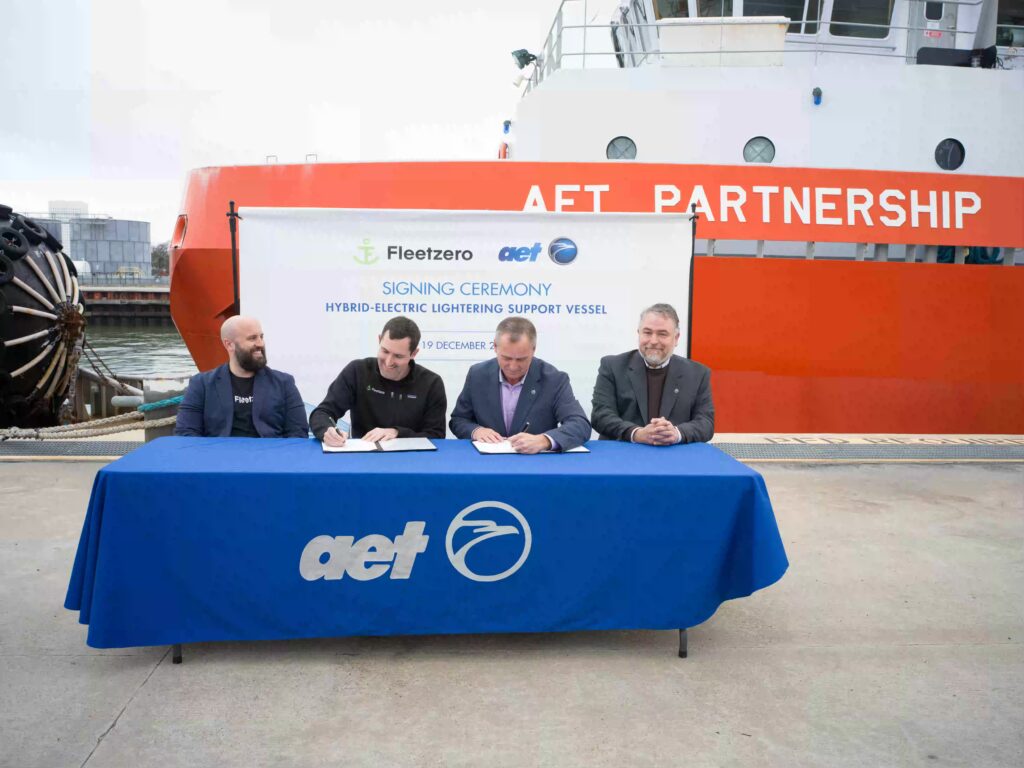
In a groundbreaking move for maritime decarbonization, AET and Fleetzero have joined forces to develop what they are calling the world’s Longest-Range Hybrid Electric Vessel. This collaboration, announced at a signing ceremony on December 19, 2024, in Galveston, Texas, is a major milestone in the push to reduce greenhouse gas emissions (GHGs) in global shipping. For readers of Sustainable Business Magazine, the significance lies in how such pioneering projects can become the blueprint for a cleaner, more efficient maritime sector—one that aligns with international sustainability goals and emerging regulatory standards.
The Journey Toward the Longest-Range Hybrid Electric Vessel
The maritime industry, responsible for carrying around 80% of global trade by volume, has often found itself in the crosshairs of environmental scrutiny. While shipping remains one of the more efficient ways to transport goods, it still contributes roughly 3% of global emissions—enough to spur calls for faster and more aggressive decarbonization strategies. Against this backdrop, the Longest-Range Hybrid Electric Vessel concept is a clear response to accelerating pressure from regulators, businesses, and the public to reduce the carbon footprint of vital shipping operations.
AET, a leading global owner and operator of maritime transportation assets and specialized services, brings extensive industry experience and operational knowledge to the table. Fleetzero, a developer and manufacturer of modular marine batteries for hybrid and electric ships, contributes cutting-edge technology designed by mariners, for mariners. Together, they plan to retrofit one of AET’s Lightering Support Vessels (LSVs)—specialized ships used to support ship-to-ship cargo transfer operations—to run primarily on battery power. This retrofit is poised to cut greenhouse gas emissions by about 82%, resulting in an estimated 1,220 tonnes of GHGs avoided annually.
AET and Fleetzero’s Historic Partnership
The formal agreement for this ambitious collaboration was signed at the AET Offshore office in Galveston. Key stakeholders from both organizations, including Capt. Ron Wood, AET’s Global Director of Commercial, and Mr. Steven Henderson, Fleetzero’s CEO, underscored the potential transformative impact of this project. If successful, it could serve as a model for similar hybrid and electric retrofits across the wider maritime fleet.
During the announcement, senior leadership highlighted the venture’s importance:
“This partnership marks a pivotal step in our decarbonisation journey and energy
transition strategy. We are proud to partner Fleetzero in developing the world’s largest
plug-in hybrid-electric LSV, reinforcing our commitment to innovative and sustainable
solutions in the maritime industry,” said Mr Zahid Osman, President & Group CEO of
MISC Group. “By integrating plug-in hybrid electric solutions into our fleet, we are
transforming ambition into action to deliver more energy with less emissions. This pilot
project also allows us to evaluate the feasibility and operational performance of this
technology, paving the way for potential deployment across AET’s and potentially
MISC’s fleet.”
For many observers in the sustainability community, comments such as these signal a tangible shift from ambition to action. Rather than discussing decarbonization as a distant concept, AET is embedding it directly into operational practice—a shift that could pave the way for other major players in maritime logistics to follow suit.
Advancing the Longest-Range Hybrid Electric Vessel Concept
Fleetzero’s role in this collaboration illustrates the symbiotic relationship between established maritime operators and innovative startups specializing in clean technology. Under the agreement, Fleetzero will supply modular marine batteries designed for demanding ocean conditions, ensuring both reliability and safety. These plug-in hybrid-electric systems will power a large portion of the vessel’s voyage, significantly reducing diesel fuel consumption. According to AET’s estimates, operational costs are also expected to drop due to lower fuel usage and reduced engine maintenance.
Mr. Steven Henderson, Co-Founder & CEO of Fleetzero, emphasized the broad implications:
“We are so excited about this project because it promises to advance marine
electrification in a commercially viable way, and the impact is immense – drastically
reducing emissions from the vessel operations. Many of us at Fleetzero have served at
sea as mariners, and we designed our technology to enhance mariner safety and ease
of operations, not only to improve emissions and efficiency. Fleetzero’s technology is
built by mariners for mariners.”
These statements underscore the practical benefits of a hybrid-electric system—not only lowering emissions but also streamlining day-to-day operations. Fleetzero’s battery modules are intended to optimize mariner efficiency, reduce labor-intensive processes, and enhance overall operational safety.
Shaping the Future of Sustainable Shipping
The development of the Longest-Range Hybrid Electric Vessel aligns with several broader trends in the maritime sector. The International Maritime Organization (IMO) aims to cut overall shipping emissions by at least 50% by 2050 compared to 2008 levels, and many in the industry consider this target a starting point rather than a final goal. Meanwhile, continued technological advancements in battery storage, hydrogen fuels, and onboard carbon capture are driving more carriers and shipowners to explore cleaner propulsion methods.
Although hybrid-electric ships are not brand new—many ferries and port vessels already run on similar systems—large-scale ocean-going commercial vessels have been slower to adopt these solutions due to cost, energy density concerns, and integration challenges. AET and Fleetzero’s project could help establish real-world proof of concept, demonstrating that even significant ocean-going support vessels can run predominantly on battery power over long distances, all while maintaining stringent safety standards.
If successful, the Longest-Range Hybrid Electric Vessel developed under this agreement could be a valuable stepping stone toward fully electric ships in the future. It may also inspire other companies to invest in similar retrofits and, eventually, next-generation vessels built from scratch with sustainable propulsion in mind.
Potential Ripple Effects
Beyond meeting environmental goals, projects like this could reshape the economic landscape of maritime shipping. With reduced fuel consumption, shipping companies can gain a competitive edge, freeing up resources to invest in modernizing fleets, training crews, or further research and development. As battery technology evolves, it may become even more cost-effective and feasible for larger ships and tankers to adopt hybrid or fully electric propulsion systems.
Moreover, the data gleaned from operational performance—fuel savings, maintenance costs, and reliability metrics—will influence future investment decisions. If AET and Fleetzero’s Longest-Range Hybrid Electric Vessel demonstrates commercial viability, insurers, policymakers, and financial institutions will have tangible evidence that decarbonizing shipping is an achievable, profitable strategy. Such success would accelerate the maritime sector’s transition to cleaner energy and potentially help other heavy industries adopt greener technologies at scale.
Looking Ahead
As decarbonization efforts intensify across all modes of transportation, shipping stands out due to its sheer volume and global reach. Innovations like the Longest-Range Hybrid Electric Vessel hold promise for drastically reducing emissions in a sector historically reliant on fossil fuels. While regulatory frameworks and market conditions will influence the pace and scope of adoption, pioneering companies such as AET and Fleetzero are already demonstrating what is technologically and operationally possible.
For sustainability-focused professionals, policymakers, and the public, this agreement offers a concrete example of how collaboration between an established industry leader and a specialized clean-technology firm can accelerate the transition to a low-carbon future. By integrating hybrid-electric systems into their fleet, AET is taking a significant stride toward meeting—and potentially surpassing—industry-wide decarbonization targets.
This project remains a pilot for now, but its success could well lead to broader deployment across AET’s global fleet—and potentially beyond, to its parent company, MISC Group. In turn, it could encourage other major shipping enterprises to invest in proven low-carbon technologies, driving momentum for sustainable shipping at scale.