West of England Leverages Digital Planning to Drive Climate Action
The West of England is taking a structured step toward achieving its net zero ambitions through a new regional energy planning approach that integrates digital tools, finance expertise, and stakeholder collaboration. Global engineering and consulting firm Arup, alongside consultancy Global City Futures (GCF) and spatial analytics company Advanced Infrastructure, has been awarded a significant contract under Bristol City Council’s Mission Net Zero initiative, funded by Innovate UK.
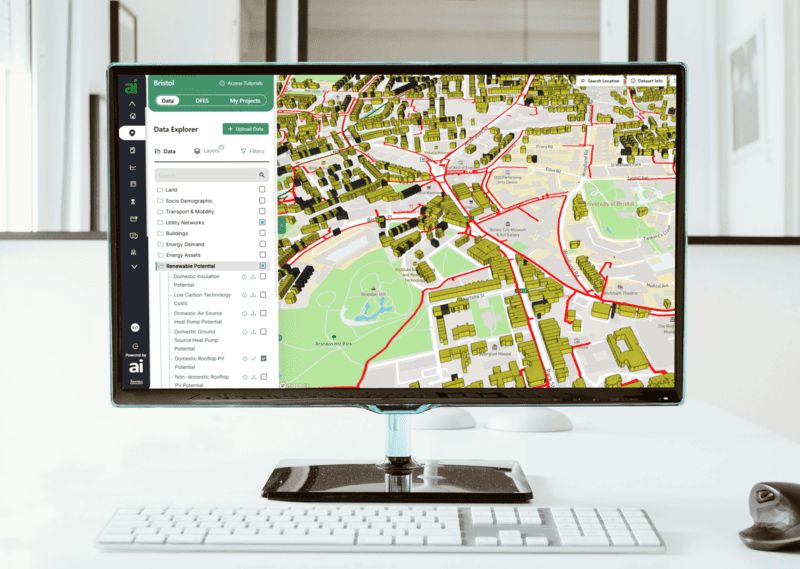
At the centre of the project is Local Area Energy Planner Plus (LAEP+), a net zero planning platform developed by Advanced Infrastructure. Already deployed in more than 200 UK towns and cities, LAEP+ is set to provide real-time, evidence-based insights to guide clean energy investments across the West of England.
“Deploying LAEP+ in the West of England will revolutionise how the region plans for net zero, providing a powerful, data-driven framework to unlock investment and accelerate climate action,” said Christopher Jackson, CEO of Advanced Infrastructure. “By bringing together key players across the public and private sectors, this initiative will help drive the large-scale transformation needed to meet net zero commitments.”
The region has clear decarbonisation targets but faces the challenge of mobilising billions of pounds in investment. Mission Net Zero aims to build a pipeline of financially viable projects focused on areas such as building retrofits, rooftop solar, heat networks, and electric vehicle infrastructure.
A Digital and Financially Viable Roadmap
One of the core aspects of this initiative is its multi-layered strategy that combines technical expertise, financial planning, and stakeholder engagement. Arup leads the project, GCF provides investment guidance, and Advanced Infrastructure powers the effort with its digital platform.
“We’re delighted to be partnering with Bristol City Council and Mission Net Zero partners on this important project,” said Ann Cousins, Project Director at Arup. “The combined expertise of our team will help to move the region towards delivery at the pace and scale required to meet our ambition.”
LAEP+ brings together granular data, digital twin capabilities, and scenario modelling. This will allow local authorities, investors, and infrastructure providers to make coordinated decisions, focusing resources where they will have the greatest decarbonisation impact.
Outputs from Arup’s analysis on heat networks and renewable energy projects will also be integrated into the platform, providing decision-makers with an evidence base that combines spatial data with financial modelling.
A Wider Movement in UK Energy Planning
The use of data-driven platforms like LAEP+ reflects a broader movement in the UK toward localised, digitally enabled energy planning. Local Area Energy Planning (LAEP) has become a recognised method for helping local authorities meet national net zero targets by identifying cost-effective pathways to decarbonisation.
LAEP+ specifically aims to improve on traditional planning methods by offering real-time capabilities and increased cost efficiency. For regions like the West of England, this means clearer pathways for investments and reduced barriers such as funding gaps and skills shortages.
“Mission Net Zero is an ambitious project to make Bristol a more sustainable and inclusive city and support Bristol’s One City Climate Change ambition of becoming a carbon neutral city,” said Councillor Martin Fodor, Chair of the Environment and Sustainability Committee at Bristol City Council. “Through Mission Net Zero we are working to speed up Bristol and the West of England‘s transition to net zero by addressing some of the barriers to progress such as finding money for improvements and having the skilled professionals to do them.”
The Six-Month Plan
Over the next six months, Arup, GCF, and Advanced Infrastructure will develop a fully costed energy plan for the West of England. The plan is designed to not only identify a pipeline of projects but also to establish a process that will guide investment and policymaking in the years ahead.
By using LAEP+, the team can model both short-term and long-term scenarios, ensuring that regional decisions on infrastructure investments are informed by robust, real-time data.
Why It Matters for Sustainable Business
For businesses operating in or supplying services to the West of England, this initiative indicates a shift toward more structured and predictable opportunities in the low-carbon economy. Companies in construction, energy services, electric vehicle charging, and renewable generation may see clearer pipelines for project delivery and financing.
Public-private collaboration, backed by digital technology and investment strategy, is increasingly recognised as essential for achieving net zero transitions. While many regions across the UK are exploring similar models, the West of England’s integrated approach sets it apart, combining evidence-based planning with financial and governance structures designed to support long-term action.
As the UK moves closer to its legally binding 2050 net zero target, projects like this offer a concrete example of how digital tools and cross-sector collaboration can move regions from ambition to implementation. Sustainable Business Magazine will continue to monitor how these developments evolve and what insights they offer to the wider industry.