Paolo Dassi, Industry and Mass Transportation Consultant at Bcomp
Decarbonising the mass transport sector means thinking about sustainability on a huge scale. Every day, millions of people rely on trains, buses and metros to move through cities and across borders. The vehicles that enable this movement are also responsible for around 800 million tonnes of CO2 emissions annually in Europe alone. With the EU and other regulatory forces continuing to push for reduced net emissions, the industry’s response has largely focused on alternative sources of fuel and propulsion systems. However, it’s just as important to rethink the materials that these vehicles are made of in the first place.
A fertile environment for change
Green cities are on the rise – a style of urban development that prioritises circularity, environmental protection and improved quality of life. This can take the form of green spaces, renewable energy use and electric vehicles. Cities around the world are beginning to demonstrate what this can look like in practice. Amsterdam’s Buiksloterham district, for example, is pioneering closed-loop construction with recycled concrete and biodigesters for energy recovery. From 2025, 20% of Amsterdam’s new housing must use bio-based materials. In Espoo, Finland, the Kera district is being built as a circular economy showcase, repurposing existing buildings and mandating recyclable or bio-based materials in all new construction.
This transformation extends naturally to the transport systems that connect these green cities. Mass transportation – from buses and trains to metros and ferries – needs to evolve alongside the buildings and infrastructure they serve. This isn’t just being driven by a moral urge to do the right thing. Regulation is pushing for decarbonisation across all sectors. The EU Green Deal mandates lower emissions and greater sustainability in transportation through binding targets and an Action Plan, requiring, for example, that 90% of new city buses be zero-emission by 2030. In the US, the EPA has introduced significantly stricter emissions standards for light-duty vehicles from model year 2027, aiming for major reductions in greenhouse gases. Coupled with growing consumer demand for sustainable solutions, this is creating a fertile environment for change.
Cutting weight and emissions
Even before considering operational emissions, the materials traditionally used to construct vehicles – like steel,aluminium and carbon fibre – are energy-intensive to manufacture and generate significant emissions during production. Composite materials like carbon fibre are useful for lightweighting, but notoriously hard to recycle. Flax-based materials can also be used in vehicle interiors as a replacement for traditional oil-based materials, like plastic polymers. The environmental impact of these materials extends beyond the factory floor, affecting the entire lifecycle of a vehicle. Bio-based materials, derived from renewable sources such as flax, offer a lightweight, high-performance and versatile alternative that could open new possibilities for cleaner transport systems.
Flax fibres have been used for thousands of years – from ancient Egyptian linen to ship sails – as they are naturally strong and durable. Modern processing techniques now allow these same fibres to be woven into composite materials that rival synthetic alternatives. Unlike carbon fibre, which require petroleum-based precursors, flax grows in fields across Europe with minimal water and pesticide requirements.
Flax fibres can also help lightweight vehicles – a proven strategy for lowering emissions as lighter vehicles consume less fuel, extend battery range, and reduce infrastructure wear.
Major OEMs like BMW, Cupra and Polestar are already adopting these technologies in their production vehicles. By replacing carbon fibre with Bcomp’s lightweight natural fibre composites, BMW achieved a 40% reduction in CO2 emissions generated from production of its M3 roof.
German automotive supplier Eberspächer used the same flax composites in a prototype bus A/C cover – one example of how natural materials might replace glass fibre-reinforced plastics in mass transport. These covers could enter full-scale production and be installed in buses operating across extreme climates.
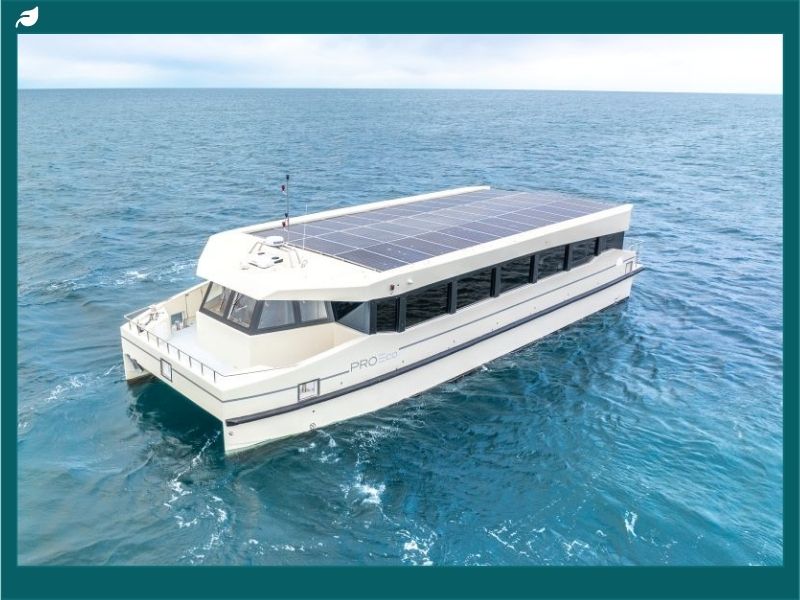
Last year, Croatian marine manufacturer Marservis launched the PROeco ferry, the first solar-powered passenger vessel constructed using natural fibre composites. Bcomp supplied materials for manufacturing the entire interior of the vessel. Operating in the Port of Rovinj on the Adriatic Sea, the ferry carries up to 100 passengers daily and runs on electric motors, saving an estimated 770 kg of diesel emissions per day.
These examples demonstrate how bio-based materials are bringing about a fundamental rethinking of how we build sustainable transport infrastructure from the ground up.
Performance, comfort and safety
For transport operators and manufacturers considering sustainable materials, performance cannot be compromised. Next-generation bio-based composites have proven they can match, or even exceed, the performance of traditional materials in the most demanding environments. In 2019, BMW introduced reinforcements made of natural fibre composites in its Formula E cars, demonstrating that these materials can withstand the extreme stresses of competitive motorsport. Porsche Motorsport, McLaren and Suzuki have similarly staked their reputations on these materials.
Safety is a critical consideration for passengers and operators alike. Bcomp’s bio-based materials match the stiffness and lightweight characteristics of carbon fibre but with better ductility – meaning when they break or get damaged, they bend and absorb energy instead of shattering into sharp pieces. This bending reduces dangerous debris, which can improve safety during accidents or incidents, especially for buses and trains. This is promising for making transport vehicles safer and more sustainable.
The passenger experience also benefits directly from these materials. Natural fibre composites like those made of flax naturally have better noise-dampening properties because of their porous cellulose structure – a consideration that matters deeply for daily commuters and can differentiate transport services. These are important considerations for public transport. Their design versatility also means they can be moulded into a wide range of shapes, sizes, and surface textures. Finishes can be customised for aesthetic appeal or to reflect specific brands, regions, or service requirements for different modes of transport.
Even with superior performance, successful adoption of a new material often depends heavily on its compatibility with existing manufacturing workflows, as the capital investment required for machinery changes can be a significant barrier to entry. Bcomp’s materials are compatible with standard manufacturing processes, which means they are easier to integrate and scale up without the need for significant changes or high initial costs.
Circular by design
Sustainability considerations in transport should extend beyond emissions. Circularity means designing for end-of-life, and it is essential for true sustainability. Engineers and designers of green city infrastructure need to consider the full lifecycle of the transport choices they make, and whether the materials used to make them will have a sustainable impact on the environment even after they have reached the end of their use. The most effective sustainable materials demonstrate their value not only through performance but through their intrinsic capability to be reused, recycled, or repurposed at end-of-life.
When a traditional composite part reaches end-of-life, it typically ends up in landfill or requires energy-intensive recycling processes that often downcycle the material into lower-grade applications. Carbon fibre recycling, for instance, is economically challenging at scale.
Bio-based composites not only reduce carbon footprint in production and operations, but at the end of their lifecycle, they can be used for thermal energy recovery, making them circular by design. Some cities are already exploring their use in buses, buildings and cars, but the potential for these innovative materials to transform our cities is huge.
Bus manufacturers are leading the way in innovation, thanks to shorter development cycles that allow for rapid iteration. They can go from concept to manufacture in a matter of months. In contrast, rail and aerospace sectors have been slower to adopt, often due to stringent safety and regulatory requirements. But even in these industries, the case for considering sustainable alternatives is growing stronger, and bio-composites are starting to play an important role in innovation. Pilot components are now in the process of being tested for aerospace, bus and rail applications.
In the future, we could see these composites replace plastics and synthetics in everything from metro seating to facade cladding, meaning cities can build with materials that are not only durable and aesthetic, but also biodegradable or recyclable. Their unique properties of acoustic insulation, thermal stability and design flexibility make them ideal for a wide range of urban applications. At the end of their lifecycle, they could be recycled into new base materials or used for energy recovery. Imagine a city where the same flax-based composite used in a tram’s interior could later be repurposed into a wind turbine blade or a public bench – a seamless loop of material reuse.
This shift in thinking from linear to circular will require collaboration and commitment across the supply chain. Designers, engineers, and manufacturers must work together to ensure that sustainability is embedded from the outset, not retrofitted as an afterthought.
If the mass transport sector is serious about meeting its climate obligations, it needs to put materials at the foundation of its sustainability strategy. The shift to bio-based alternatives is already underway, though adoption has been uneven. Regardless, the benefits to performance, passenger experience and circularity will become hard to ignore. The latest advanced sustainable materials are proving that it’s possible to build transport systems that reflect the values of the cities and societies they serve. More importantly, it’s possible to do so safely, at scale.