How Digital Product Passports are reshaping EU market access, compliance, and circular business models.
Provenant is a specialist venture launched by technology provider Protokol to help organisations prepare for upcoming EU Digital Product Passport regulations. The company works with businesses across sectors, including textiles, apparel, furniture, and electronics, to support compliance while enabling more transparent and circular product ecosystems.
In this interview, Matthew Ekholm discusses the implications of the EU Ecodesign for Sustainable Products Regulation, the practical realities of implementing Digital Product Passports at scale, the challenges of fragmented product data, and how better traceability can unlock new circular business models beyond compliance.
Q: Please introduce yourself to our readers and tell us a bit about your role and your organisation.
I am a Digital Product Passport (DPP) and Circularity Specialist at Provenant, a new venture recently launched by technology provider Protokol to help organisations prepare for EU regulatory requirements for DPPs. Provenant was created to provide businesses with focused support as they navigate upcoming EU regulations that mandate the implementation of DPPs such as the Ecodesign for Sustainable Products Regulation (ESPR).
We work with businesses across various industries, including textiles and apparel, to pilot and implement DPP solutions that align with EU regulatory compliance, as well as creating more circular and sustainable product ecosystems. At Provenant, we also understand DPPs beyond simply ESPR compliance, noting their power in supporting businesses provide their customers with transparent sustainability information.
My role is focused on helping businesses understand what DPPs can mean for their business, and how they fit in the picture, from advising on regulatory alignment, to the practical steps they can take to integrate them seamlessly to support business operations.
“My role is focused on helping businesses understand what DPPs can mean for their business, and how they fit in the picture.”
Q: The EU Ecodesign for Sustainable Products Regulation will make Digital Product Passports mandatory in several sectors. What do you see as the biggest implications for companies that sell into the EU market?
The most pivotal implication of the EU’s ESPR enforcement is that sustainability performance is shifting from a nice-to-have to a market access requirement. Businesses selling into the EU will likely need auditable, product-level data on materials, sourcing, carbon footprints, and end-of-life pathways. That means moving from static PDFs and marketing claims to dynamic, verifiable product data.
Operationally speaking, DPPs will force companies to examine the full lifecycle of their products – not just what goes into them, but how they are used, repaired, refurbished, and eventually recycled. For many companies, this is the first time they have had to map supply chains in such detail.
Strategically, it will change competitive dynamics. Products with clear, low-impact lifecycle data will have an advantage, and companies with opaque supply chains risk losing access to the EU market or facing growing scrutiny from customers and regulators.
“Sustainability performance is shifting from a nice-to-have to a market access requirement.”
Q: Provenant focuses on turning product data into DPPs at scale. How does your platform work in practice, and how can better data and traceability improve both compliance and circularity outcomes?
Provenant’s DPP platform acts as a partner for businesses faced with the EU’s Digital Product Passport mandate and combines both compliance expertise with a focused platform and deep ecosystem connections. This ensures businesses can coherently encompass product data from across the supply chain.
In practice, the solution connects with existing product systems such as ERP, PLM, and LCA tools and helps map raw product data into formats required for DPPs. Provenant’s core ambition is to ensure that businesses are prepared for DPP mandates, both in terms of the DPP technology and the data that will be required to be housed within it.
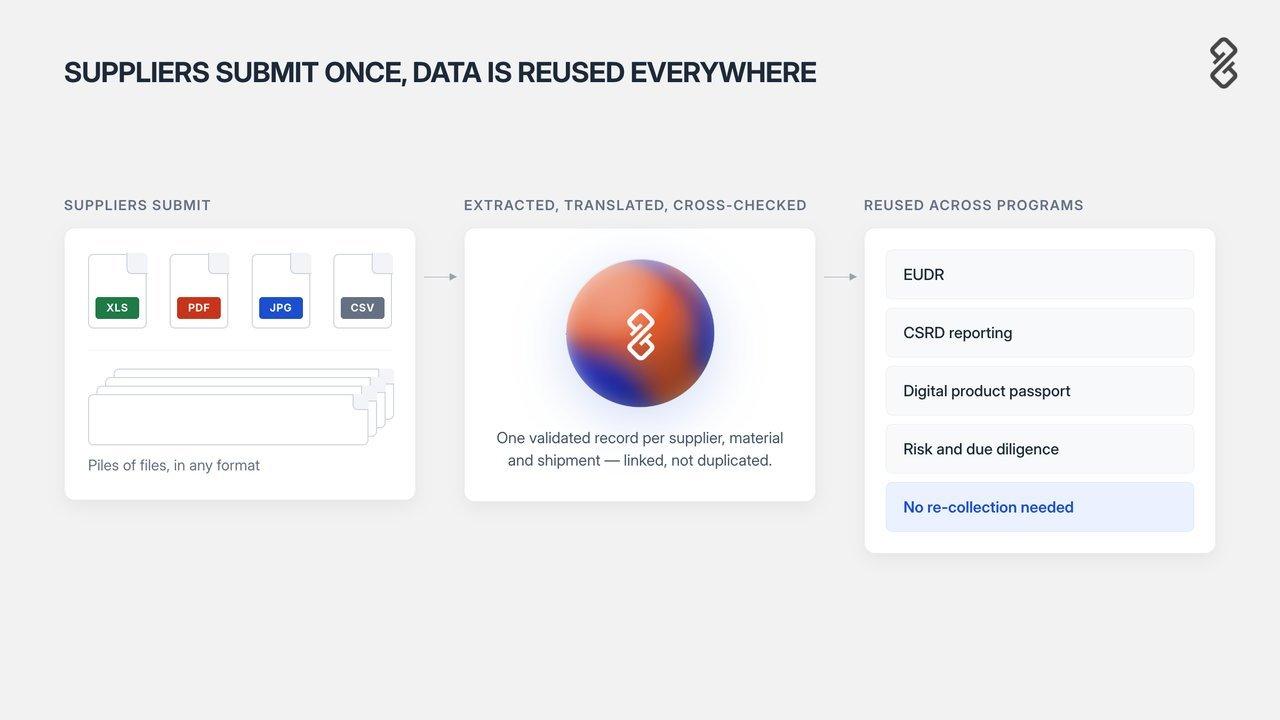
Lengthy and time-consuming data collection processes can be minimised with data uploads or direct integration into legacy ERP or PIM tools, while data validation can be achieved with tools such as compliance alignment checkers. This makes the process of creating, validating, and utilising DPPs considerably more efficient and less time consuming.
This accessibility and traceability of data strengthens EU compliance by providing a single source of truth for product lifecycle data, while also enabling circular outcomes. DPPs make previously siloed product information accessible and precise, empowering consumers and third parties to make informed decisions about product care, repair, and disposal.
“DPPs become the infrastructure that allows circular systems to function at scale.”
Q: Many organisations struggle with fragmented systems and data. What are the main challenges you see around data collection, standardisation, and integration with existing tools such as ERP and PLM, and how can these be addressed?
The biggest challenge is that companies have been collecting data for different functions for years using a wide range of tools. Over time, this has naturally led to fragmentation, with data sitting in siloes across the organisation and with external partners.
Critical product data may live in LCA tools, ERP systems, PLM platforms, or supplier documents, all using different formats. Suppliers also have uneven digital maturity and inconsistent reporting capabilities, which affects both the quantity and accuracy of incoming data. On top of this, different naming conventions, units, and material definitions further increase complexity.
To address these challenges, businesses need to orchestrate the entire process by harmonising data, enforcing standards, and applying automated quality checks. A strong starting point is proactively mapping existing product data in preparation for the mandate.
Businesses should also collaborate closely with supply chain partners to consolidate data, conduct gap analyses, and identify missing information such as waste metrics or carbon footprints. From there, targeted actions like implementing new measurement tools or working with additional suppliers can help close gaps and improve transparency.
“The data needed for DPPs sits scattered across dozens of internal systems and even more external partners.”
Q: Looking beyond compliance, how can DPPs help businesses create value, for example through new circular business models, improved customer information, or stronger relationships across the value chain?
DPPs open the door to a wide range of value creation opportunities. With improved lifecycle visibility, companies can introduce repair services, subscription models, refurbishment programmes, or product take-back schemes, all supported by accurate part-level and material-level data.
They also play an important role in strengthening customer trust. Consumers increasingly want transparency, and DPPs provide a way to communicate verified sustainability information rather than marketing claims. This helps build credibility and long-term brand loyalty.
“DPPs open the door to a range of value-creation opportunities for businesses.”
Q: What exciting plans and goals do you have for the next few years?
Over the next few years, Provenant is focused on scaling the infrastructure that makes circularity practical and profitable. We are working on pilots across multiple industries, from textiles and furniture to electronics and beyond, to support businesses as ESPR deadlines approach.
As the ESPR rolls out sector by sector, Provenant aims to develop sector-specific data models and connectors that make compliance both efficient and future-proof. We are also collaborating closely with standards bodies and industry alliances to ensure DPPs are interoperable across regions and platforms.
Ultimately, this work is about laying the foundations for a truly global circular economy.
“We are focused on scaling the infrastructure that will make circularity practical and profitable.”