Muskan Mehan is a sustainable fashion designer and founder of Ekcharkha, a slow fashion label. Her work combines cultural storytelling, upcycling and contemporary designs. She answers questions for the Sustainable Business Magazine exploring her journey into sustainable fashion, and how her cultural heritage inspires her designs.
Can you share a bit about how you became a sustainable fashion designer?
The idea of starting my own label came to me during the pandemic, but the feeling behind it had been with me for much longer. While studying for my bachelor’s degree in Fashion Design in 2018, I realised I was never drawn to rich textiles or glamorous gowns. Silk, organza, and brocade did not interest me as much as old, ripped denim jeans. Even then, I knew that if I pursued fashion, I wanted my work to stand for something beyond aesthetics. I wanted it to have an impact and exist for the sake of others. At university we explored various natural dyes and their process. I was so intrigued to know how colours can be sourced or made naturally.
My approach to design was always different. I was more inclined towards a cause than towards glamour. During my studies, I learned about the Rana Plaza disaster that took place in Bangladesh in 2013. Factory workers were forced to enter a building that was already unsafe, to continue producing garments for fast fashion brands. When the building collapsed, more than a thousand workers lost their lives. This incident pushed me to look at the side of fashion that is rarely shown, the side that is not glamorous, but deeply human and purpose oriented.
To understand this reality better, I started to work with a sustainable fashion label as a content writer. I used to study from all the sources about sustainable fashion, and then I started watching real life documentaries and working closely with fashion brands. I saw how leather is produced in Kanpur, a city in India, where workers often operate without basic safety equipment such as gloves or masks, leaving them vulnerable to serious health risks. While working as an assistant fashion designer, I also heard tailors speak about unfair wages and long working hours. These experiences made me realise how dangerous and exploitative the fashion industry can be, not only for people but also for the environment.
Even then, I knew that if I pursued fashion, I wanted my work to stand for something beyond aesthetics. I wanted it to have an impact and exist for the sake of others
How did Covid influence the evolution of your brand?
When the pandemic arrived, it became impossible to ignore how endlessly we take from nature without giving anything back. For me, sustainable fashion stopped being a trend and became a responsibility. I began using leftover fabrics to make scrunchies as a small, personal practice. What started as a hobby soon turned into something more, as friends and family became my first customers. Their support, especially my family’s, gave me the confidence to continue. One of my sisters became my photographer, and the other is my manager. In June 2021, I launched my label EK. In Hindi, “Ek” means one. The idea was to make some that is authentic, not a copy of a design.
Over time, the label evolved and became EKCHARKHA. This shift marked my deeper engagement with Khadi, a traditional Indian textile created by spinning yarn on a charkha (spinning wheel). Khadi is handmade, breathable, sustainable, and environmentally responsible. Through EKCHARKHA, I aim to honour slow processes, cultural heritage, and mindful creation.
How do the links between sustainability, traditional practices, and modern design inspire your work?
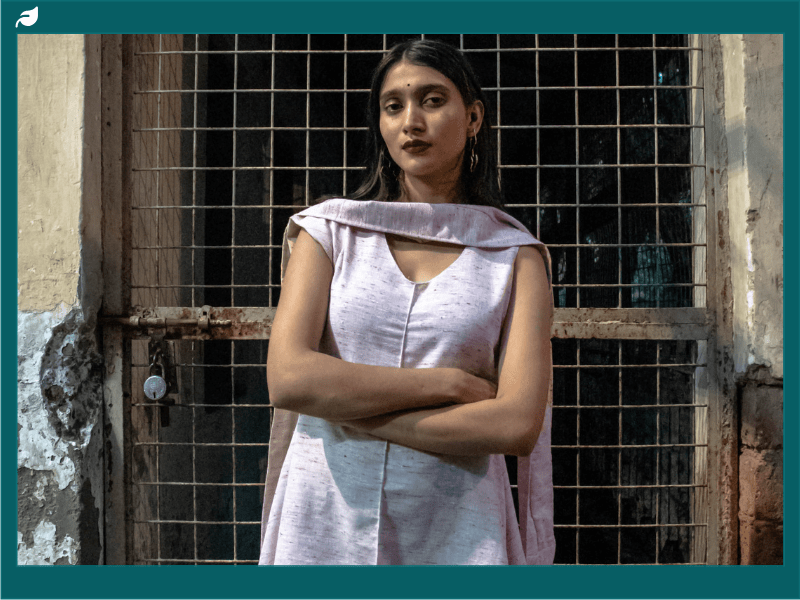
My work allows space for traditional embroideries and contemporary design. For example, one of my collections is called KATHA (KATHA means Story or to tell). I have used traditional embroidery of West Bengal to showcase my concept on Khadi fabric. Kantha embroidery is done on the leftovers of fabric using a running stitch to depict daily life scenes. Women of the family do this as a form of hobby or work. I have combined this technique with Khadi textile. Both are traditional crafts of India. I add a modern touch to my garment by experimenting with the shape of the garment. For example, big puff sleeves, a pink colour palette. I have decided to use pink as a form of love and care for the environment.
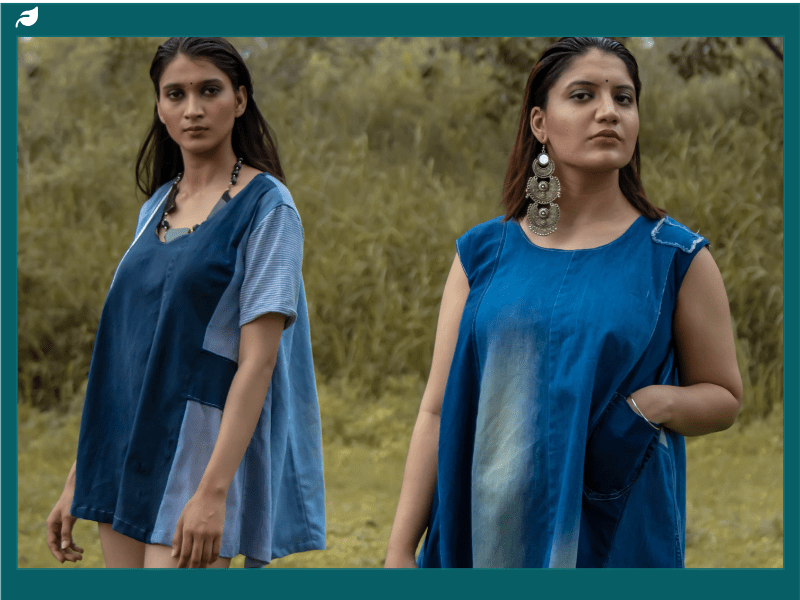
Another textile I love to work with is used or secondhand denim. Denim was introduced for the working class in the late 18th century. I never used new denim fabric as indigo dyeing is harsh on the soil and land. Giving secondhand denim fabric or clothes a new life is a step toward reducing the carbon footprint.
Provide some examples of your work?
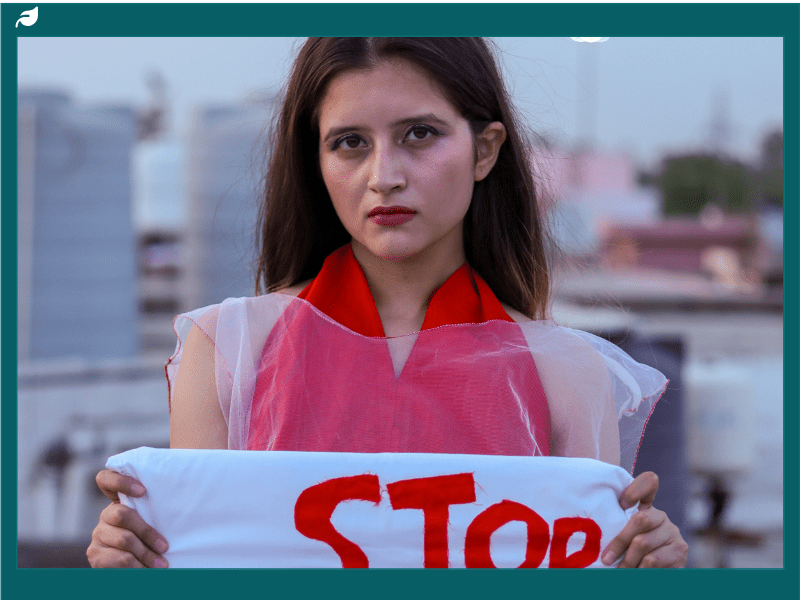
One of my projects, Stares (2023), is deeply personal and rooted in my lived experience as a woman from India. It reflects the discomfort of being constantly watched and subjected to the male gaze. One piece in particular uses red and white to express this tension, red representing anger and resistance, and white symbolising peace and the desire for respect. It is a combination of leftover cotton fabric and organza. Organza is fragile in nature and cotton is naturally strong.
Another piece from my collection is called: A Scrappy Cinderella. It is a skirt made entirely from fabric scraps and leftover materials. It questions traditional narratives around women and dependency. I imagined what the story of Cinderella might look like if she were a Gen Z woman, independent and self-defined. I am not very vocal when it comes to expressing myself, so fashion became my language and my way of speaking.

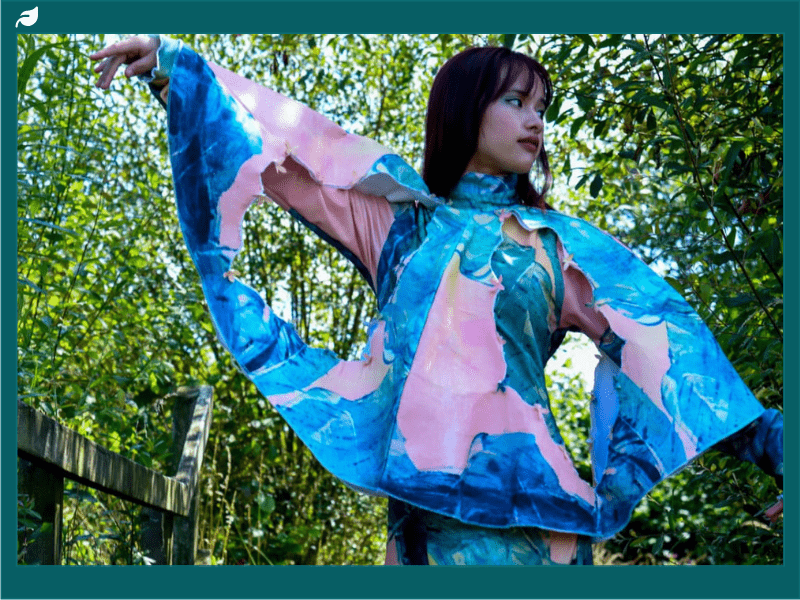
I recently made a dress from Oeko-Tex certified lycra and denim that I sourced from Contrado. I have developed hand-painted prints inspired by my cultural heritage. I translated two places in Old Delhi, which I am deeply connected with, onto fabric through screen and digital printing. My collection utilises a pastel palette of yellow, orange, and blue to evoke the comfort and nostalgia of our cultural heritage.
How do you think we can mainstream sustainable fashion?
We can mainstream sustainable fashion by changing the mindset of people. We can start small. I have experienced how people don’t realise how much they are over-consuming by buying from fast fashion brands. The more we create awareness and educate, the more we can mainstream sustainable fashion. Another point is to change the idea of how people connect with clothes. Rather than buying something impulsively ask yourself if are you are going to wear it 30 times. This is the 30 wear challenge started by Livia Firth. We also need to preserve our heritage, handmade techniques, and traditional textiles. We cannot give fast fashion a chance to replace everything. We still have a long way to go because now sustainable fashion has become more of a trend than a cause.
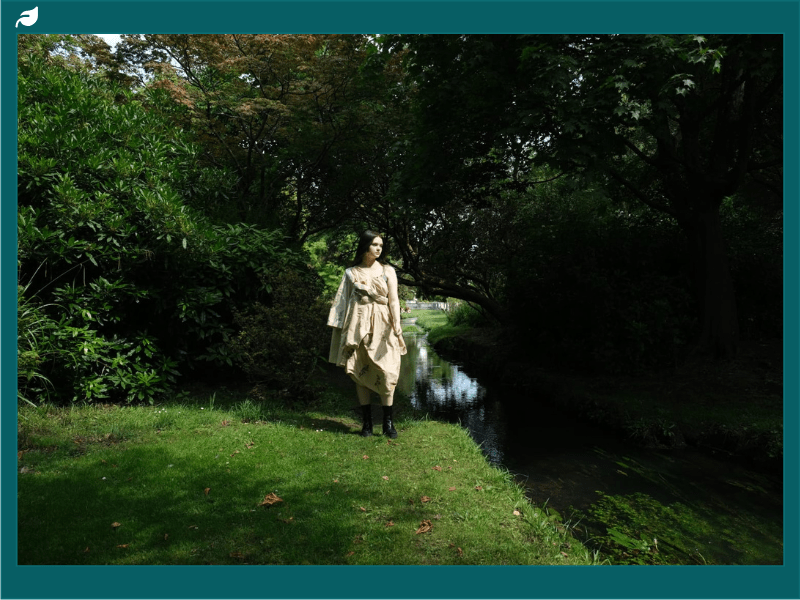
My friend gave me six McDonald’s shift manager shirts which I upcycled into a dress. Once the dress was sewn, I dyed it naturally with beetroot, avocado pits, and turmeric. Beetroot faded quickly, but the avocado and turmeric left a soft buttermilk colour that stayed. That colour became a reminder of what is left behind. It is a homage to the beauty and fragility of the environment. On top of this buttermilk base, I painted floral motifs with stencils and permanent markers. I chose black to symbolise what is already lost and brown as a warning. This dress is not just a garment. It is a reminder about memory, traces, and about the cost of consuming too much. For me, it is all about turning something ordinary into something unique, and showing what we risk losing forever.
Beetroot faded quickly, but the avocado and turmeric left a soft buttermilk colour that stayed. That colour became a reminder of what is left behind. It is a homage to the beauty and fragility of the environment.
Tell us a bit about your podcast and what inspired you?
The idea of starting a podcast came simply, when I used to talk about fashion with my room-mate, she suggested that I look for platforms and people who are actually interested in fashion content. So the inspiration came from everyday life. That little nudge pushed me to create that space where women’s voices are unheard, especially women working in craft. My podcast is called CHARKHA TALKS. I talk about women who shaped the history of fashion in their own rebellious ways and how to style these pieces in everyday. Each episode talks about their personal journeys, creative aspects and how they became who they are. I highlight the purposeful side of fashion and connecting with people.
What conscious fashion projects or sustainability goals are you planning in the future?
I am currently working on making onion-based leather, a bio-textile. I am also collecting food nets to crochet. It takes ages for them to decompose, and when mixed in the ocean, they are harmful to aquatic life. I am organising the first-ever independent sustainable fashion show in Bournemouth to celebrate 5 years of my label in February 2026. I am preparing to showcase my work in Paris Fashion Week in March 2026 and many more shows and competitions. In the future, I hope to develop the brand into a platform that not only produces unique clothing but also promotes traditional methods, guaranteeing equitable compensation and creative chances.
In the end, I want to contribute to an industry where environmental responsibility, cultural heritage and careful design coexist. I want to encourage people to embrace sustainability in fashion.
For updates on Muskan’s work, podcast and exhibitions please see her LinkedIn.