A year after the mandatory implementation of Biodiversity Net Gain (BNG) under the Environment Act 2021, the national property consultancy Carter Jonas has released its latest research, Biodiversity Net Gain: Navigating the Evolving Market. The study examines the effects of BNG policy on landowners, developers, local authorities, and environmental organizations, highlighting key successes, ongoing challenges, and the road ahead.
Understanding BNG and Its Impact
Since its introduction on February 12, 2024, BNG has required all new developments to leave biodiversity in a measurably better state—typically by a statutory minimum of 10%. According to Carter Jonas’ analysis of over 3,300 hectares of development sites across England, the average habitat baseline value stands at 3.45 biodiversity units (BU) per hectare. For a standard 10-hectare site, this means developers must create or enhance habitats to achieve at least 37.95 BUs.
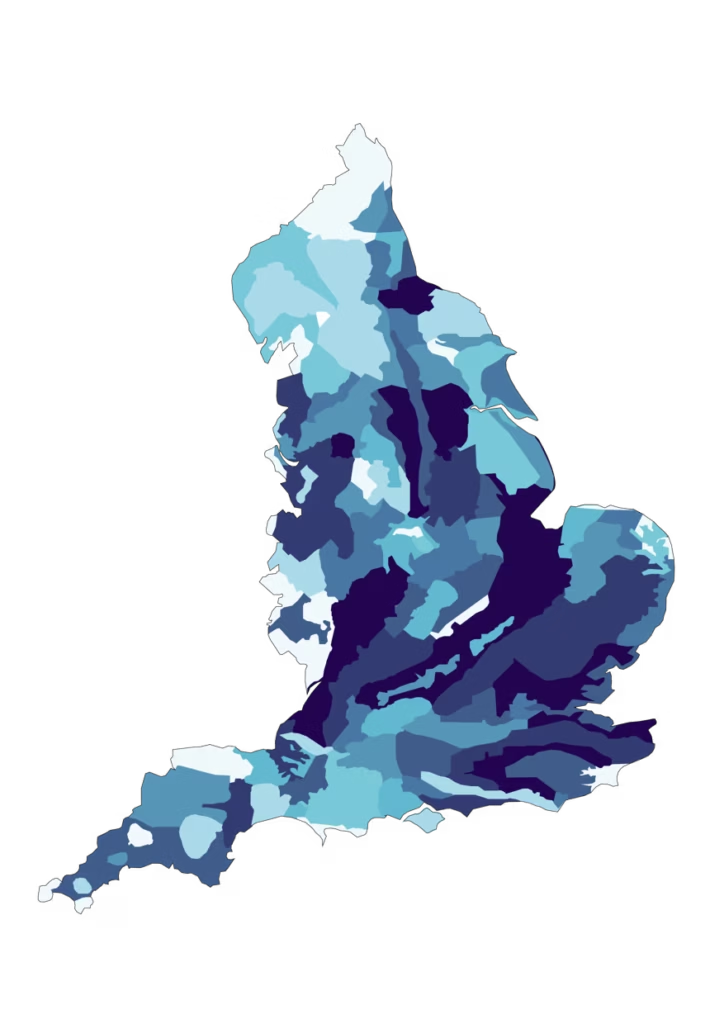
The study reveals that 54.7% of developments deliver BNG entirely on-site. The remainder rely on alternative solutions, such as the developer’s own land bank, purchasing biodiversity units from third parties, or, as a last resort, using the national statutory credit scheme. However, significant regional disparities exist. While the East and South East have well-established habitat banks, other regions face shortages, limiting off-site options.
Regional Disparities and Site Variations
One of the report’s key findings is the variation in BNG implementation across different regions and land types. While differences between greenfield and brownfield sites were expected, the actual variation was less pronounced than many anticipated. The average baseline biodiversity value for greenfield sites is 3.60 BU/ha, compared to 3.17 BU/ha for brownfield sites.
Despite regional challenges, the development industry has largely embraced BNG. The research shows that 69.4% of proposed schemes include BNG solutions at the planning application stage, despite the policy being a pre-commencement condition under the Environment Act. This proactive approach suggests an increasing awareness and integration of BNG into early project planning.
Key Challenges in Implementation
While the response to BNG has been positive, several issues remain. David Albrough, Joint National Lead of Carter Jonas’ Natural Capital Services Team, identifies two major concerns:
“The industry has been slowly getting to grips with mandatory BNG over the past year, and there are a couple of key issues coming through. Firstly, the invisibility of demand to potential suppliers. Developers of all types are having real difficulty in predicting their likely demand. This means that it is not clear to the likely providers if there will be a market for the units they want to produce. Thus, in some cases, they are not committing to schemes.
“Secondly, this bias in the regulations towards on-site mitigation is already causing problems, especially for smaller developers and developments. With the additional costs and risks being passed on to the owners of the houses, which in turn will make them harder to sell, this risks making some developments unviable.”
Planning and Policy Considerations
From a planning perspective, the findings indicate that many developers are exceeding the minimum BNG requirements, possibly due to broader planning policy considerations. Richard Holliday, Associate at Carter Jonas’ Leeds office, notes:
“The take-up of BNG has been generally positive, with the majority of developers providing considerably in excess of the minimum requirement, perhaps due to other planning policy requirements or to err on the side of caution and avoid potentially costly repercussions if the final calculation falls short of 10%. However, if the government is successful in meeting its ambitious housing target of 1.5 million homes within five years, demand will increase exponentially. On-site, this may pose issues in relation to density and viability. Off-site, demand may well exceed supply, at least initially.”
Future Developments in BNG Policy
Looking ahead, national policy changes could further shape BNG. The government’s ongoing consultation on a national land use strategy may influence future regulatory frameworks. Lucy George, Senior Natural Capital Advisor at Carter Jonas, highlights the importance of strategic land use planning:
“We live on an island, and as such, there always has been and will continue to be conflicting, and complementary, demands on land. Land is ultimately in finite supply. Any land use policy needs to make sure the markets for nature-based solutions, including BNG, sit alongside economic growth and food security. Engaging in these evolving markets must be a strategic decision for landowners, and habitat banking particularly should be viewed as a semi-permanent, if not permanent, land use change.”
Additionally, the upcoming rollout of Local Nature Recovery Strategies (LNRS) is expected to influence market dynamics. LNRS areas are likely to attract premium biodiversity unit values. Another significant shift will occur in November 2025 when BNG requirements are extended to Nationally Significant Infrastructure Projects (NSIPs), increasing competition for biodiversity units.
Navigating the Future of BNG
As BNG policy continues to evolve, its implications for housing and infrastructure development, land management, and conservation will remain significant. Carter Jonas plans to monitor these changes closely, providing strategic advice, brokering biodiversity units, and supporting clients in navigating this evolving regulatory landscape.
The first year of BNG implementation has demonstrated both progress and challenges. While developers are adapting, policy refinements will be necessary to ensure that the system functions effectively for all stakeholders. With increasing demand and evolving regulations, the future of BNG will require collaboration between developers, policymakers, and landowners to create a truly sustainable development framework.