Introduction to the Saber-toothed Tiger
Two seven-inch canine teeth. That’s what stopped everyone in their tracks when the first Smilodon skull turned up, and it’s still what stops people cold in museum halls today. A 2020 peer-reviewed study published in ScienceDirect found that two subadult Smilodon fatalis specimens from Ecuador were confirmed as siblings via a rare genetic marker, providing direct fossil evidence of prolonged sibling cohabitation and kin-based social structure in this species. The saber tooth tiger isn’t just another extinct predator. It’s the predator that makes you realize how strange and magnificent the Pleistocene world really was.
We call them saber-toothed tigers, but that’s a nickname, not a family connection. Every saber-toothed cat shares no close lineage with the tigers prowling Asia’s forests today. They’re a separate branch of the cat family tree, one that grew in its own direction for millions of years and produced something the world has never seen since. Their oversized canines weren’t for show.
Scientists believe those sabers were precision instruments for seizing and dispatching prey, driving deep into soft tissue with terrifying efficiency.
Three distinct Smilodon species eventually evolved across the Americas, each shaped by its own terrain and prey base. Read the fossil record closely and you see a genus in constant negotiation with its environment, always adapting, always pushing the limits of what a cat-shaped body can do. That story is worth knowing.
Historical Background of the Saber-toothed Tiger
Saber-toothed cats first appeared roughly 2.5 million years ago, right as the Pleistocene epoch was getting started and the world was cycling through its first serious ice ages. The Smilodon genus eventually sorted itself into three species: Smilodon gracilis, Smilodon fatalis, and Smilodon populator. All three were native to the Americas, but they weren’t interchangeable.
Smilodon fatalis dominated North America. Smilodon populator, the largest of the three, ruled South America, and was built on a scale that makes modern lions look modestly sized. These weren’t the sleek, long-legged sprinters we picture when we think of big cats. Saber-toothed cats were barrel-chested, massively fore-limbed animals, built for power the way a wrestler is built for power, not a sprinter.
Their hunting strategy reflected that build. Modern tigers rely on speed and a quick suffocating bite to the throat. Saber-toothed cats were ambush specialists. They’d close the distance fast, pin prey with those enormous forearms, and then use the sabers to deliver a precise killing strike to exposed soft tissue, probably the throat or belly.
Prey included bison, horses, camels, and possibly young mammoths. Animals bigger than themselves. That tells you something about the confidence built into that body plan.
Fossil records place these cats squarely in periods of dramatic climatic change. Ice ages came and went, reshaping habitats and reshuffling the herds these predators depended on. For a long time, saber-toothed cats kept pace with those changes. Then, around 10,000 years ago, they didn’t.
The reasons are still debated, but a collapsing prey base combined with competition from human hunters almost certainly played a role.
Differences Between Saber-toothed Tigers and Modern Tigers
Here’s the thing: calling a Smilodon a saber-toothed tiger has always been a bit misleading. Modern tigers belong to the genus Panthera. Saber-toothed cats belong to an entirely separate branch of the Felidae family. The name stuck because of the teeth and the vague big-cat silhouette, not because of any close evolutionary kinship.
The physical differences run deep. Tigers are built for agility. Long legs, a flexible spine, and a lean frame let them accelerate quickly through dense forest cover and take prey down with a fast, precise bite. Saber-toothed cats were the opposite profile: stocky, low-slung, heavily muscled through the shoulders and chest.
Think less cheetah, more bear wearing a cat suit. Speed wasn’t their weapon. Strength and surprise were.
Their environments shaped them differently too. Tigers evolved in dense Asian forests and grasslands where cover is everywhere and a solitary ambush works beautifully. Saber-toothed cats, particularly Smilodon fatalis in North America, roamed more open terrain. Less vegetation meant different tactics, and some researchers think it meant more social behavior.
A group of saber-toothed cats working together could bring down prey that would defeat any individual hunter, however powerful.
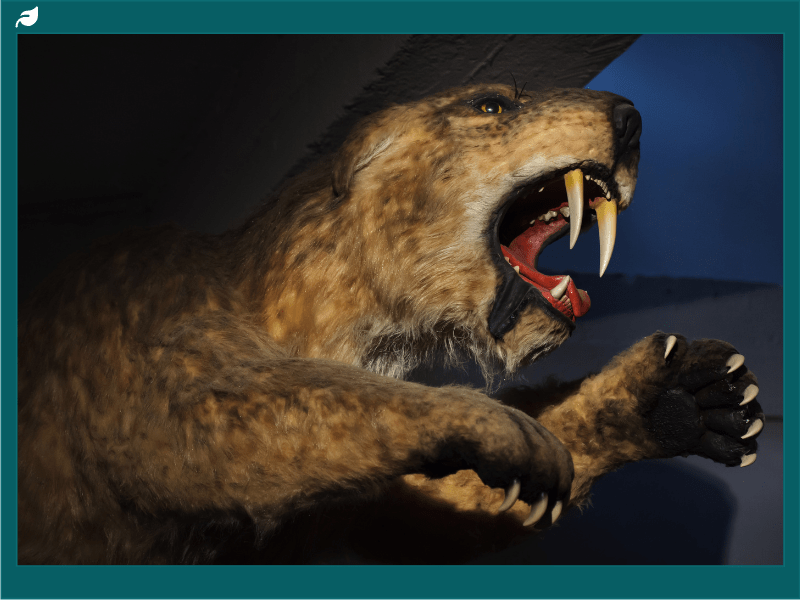
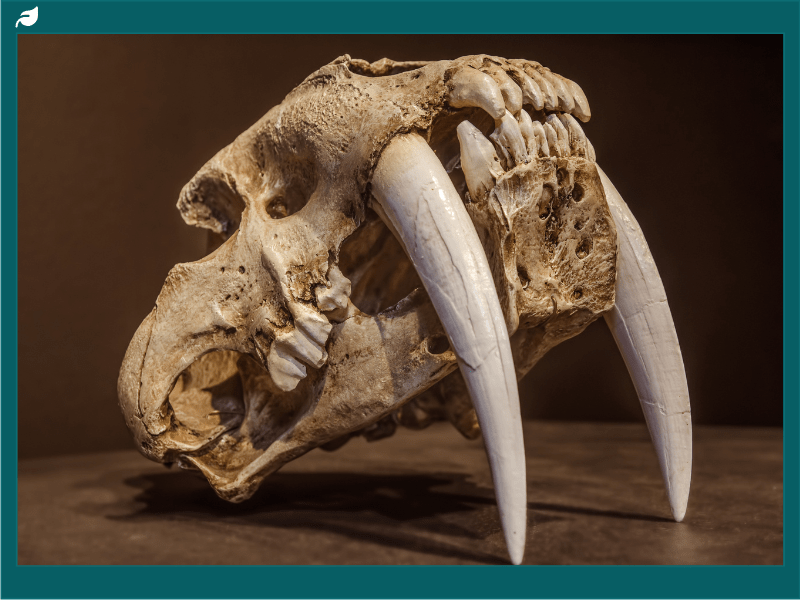
The saber itself is the most obvious difference and the most consequential. A modern tiger’s canines are formidable but proportional. Smilodon’s canines were not proportional. They were the defining feature of the entire animal, up to seven inches long in large adults, serrated along the back edge, built for one specific purpose.

Driving them into prey effectively required the mouth to open to an extraordinary gape angle, around 120 degrees, compared to a tiger’s roughly 70. The whole skull architecture evolved around making those teeth usable. Every bone in that skull was a compromise between housing a massive brain case and anchoring the jaw muscles needed to drive sabers that size through hide and flesh.
And consider what those proportions meant in practice. A modern lion’s canine might reach two or three inches. Smilodon’s were more than double that, serrated, slightly curved, and sitting in a jaw that could drop open wide enough to make the strike work. The saber-toothed cat was, in this one specific sense, more specialized than almost any predator that has ever lived.
That specialization was its strength for millions of years, and arguably its vulnerability when the world changed.
Tigers are still here, barely. Fewer than 4,000 remain in the wild. Saber-toothed cats have been gone for 10,000 years. Both facts deserve attention.
The Ice Age and Its Influence on the Smilodon
The ice age didn’t just set the backdrop for the Smilodon’s story. It wrote most of the plot. Glaciations advanced and retreated across North and South America repeatedly through the Pleistocene, and every cycle reshuffled the ecological deck: different prey distributions, different migration corridors, different vegetation zones. Smilodon fatalis and Smilodon populator had to keep up with all of it, and for a remarkably long time, they did.
The Role of Ice in the Smilodon’s Environment
When the ice sheets expanded, they didn’t just freeze things. They created open, treeless landscapes across huge stretches of the continent, ideal country for large herds of megafauna and, by extension, ideal hunting ground for a powerful ambush predator. The Pleistocene grasslands and steppes that formed at the edges of the glaciers were essentially a vast, well-stocked larder for Smilodon, populated with mammoths, ground sloths, giant bison, and native American horses and camels, all of which were considerably larger than their modern equivalents.
Ice also controlled water. As glaciers advanced, they locked enormous volumes of freshwater in place. When they retreated, meltwater carved river systems, filled lakes, and created wetlands that supported dense concentrations of herbivores. For saber-toothed cats, following prey to water sources was likely a key hunting strategy.
The La Brea tar pits in Los Angeles exist precisely because animals congregated near surface water seeps, only to be trapped in the asphalt beneath. Smilodon showed up to hunt the trapped animals, and sometimes got stuck too.
Ice ages also drove migration on a continental scale. Herds moved seasonally and over longer periods as habitat shifted, and predators followed. This dynamic landscape may have pushed some Smilodon populations toward more cooperative behavior, since coordinating hunts in open terrain with mobile prey makes more sense than going it alone.
Cooler, drier conditions also slowed organic decay, which is part of why the fossil record for Pleistocene megafauna is so rich. The ice age, in a roundabout way, helped preserve the evidence we now use to reconstruct these animals’ lives.
Adaptations of the Smilodon During the Ice Age
Cold environments demand particular solutions, and saber-toothed cats had several. Dense fur almost certainly provided insulation, though soft tissue rarely fossilizes and we reconstruct this from context rather than direct evidence. The massive musculature visible in skeletal remains served double duty: generating the explosive force needed for ambush hunting and producing body heat in cold conditions. Heavier animals retain warmth more efficiently than lighter ones, and Smilodon populator, which could weigh over 800 pounds by some estimates, would have had a real thermal advantage in frigid climates.
The robust forearms deserve special mention. They’re overdeveloped compared to any modern big cat, thick-boned and heavily muscled. The most likely explanation is that they served to restrain prey while the saber strike was delivered, functioning like a living trap. In open ice age terrain, where prey could kick, bolt, or roll, holding an animal steady long enough to use those canines effectively was critical.
Social behavior is harder to read from bones, but the evidence leans toward at least some degree of group living in Smilodon fatalis. Fossil specimens from La Brea include individuals that suffered serious injuries, broken bones and damaged joints, that had healed over months or years. An animal with a severe leg injury can’t hunt effectively alone. The fact that these individuals survived suggests others were feeding them, which implies a social group with some degree of cooperative care.
That’s a significant adaptation, and it mirrors what we see in modern lions facing similar ecological pressures.
As the last ice age wound down around 12,000 to 10,000 years ago, the open habitats that saber-toothed cats depended on began to close in. Forests expanded. The great herds of megafauna collapsed, partly due to climate change and partly due to hunting pressure from newly arrived human populations. Saber-toothed cats lost both the terrain and the prey base that their whole body plan was built around.
The adaptations that made them so effective during the ice age became liabilities in the new world.
Fossil Discoveries and Brea Tar Pits
No fossil site on earth has produced more Smilodon material than the La Brea tar pits in Los Angeles. More than 2,000 individual Smilodon fatalis specimens have been recovered there. That’s not a sample. That’s a population-level dataset, and it has transformed what we know about these animals.
Significance of Brea Tar in Preserving Saber-toothed Tiger Fossils
The La Brea tar pits formed where crude oil from underground deposits seeped to the surface and pooled. The heavier fractions evaporated, leaving sticky asphalt that trapped animals for over 40,000 years. Water collecting on top of the tar made the surface look like an ordinary puddle. Animals came to drink.
Some waded in and couldn’t get out. Predators, including saber-toothed cats, came to take advantage of the easy prey and got stuck in turn. The brea tar then preserved whatever sank into it with remarkable fidelity.
Bone preserved in tar is chemically altered but structurally intact. At La Brea, this means researchers can examine muscle attachment points, injury patterns, growth rates, and even isotopic signatures in the bone that reveal diet. The Smilodon fatalis specimens from the tar pits show animals that were heavily built but also frequently injured: dislocated shoulders, arthritic joints, healed fractures. High-impact hunting leaves marks.
These bones carry the biography of a hard life.
The tar pits also preserved the prey community surrounding saber-toothed cats: dire wolves, horses, ground sloths, mammoths, giant condors. Studying the whole ecosystem together rather than the predator in isolation gives a much richer picture of how Smilodon actually functioned in its environment. The brea tar is, in this sense, an accidental ecological snapshot, one of the best we have for the late Pleistocene of North America.
The Page Museum, built directly over the active excavation site at La Brea, lets visitors watch paleontologists work in real time. That connection between research and public engagement matters. It keeps the saber-toothed tiger present in the cultural conversation in a way that a storage room full of bones never could.
Major Fossil Sites for Ice Age Creatures
La Brea gets most of the attention, but it isn’t the only place Smilodon fossils have turned up. The Hot Springs Mammoth Site in South Dakota has produced exceptional ice age fauna, including prey animals that give indirect evidence of predator pressure from saber-toothed cats. Cave sites in Nevada and the broader Great Basin have yielded Smilodon material in sedimentary contexts very different from tar preservation, showing that these animals ranged across diverse terrain types.
South America has its own rich record. The fossil beds around Buenos Aires and in the Pampas region of Argentina have produced extensive Smilodon populator material, the larger South American species that represents the extreme end of the Smilodon body plan. Comparing populator specimens with fatalis material from La Brea shows how the two species diverged as they adapted to different prey communities and environments on opposite ends of the continent.
Patagonian sites add further detail, including specimens that help track how saber-toothed cats moved through South America after the formation of the Isthmus of Panama roughly 3 million years ago allowed North American fauna to cross south. The populator lineage apparently descended from fatalis-like ancestors that made that crossing and then evolved into something larger and more powerful in response to South America’s enormous prey base.
Modern imaging technology has transformed what researchers can learn from existing collections. CT scanning of La Brea skulls has revealed internal sinus structures and canal pathways invisible to earlier researchers. Isotopic analysis of tooth enamel from multiple sites is starting to map seasonal movement patterns. Every few years, a reanalysis of known material produces a new finding.
Conclusion: The Legacy of Toothed Predators
The Smilodon has been gone for 10,000 years and somehow still manages to dominate the conversation about prehistoric life. That’s not an accident. It’s a measure of how completely these animals embodied something about predatory power that we recognize and respond to instinctively.
The Lasting Impact of Saber Cats on Popular Culture
Saber-toothed cats have made it into film, television, video games, literature, and corporate logos. The Ice Age animated franchise put a saber-toothed tiger named Diego in front of millions of children. The Mahwah, New Jersey-based hockey team the New Jersey Devils briefly considered a saber cat mascot. Brands reaching for associations with power and ferocity reach for the saber tooth silhouette almost reflexively, those twin canines functioning as a kind of universal symbol.
Museums have been smart about this. The Page Museum at La Brea uses the dramatic fossil record, including reconstructed skeletons posed mid-action, to pull visitors into genuine paleontology. The emotional hook is the teeth and the implied power. But what visitors actually learn, if the exhibit does its job, is something more subtle: how ecosystems work, how species adapt, why extinction happens, and what the fossil record can and cannot tell us.
In literature, saber-toothed cats tend to stand for something beyond themselves: the wild before humans reshaped it, the idea that nature produced solutions to survival problems we can barely imagine, the strangeness of a world where a cat needed seven-inch teeth to make a living. Those are real ideas worth exploring, and the saber-toothed cat carries them well.
What the cultural presence of saber-toothed cats ultimately does is keep the question of extinction personal and present. These weren’t obscure invertebrates. They were charismatic, powerful, obviously impressive animals that vanished within the last geological instant. The fact that Smilodon populator and its relatives are gone while far less striking creatures survived asks something of us.
It asks whether the impressive and the powerful are actually fragile in ways we don’t expect, and what that might mean for the large predators still alive today.