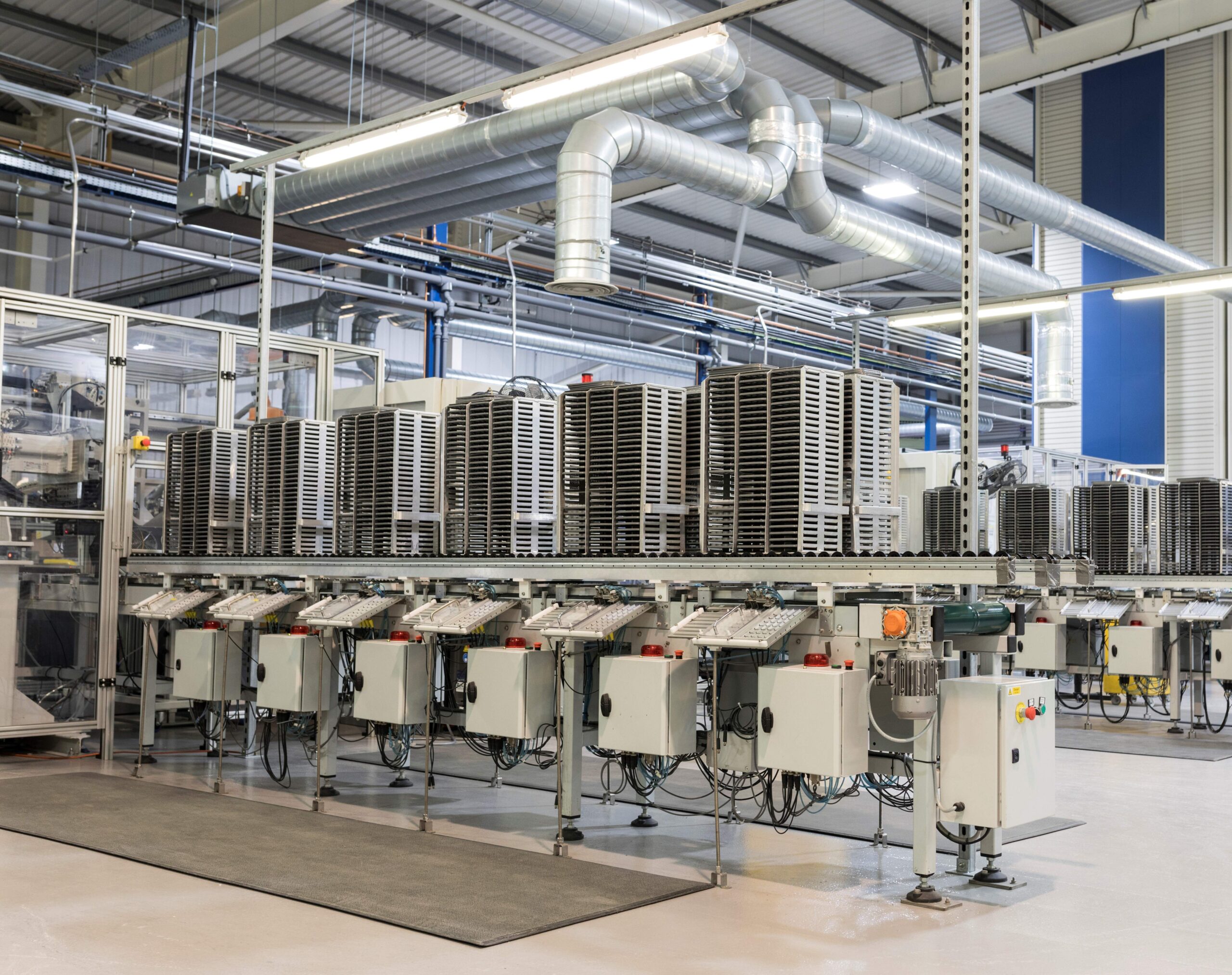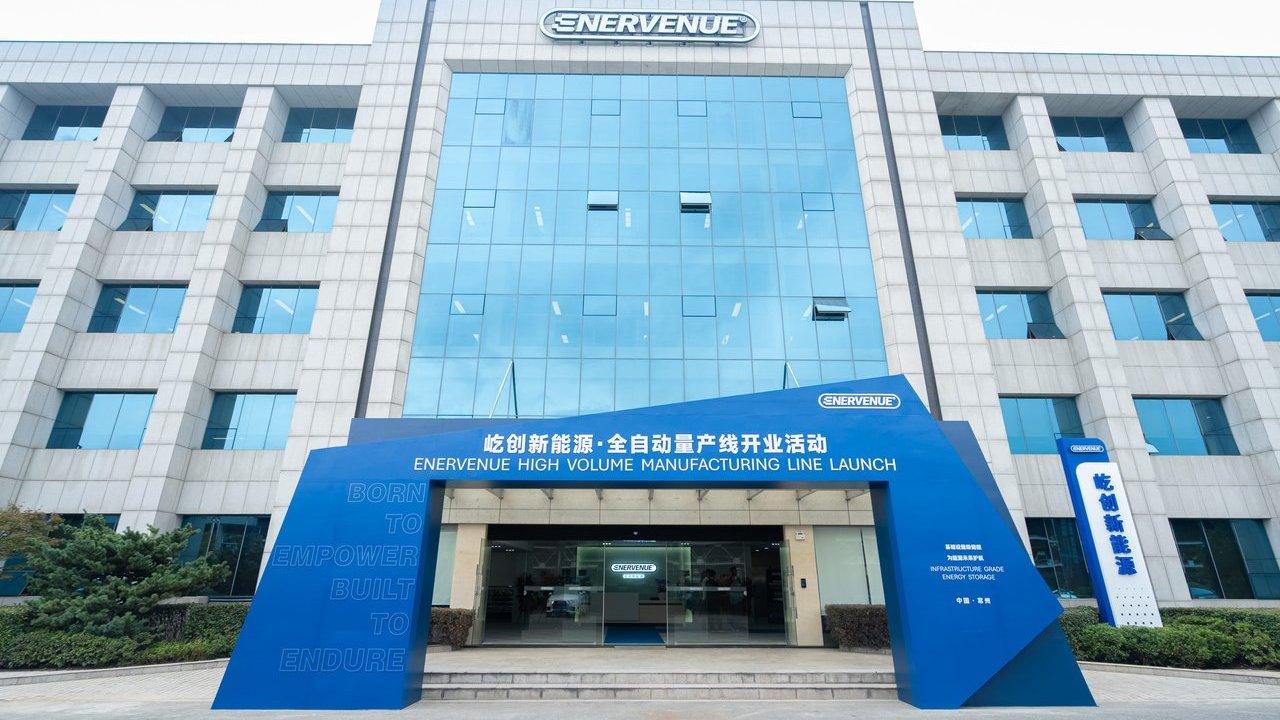
EnerVenue has begun production at its Changzhou, China facility, described as the world’s first high-volume manufacturing line for the Aqueous Metal Cell. Built in 25 weeks, the first phase is rated at 250 MWh of annual capacity and is planned to expand to 1 GWh in 2027, reaching multi-gigawatt-hour scale by 2028. At full automation, the line is designed to produce around 300 fourth-generation water-based nickel-hydrogen cells per day. The development gives the energy storage company a manufacturing base for batteries intended to operate for 30,000 cycles and up to 30 years of service.
A New Manufacturing Blueprint
Ground was broken at EnerVenue’s Wujin site in April, with the first conforming cell produced at the end of September. The 20,000-square-metre plant has provision within the same building for a second phase of comparable size, while its standardised stations are intended to allow additional capacity through replication.
The company presents Changzhou as a production blueprint for a local-for-local manufacturing model. The city offers a concentrated battery supply chain, with around 160 battery-industry companies active locally and a broad supplier base located within a 50 to 100 kilometre radius of the plant.
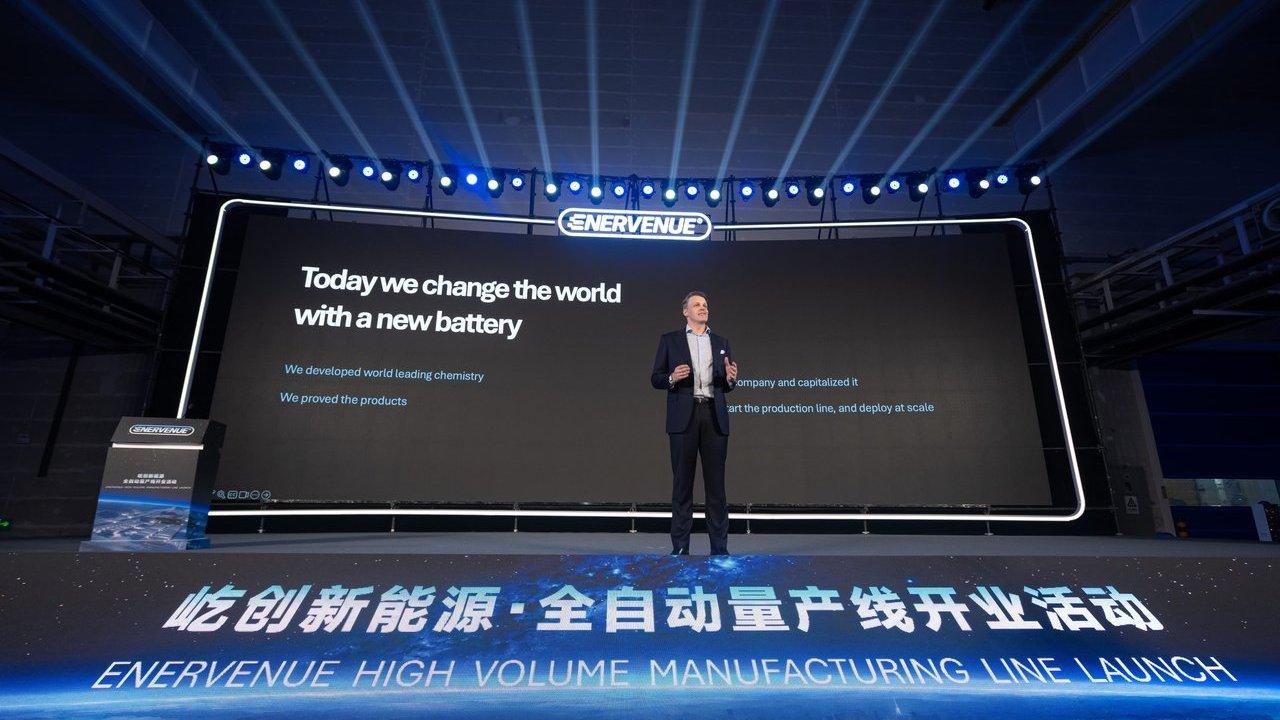
Henning Rath, Chief Executive Officer at EnerVenue, said:
“The Enervenue AMC is now being manufactured at scale, that’s what changes today. This is the only facility in the world making this high performing water-based nickel-based battery; it’s the first battery of its kind that acts like infrastructure rather than a degrading asset. It’s built for 30,000 cycles, can operate in the world’s harshest environments and has no risk of fire from thermal runaway. What we prove here, we can build anywhere.”
Equipment Designed For One Chemistry
As no other manufacturer builds an Aqueous Metal Cell, EnerVenue designed the production equipment specifically for this chemistry. The high-volume line runs from raw materials to finished cells in a single flow, using automated guided vehicles to move cells between stations without manual handling.
A stacking machine assembles electrode stacks under a vision system, while the cell is wound in fibreglass with tension controlled from the inside out. Each machine feeds data into one manufacturing execution system. Before leaving the facility, every cell undergoes 41 quality checks across 11 test and measurement stations, covering weld integrity, leak tightness and performance.
Fully commissioned 150 kWh battery racks are also tested on site before shipment. The manufacturing equipment was engineered and validated at EnerVenue’s research and development line six kilometres away before being committed to the Changzhou operation.
TJ Hua, Head of Production at EnerVenue, said:
“A cell only leaves this building after 41 checks across 11 stations. Anyone can make one good vessel. The job is making the ten-thousandth one exactly the same.”
Storage Products For Multiple Applications
The Changzhou line will supply a product range built around the same underlying chemistry. The 30 kWh Energy Core is aimed at UPS applications in telecoms and other distributed sites, while the 108 kWh Energy Cube is intended for in-building and data centre UPS solutions. The 150 kWh Energy Rack is designed for commercial, industrial and grid-connected duty, and the Energy Prism serves containerised projects ranging from 600 kWh to 1 MWh.
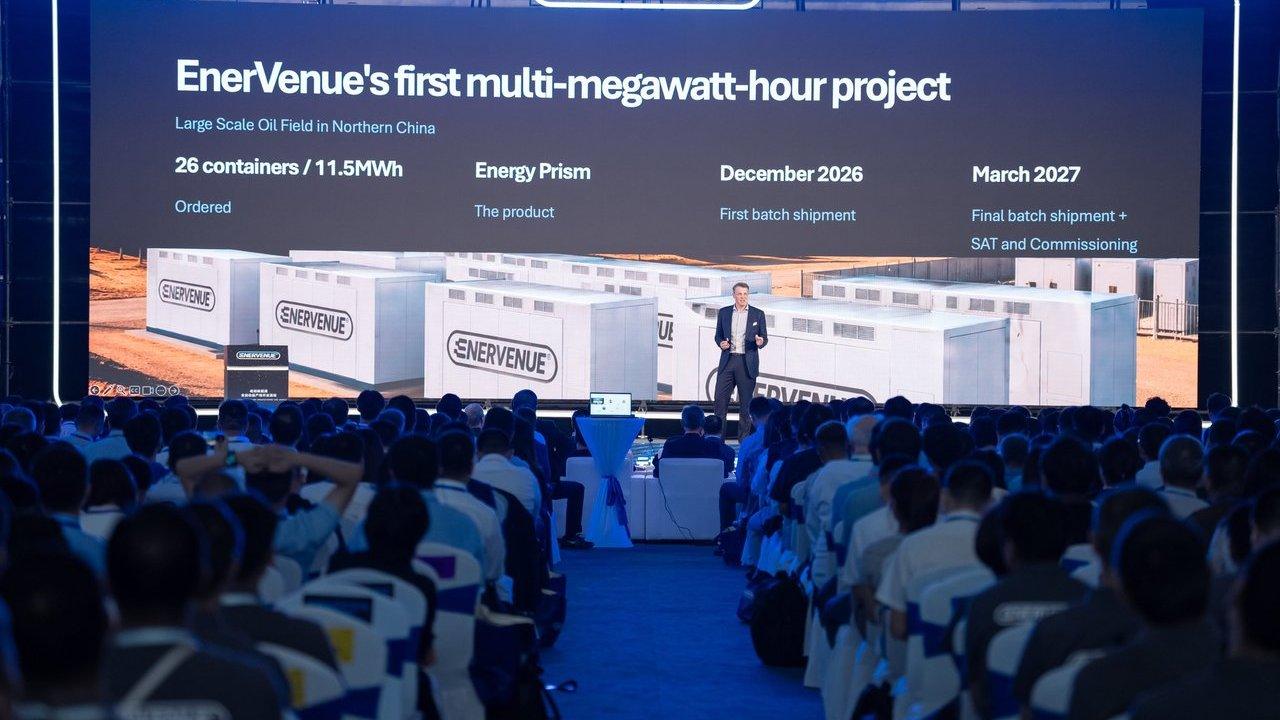
EnerVenue announced its first signed multi-MWh commercial order on 23 September. The 11 MWh project comprises 26 Energy Prism containers for an oilfield company in Northern China, pairing on-site generation with storage. The first containers are scheduled to ship in December.
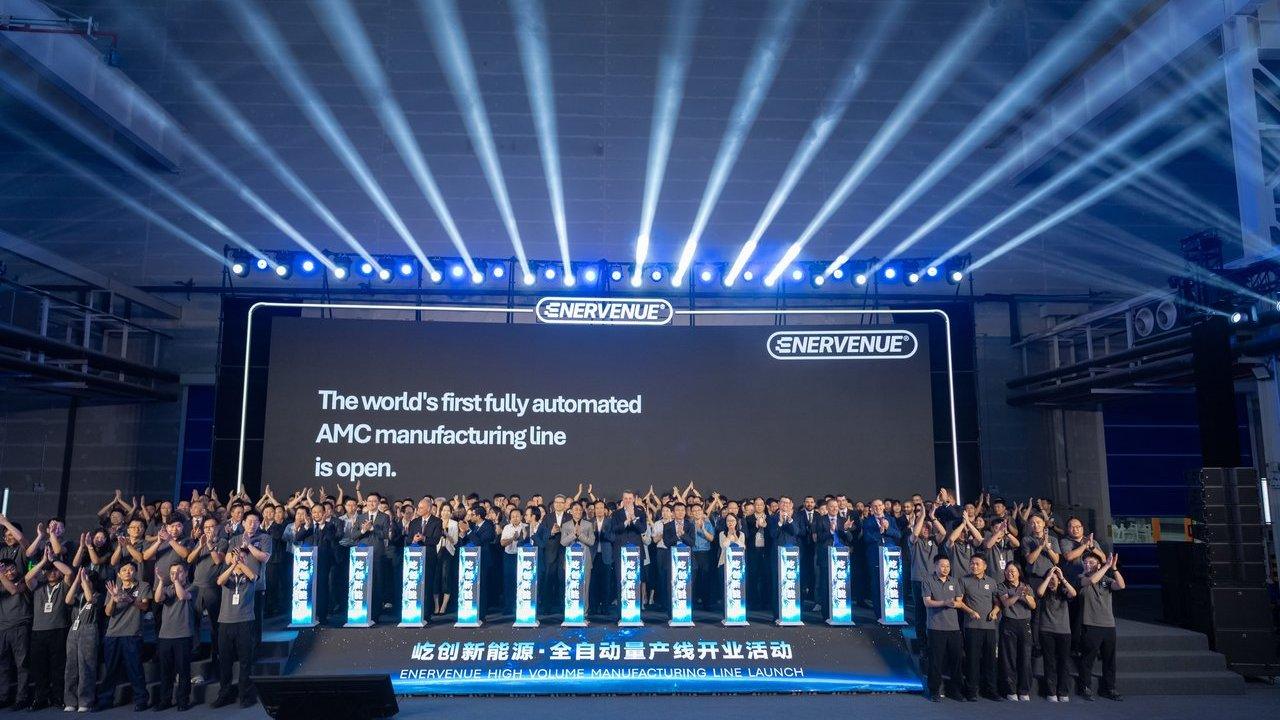
At the opening ceremony, the company also signed a memorandum of understanding with eight organisations for future business opportunities: The Hong Kong and China Gas Company Limited, known as Towngas, Towngas Smart Energy, Shanghai Electric, Guangzhou Development Group, Jiangsu Huahong New Energy Development, PCG Power, Suzhou Yuanzhang New Energy Technology, Desert Technologies and KIOZ.
Battery Chemistry Built For Service
The Aqueous Metal Cell uses water-based nickel-hydrogen chemistry, a technology associated with the Hubble Space Telescope and the International Space Station. EnerVenue has re-engineered the chemistry for terrestrial energy storage using low-cost materials. The company states that the cell is designed for 30,000 charge cycles, equivalent to up to three cycles per day over 30 years, without scheduled augmentation.
Rather than positioning the product solely against lithium-ion batteries on a price-per-kilowatt-hour basis, EnerVenue compares it with pumped hydro, flow batteries and compressed air. Its focus is on the total energy moved over an asset’s working life and the ownership cost across that period.
The water-based, non-flammable electrolyte is central to the company’s safety proposition for use in buildings, data centre halls and oil and gas settings. The cell contains no lithium or rare earths, while nickel can be recovered and reused at end of life.
Dr Majid Keshavarz, Chief Technology Officer at EnerVenue, said:
“While thermal runaway is generally defined as a self-accelerating sequence of exothermic reactions, the AMC chemistry does not produce the same progression of events that leads to ignition, fire, explosion, or propagation to adjacent cells.”
From Changzhou To Wider Deployment
Cells made in Changzhou are already in service. EnerVenue’s first commissioned deployment of its fourth-generation Aqueous Metal Cell has operated since November 2025 at Jintan in Changzhou with Towngas, integrating on-site renewable generation with electric-bus charging. The company has also shipped cells to customers in the United States, Belgium and Saudi Arabia.
EnerVenue reports active projects and customer engagements in China, Australia, the United States, the European Union, Saudi Arabia and Canada. Its customers include PowerSecure in the United States, Radiance Energy in Canada and Horizon Power, Western Australia’s state-owned regional utility.
Backed by a $300 million Series B extension announced in March 2026 and led by Full Vision Capital, the Changzhou line represents a tangible step from aerospace-derived battery chemistry towards high-volume commercial deployment. With production now under way, the facility provides a practical test of whether long-life, water-based storage can be manufactured consistently at the scale needed for resilient energy infrastructure.