Written By Glenn Westall
Sustainable Business Magazine speaks to Karim Sifflet, Senior Manager of Marketing, Business Development and Customer Care at the St Lucia Air and Seaport Authority. Mr. Sifflet discusses the environmental and social sustainability initiatives that the organization has turned towards in recent years.
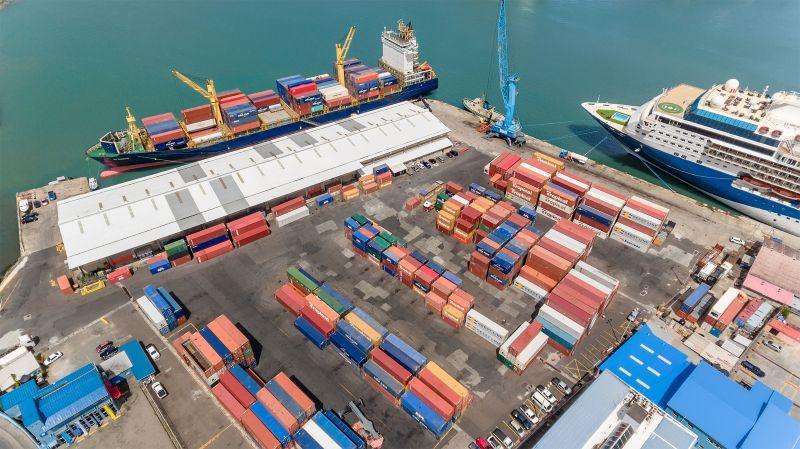
The St Lucia Air and Seaport Authority (SLASPA) is a regional leader in sustainable maritime operations, demonstrating how port authorities can balance economic growth and environmental responsibility. Karim Sifflet, Senior Manager of Marketing, Business Development and Customer Care at SLASPA outlines the wide scope of the organization’s operations:
“SLASPA is responsible for operating Castries and Vieux Fort seaports in St Lucia, as well as the Hewanorra International Airport, the George FL Charles Airport and three smaller points of entry. They are the Rodney Bay Marina, Marigot Bay Marina and Soufriere. SLASPA was established in 1983 through a merger of the then-separate St. Lucia Port Authority and the Airports Division from the Ministry of Communications and Works. We also handle ferry passengers from St Lucia to Martinique, Dominica and Guadeloupe, and the Antilles area in the Caribbean. SLASPA is also responsible for managing the Moule-à-Chique and the Vigie Lighthouses.
“Across these assets, we handle about 600,000 tons of cargo per year and accommodate about 800,000 passengers throughout the airports. We also support about 40,000 aircraft movements per year.”
Sustainability Throughout the Supply Chain
SLASPA’s approach to environmental responsibility extends beyond its own operations, encompassing the entire logistics network.
“Sustainable practices are a major priority for SLASPA,” Mr. Sifflet says. “We do our best to share responsibilities across the logistics chain. For us, that means working with our shipping lines, freight forwarders, fuel importers, and cruise line promoters to promote eco-friendly best practices. One of the first steps we’ve taken is to focus more on collaborating and implementing a solid waste oil disposal management system. That’s one of the key things we’re doing in the short term as our starting point toward a more eco-friendly and sustainable operation.”
Mr. Sifflet continues, explaining how the Authority’s commitment to sustainability also includes comprehensive local community outreach programs:
The core of our corporate social responsibility program is working in the local communities where our operations have a footprint. For example, we operate our main seaport in Castries, and nearby is the Faux A Chaux community, where we have held back-to-school drives with the kids. In these events, we provide school supplies to children because the area is considered one of the more impoverished communities near the port. We have done this for two consecutive years, and this year will be our third year.
That isn’t the only way that SLASPA provides for local children, though, as Mr. Sifflet explains:
We support school groups by organizing tours to our lighthouses. When schools want to visit a lighthouse, we allow them in so students can learn about the rich history of these buildings. Mole-a-Chique Lighthouse, located in Vieux Fort, is especially interesting because it is dubbed the second-highest elevated lighthouse in the world. We also support school children in nearby areas by providing tours and sharing other rich histories.
SLASPA’s community outreach goes beyond schools, though.
“We also had the SPARC of Hope,” says Mr. Sifflet. “That is our annual Christmas charity drive in which we provide the gift of giving during the festive period to those near our ports. We’ve had that for two consecutive years, and this December will be our third year. In previous years, we focused on those primarily within the Castries Basin, but for this coming year, we’re going to expand it down to the south of the island. So we’re doing two touchpoint areas for this upcoming Christmas.”
Another of our annual CSR initiatives is ‘Walk-4-Miles’ which is a unique fundraising walk that raises awareness about cancer and supports those affected by it. Proceeds go to organizations such as Faces of Cancer Saint Lucia, which provide vital support to cancer patients. It’s a special charity walk that allows people to walk along the airport strip, which isn’t something they normally get to do. We are preparing for this event in October, since October is usually marked by many breast cancer awareness initiatives, and this is our way of participating.
“That’s some insight into our key CSR initiatives in which the port SLASPA connects to the community.”
New Machines
Recent infrastructure investments have demonstrated SLASPA’s commitment to reducing environmental impact, for example through modernizing its equipment, Mr. Sifflet says:
When SLASPA celebrated its 40th anniversary two years ago, it marked the occasion by replacing our 20-year-old shore crane, the LHM 320, with the newer LHM 420. This was our major first step toward improving operational efficiency. It became our priority to acquire upgraded equipment that would enable faster, cleaner, and more efficient cargo handling while reducing noise and emissions. Therefore, this was the highlight of SLASPA’s 40th anniversary and a significant milestone.
We’ve also examined other internal operations for improvements, such as reducing plastic waste by installing new port systems where you can bring your own water bottles to refill instead of distributing new plastic bottles each time. Additionally, we’ve adopted LED lighting and motion sensors within our facilities. We’ve even installed motion sensors for HVAC systems. On-site at our ports, we’ve increased our fleet of electric vehicles, primarily forklifts for now. However, it is our goal to gradually replace our entire fleet with either hybrid or electric vehicles whenever possible.
The Authority is also taking tentative steps into renewable energy to create a holistic approach to sustainability.
“In collaboration with other key agencies, we are close to concluding the installation of a solar-powered carport project,” explains Mr. Sifflet. “That means we are installing charging stations at our main international airport that are within the main carport area.”
“So those are some of the main things that we’ve moved towards in terms of operational improvements that take into consideration reducing our environmental footprint.”
PMAC
SLASPA is a member of the Port Management Association of the Caribbean (PMAC). Mr. Sifflet explains how its participation in the network helps to enhance its sustainability efforts through knowledge sharing and best practice adoption:
PMAC has been very supportive of SLASPA, and we value the services they provide, especially as a key facilitator of benchmarking and peer learning. Through PMAC, we’ve also evaluated best practices, networked, connected with other ports, supported workshops and safety training forums, and acted as an advocate for increased representation in maritime policy discussions.
Recently, for example, SLASPA’s management team was guided by the port authority in Barbados through a walkthrough where we engaged in knowledge sharing, transferred, and learned best practices. It’s been invaluable for both qualitative and quantitative benefits to us and port authorities throughout the region.
Future Growth
The authority’s plans for the near future prioritize environmental considerations for its upcoming infrastructure projects and operational expansion. Mr. Sifflet describes what SLASPA wants to do in the coming years:
I don’t want to reveal too much, but one of the things we will be undertaking is the redevelopment of Berth Four, which is our primary berth at Port Castries. The work there will improve our infrastructure and also consider our sustainability, using the best environmental practices available. Additionally, with the growing demand for port activities, we have conducted feasibility studies on a new cargo operations area in Cul de Sac. Furthermore, in the past year, we’ve submitted a request for proposals for a feasibility study, demonstrating our efforts to explore alternative locations for our main cargo operations.
Our main seaport is a versatile terminal that handles ferry services, container traffic, general cargo, cruise port operations, and vehicle imports. Currently, everything is managed at this one port. With increasing demand, especially after COVID, it’s time for us to re-evaluate our strategy and expand our portfolio.
Meanwhile, we also have cruise activity at our main seaport, and we have entered into a public-private partnership agreement with Global Ports Holding for its future. GPH will exclusively manage the cruise operations at Port Castries and Soufriere. With this strategic move, it also allows SLASPA to focus on other areas of efficient cargo handling operations.
Finally, we’re also developing a master plan at Port Vieux Fort, which is south of the island. This plan will focus on supporting additional investment opportunities in the southern part of the country.