Global energy efficiency remains a tough challenge. Despite new technologies, overall gains are modest. For instance, the IEA reports world energy efficiency progress only reached about 1.8% in 2025. Inefficient buildings, wasteful industrial processes and aging power systems still drive high consumption. To meet climate goals, companies are turning to AI-driven tools in hopes of squeezing more efficiency from existing assets. The question is, under what conditions does AI actually reduce energy consumption, and when does it merely add complexity to already strained systems?
Where AI Delivers Measurable Efficiency Gains
Smart Grid Optimization and Renewable Integration
Modern power systems must balance variable renewable generation, growing electric vehicle charging loads, and aging infrastructure simultaneously, which is challenging for human operators. IRENA’s 2025 report for the G7 identifies AI as a gamechanger for the energy transition. It notes that AI-based applications cut electricity costs for end-users, increase energy security, and help integrate low-cost renewables at scale.
The market is responding accordingly. The AI-powered smart grid sector reached $6.62 billion in 2025 and is projected to grow to $12.79 billion by 2030. It follows measurable performance improvements in renewable integration, where AI-optimized portfolios are forecast to capture 12-18% more revenue than manually managed assets, driven by better forecasting, smarter bidding, and predictive maintenance.
A specific example comes from Poland, where the energy storage provider Sigenergy deployed its AI-driven platform at a commercial office and warehouse complex. After switching from fixed electricity pricing to dynamic tariffs managed by machine learning algorithms, which optimize battery charge and discharge cycles based on real-time price signals, weather patterns, and load predictions, the facility achieved up to 48% savings on electricity costs.
Predictive Maintenance
Traditional grid maintenance operates on fixed schedules or responds after equipment fails. AI-based predictive maintenance flips this model by analyzing sensor data, operational history, and environmental conditions to identify failure signatures before outages occur.
Continuous monitoring with predictive analytics can extend transformer life by up to 20% while reducing maintenance costs by up to 25%. Transformers typically progress from initial gassing to complete failure within six months, meaning a fault can begin, escalate, and become irreversible between one sample and the next without intelligent monitoring.
Effective predictive maintenance requires integrated data flows across maintenance scheduling, load balancing, and field crew coordination. The real opportunity lies in coordinating prediction, prevention, and response rather than optimizing individual departmental functions in isolation.
Load Forecasting and Demand-Side Management
Every megawatt-hour of over-generation represents wasted energy, while under-forecasting forces operators to fire up expensive and often carbon-intensive peaker plants. Machine Learning helps predict demand spikes and manage voltage, lowering losses on transmission lines. By anticipating peak values more accurately, grids need less extra capacity sitting idle. In some markets, AI-driven demand response (time-shifting HVAC or EV charging) has already shaved peak loads and reduced generation needs and emissions. IRENA emphasizes that AI forecasting is essential for managing variable renewable energy, from demand and pricing forecasting to flexibility and smart grid management.
Where AI Fails to Deliver (or Even Makes Things Worse)
Data Quality and Governance Issues
AI models learn from data, and in many utility environments, that data remains fragmented across incompatible systems, inconsistent formats, and organizational silos. The fragmentation is both technical and organizational. Utility IT, operations, maintenance, and customer service departments often use different systems and measure different outcomes. When AI models trained on incomplete or siloed data generates recommendations, they may optimize one part of the system at the expense of overall performance, a phenomenon called “fragmented intelligence.”
This problem is particularly acute when companies attempt to layer AI onto legacy software environments. Organizations that build energy management software development solutions customized to their specific operational workflows report significantly higher success rates than those attempting to retrofit AI onto generic platforms, precisely because tailored systems can enforce data consistency from the ground up.
The Consumption Paradox
Perhaps the most uncomfortable finding for sustainability advocates is that AI itself is becoming a big energy consumer. Gartner projects worldwide data center electricity consumption will rise to 980 TWh by 2030, with AI-optimized servers accounting for 44% of total data center power usage by the end of the decade. While AI can enable significant efficiency improvements, the net energy impact depends on whether efficiency gains in end-use sectors outpace the growth in data center consumption.
Complexity and Missteps
Sometimes AI projects add operational overhead. Overly complex control systems with little transparency breed distrust. If employees can’t see or trust the AI’s actions, they may override it. Security is also a risk. More smart devices and AI systems expand the attack surface. The IEA highlights that cybersecurity incidents are rising alongside AI use, and one misconfiguration could even cause more downtime, offsetting any efficiency gain.
Making Smart Choices: AI Decision Framework
Measurable ROI should be the starting point. Pilot projects that demonstrate specific efficiency gains (quantified in kilowatt-hours, tonnes of CO₂ avoided, or reduced downtime hours) deserve scaling. AI initiatives justified primarily by vague “digital transformation” narratives warrant far more scrutiny. Capital flowing toward unproven AI deployments means capital not flowing toward established efficiency measures with known payback periods.
Infrastructure readiness is equally critical. AI cannot optimize a grid it cannot see. Sensor deployment, communications networks, and data integration must precede or accompany AI implementation. Organizations that invest in data infrastructure first and algorithms second consistently outperform those that reverse the sequence.
Custom-built solutions often more effective than off-the-shelf products for complex, asset-heavy energy operations. Off-the-shelf tools can handle standard use cases but frequently struggle with the idiosyncratic workflows of solar farm development, where project timelines span years and involve dozens of interdependent tasks, regulatory approval stages, and phased equipment deliveries. A custom Gantt chart system for solar energy projects illustrates this principle. By mapping software architecture directly to operational reality organizations gain visibility and control that generic project management tools cannot provide:
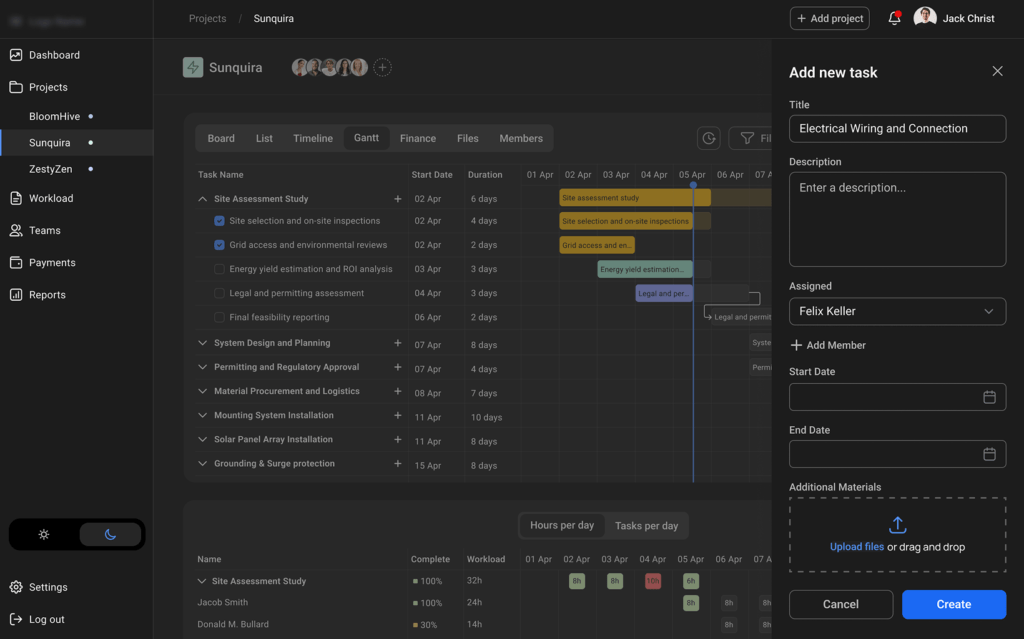
An interactive Gantt chart for renewable energy projects that visualizes tasks, timelines, and milestones
You need to monitor and adapt constantly. Deploy AI incrementally and measure its effect. Use dashboards to track energy use and performance metrics in real time. If an AI control isn’t delivering expected savings, be ready to tweak or roll it back. Maintain human-in-the-loop oversight to catch unanticipated issues (like anomalous control decisions) early.
Finally, governance must precede deployment. AI models that influence physical energy infrastructure require clearly defined accountability for decisions, fail-safe mechanisms when predictions prove wrong, and transparent audit trails. As the energy sector learned from earlier waves of digitalization, the most sophisticated algorithm adds negative value when deployed without these guardrails.
By following a disciplined, data-driven approach, companies can maximize where AI truly cuts consumption, for example, smart grid balancing, predictive maintenance, optimized scheduling, etc. In areas where AI fails (outdated wires, siloed data, or unsustainable compute) such analysis will reveal the gaps.