Introduction to Alaska’s Majestic Mountain Goat
Picture a 300-pound animal standing on a ledge barely wider than your hand, thousands of feet above the valley floor, completely unbothered. That’s the mountain goat for you. Oreamnos americanus is not performing a trick. It’s just Tuesday. research published in Communications Biology and highlighted by the Alaska CASC reports that a 17-year study of four coastal Alaska populations found that over one-third of all mountain goat deaths are caused by avalanches, with these deadly events occurring across nine months of the year, a striking illustration of just how extreme the stakes of high-altitude life truly are.
This is one of North America’s most extraordinary large mammals, and Alaska is where you see it at its finest. The mountain goat thrives where almost nothing else can, in the wind-scoured alpine zones above the tree line, on cliff faces that would stop a human climber cold. And yet, despite living in plain sight on some of the most dramatic terrain on the continent, most people know surprisingly little about what makes this species tick.
So let’s fix that. Here’s what mountain goats actually are, how they live, why they matter, and what’s being done to keep them on those impossible ledges for generations to come.
The Distinctive Features of the Mountain Goat
Start with the hooves, because the hooves are genuinely remarkable. Each hoof on a mountain goat splits into two toes, and those toes work independently, gripping rock the way fingers grip a railing. The outer edge is hard and sharp, biting into ice like a crampon. The inner pad is soft and rubbery, providing friction on bare rock.
No climbing boot engineer has come up with anything better for the specific problem of moving fast on vertical terrain.
Then there’s the coat. Mountain goats carry a double-layer system that would make any outdoor gear brand envious. The inner layer is dense and woolly, trapping body heat the way insulation traps warmth in a wall. The outer layer sheds moisture, keeping the animal dry when wet snow is driving sideways at 40 miles per hour.
Come summer, that heavy outer layer falls away in patches, because overheating at altitude is a real problem when the sun is high and the rock reflects heat back up at you.
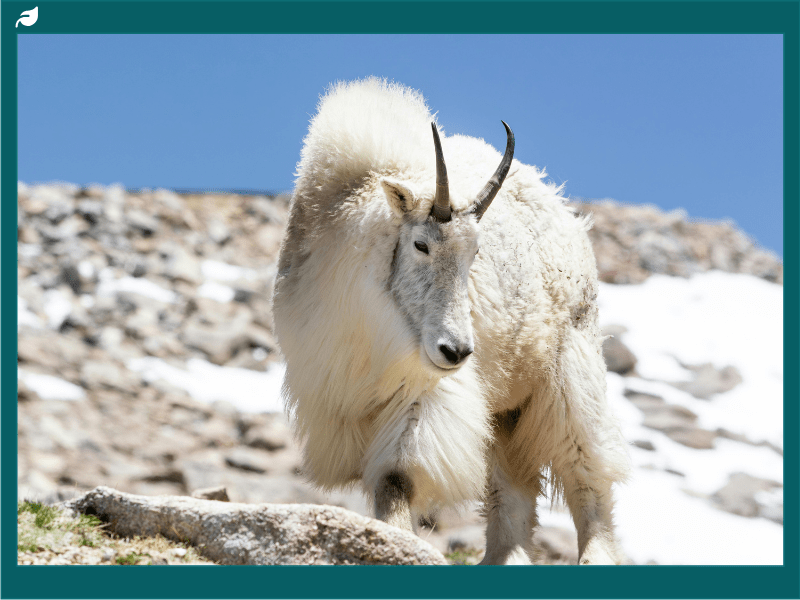
Both adult males (billies) and adult females (nannies) grow those famous black horns. They curve gently backward, which is not a design flaw but a smart one: a straighter horn would snap more easily during the head-butting and pushing contests that determine social rank. The slight backward curve absorbs force, keeps the horn intact, and keeps the animal in the competition longer. Adult males tend to be noticeably larger than nannies, with billies frequently outweighing females by a significant margin, a size difference that becomes especially visible when the two sexes occupy the same feeding area in late autumn.
Muscle-wise, these goats are built like compact powerhouses. The shoulder and leg muscles are disproportionately large relative to overall body size, enabling them to launch between rock faces and land with precision. Their snow-white coat does double duty as camouflage against snow-covered slopes and as a reflector of sunlight, reducing heat absorption on bright days.
None of these features evolved in isolation. Each one is part of a complete system shaped over thousands of years by the specific pressures of high-altitude life in places like the ranges of Alaska and the Rocky Mountains. Together they add up to an animal that is, in its element, essentially unstoppable.
Understanding Their Natural Habitat
The mountain goat is a specialist. It does not tolerate middle ground. Its home is the subalpine and alpine zone, that narrow band of the world above where trees can grow and below where nothing grows at all. In Alaska, that means elevations that would leave most people gasping, on slopes angled so steeply that every step demands a decision. a genetic analysis posted on bioRxiv reports that mountain goats in Alaska comprise four genetically distinct subpopulations, with the primary evolutionary split between Southcentral and Southeast Alaska occurring approximately 14,000 years ago, a timeline that reflects just how long these animals have been shaped by the specific pressures of Alaskan terrain.
Within that zone, goats are picky about specifics. They want rocky terrain with good sight lines, so they can spot a wolf or a bear long before it gets close. They want scattered patches of grass, sedge, and low shrubs, enough to eat but not so lush that the habitat attracts too much competition. They want proximity to cliff edges, because when a predator does close the gap, a sheer drop is the mountain goat’s best defense.
Most predators simply will not follow them there.
Seasonal change shifts those preferences. In summer, mountain goats push as high as they can go, taking advantage of the brief alpine growing season. Come winter, deep snow makes foraging impossible at the highest elevations, and the goats drop down to slightly lower terrain. There they seek south-facing slopes that collect more sunlight, rock overhangs that block the worst of the wind, and areas where shallower snow lets them dig down to edible material.
These mountain goats also share their habitat with other species. Deer occupy some of the same transitional zones, particularly in areas where alpine terrain grades into subalpine forest. That overlap creates low-level competition for forage, adding another layer of ecological complexity to an already demanding environment. The presence of goats shapes the vegetation those deer and other species depend on, so what the goats eat ripples outward through the whole community.
Understanding those relationships is not just interesting science. It is the foundation of every serious conservation plan aimed at keeping Oreamnos americanus on Alaska’s peaks where it belongs.
The Range and Terrain of Alaska’s Mountain Goats
Alaska does not lack for dramatic terrain, and mountain goats have claimed the most dramatic portions of it. From the coastal ranges of the southeast to the mountains of the interior, these animals occupy a geographic range that spans some of the least-visited country in North America. Their distribution is not random. It follows the specific combination of elevation, rock, and climate that their bodies are built for.
Understanding where they go and why they go there tells you a great deal about how they survive.
Exploring Their Preferred Alpine Environments
When people talk about mountain goat habitat, they usually lead with the altitude. Fair enough. These animals are genuine high-altitude specialists, and in Alaska that means ranges where the summits push well past 6,000 feet and the alpine zone stretches for miles in every direction. But altitude alone is not the whole story.
What mountain goats are really selecting for is ruggedness. Smooth, grassy slopes do not interest them much. They want broken rock, narrow ledges, cliff faces with multiple routes, terrain that rewards their specific physical toolkit and punishes anything that lacks it. In that sense, the Rocky Mountains and the coastal ranges of Alaska offer essentially ideal real estate.

The geology is young, the peaks are jagged, and the vertical relief is extreme.
Within Glacier National Park and comparable protected areas in Alaska, mountain goat populations have maintained themselves for decades precisely because those areas offer both the terrain these animals need and the legal protection that keeps human disturbance manageable. The park boundary does not mean much to a goat, but the regulations that come with it protect the habitat the goat depends on.
Summer in these alpine environments is brief and intense. Snow melts off the upper slopes in late May or June, exposing months’ worth of compressed plant growth almost simultaneously. Mountain goats take full advantage, grazing heavily on the suddenly available grasses, sedges, and forbs. They put on fat reserves during this window that will carry them through the coming winter.
The timing matters enormously. A late snowmelt or an early autumn storm can compress that feeding window dangerously.
The physical agility these animals show in these environments still stops experienced wildlife biologists cold. A mountain goat crossing a rock face at speed, choosing foot placements in real time on ground that offers almost no margin for error, is watching the product of millions of years of selection pressure playing out in a few seconds. No other large mammal in North America does what they do, the way they do it.
The alpine zone also provides a thermal advantage. On hot summer days, temperatures at high elevation are cooler than in the valleys below. That matters for an animal wearing what amounts to a heavy insulated suit. The cooling breeze at 5,000 feet keeps goats comfortable when lower-elevation terrain would stress them thermally.
Seasonal Migrations and Movement Patterns
Mountain goat movement is vertical, not horizontal. While some large mammals migrate hundreds of miles between seasons, these goats typically move up and down within a relatively compact home range. The distance traveled might be just a few miles as the crow flies, but the elevation change can be dramatic, and every foot of that descent or ascent is deliberate.
The upward push begins in late spring as snow retreats. Goats follow the snowline upward, tracking the green flush of new vegetation as it appears progressively higher on the mountain. By midsummer, mature animals may be at the very top of their range, close to or above 7,000 feet in Alaska’s higher ranges.
The downward migration starts before the first major snowfall. Mountain goats are not caught by surprise by winter. They read subtle environmental cues, shortening days, dropping temperatures, changes in wind patterns, and begin shifting to lower terrain in advance of conditions that would strand them. This anticipatory behavior is one reason the species has survived in these environments for so long.
Wintering areas are chosen with precision. South-facing slopes capture more solar radiation and tend to have shallower snow cover than north-facing ground. Rock outcroppings and cliff overhangs create natural windbreaks and provide structural shelter that significantly reduces heat loss. In these spots, a mountain goat can reduce its energy expenditure during brutal cold snaps by staying put, sheltered, and conserving the fat reserves it built during summer.
Social structure supports survival during these seasonal transitions. Nannies tend to be the experienced navigators of the group, knowing the established routes between summer and winter range from years of travel. Younger goats learn by following. That transmission of route knowledge from experienced nannies to younger animals is a form of cultural memory, and it is part of why protecting adult females in a population matters so much to long-term sustainability.
Adult males follow somewhat different movement patterns than nannies. Billies spend much of the year in smaller, separate bachelor groups, occupying their own sections of the mountain and rejoining the larger mixed groups only during the rut in late autumn. That separation means males and females are often exploiting different parts of the terrain at the same time, which effectively spreads the grazing pressure across a wider area and reduces competition within the herd.
The goats’ movement patterns also leave a physical mark on the mountain. Their regular trails across steep terrain concentrate foot traffic in ways that affect erosion, soil stability, and water flow during snowmelt. Those effects are subtle compared to the changes a large herd of cattle would produce, but in the fragile alpine ecosystem, even subtle changes matter. Wildlife researchers monitoring goat populations pay attention to trail patterns as one indicator of population pressure on specific areas of habitat.
Feeding Habits and Diet
Ask what a mountain goat eats and the honest short answer is: whatever it can reach that has nutritional value, which in the alpine zone is not always much. These are not picky animals in the sense of refusing food. They are picky in the sense of being highly skilled at finding and extracting nutrition from an environment that offers it in small quantities, spread across difficult terrain.
That skill is worth examining closely.
The Goats’ Unique Foraging Techniques
Mountain goats are ruminants, which means they chew their cud and extract nutrition from plant material through a multi-stage digestive process. That system is well-suited to the fibrous, often low-quality vegetation available in alpine zones. But the digestive advantage only works if the animal can find and harvest enough food in the first place, and that’s where their foraging technique becomes critical.
The lips are the first tool. Mountain goat lips are unusually dexterous, capable of selecting individual leaves or biting neatly at the base of a grass stem without pulling the root. That precision reduces waste and, over the course of a day’s grazing, adds up to meaningfully better caloric intake than a less selective feeder would achieve on the same patch of ground. Their sense of smell guides them to the most nutritious patches, the spots where soil quality or sun exposure has produced denser, more nutrient-rich growth.
The hooves, already celebrated for their climbing ability, also serve a foraging function. Mountain goats will use a foreleg to scrape snow away from vegetation, exposing edible material in winter when surface grazing is impossible. They will also stand on their hind legs to reach shrub branches, extending their effective foraging height significantly above what their standing posture would suggest.
Summer grazing focuses on grasses, sedges, and forbs in alpine meadows. These provide the high-protein, high-energy diet that fuels fat accumulation before winter. As summer ends and the meadows begin to die back, goats shift toward lower-quality but more available material: twigs, woody stems, lichen, and the dried remnants of summer growth. This dietary flexibility is one of the species’ core survival mechanisms.
An animal that could only eat fresh green vegetation would not last a single Alaskan winter.
The social dimension of foraging is easy to overlook but genuinely important. Nannies with experience of the range know where the best feeding areas are, including patches that are not obvious to younger animals. Groups of goats moving through terrain together communicate, at least behaviorally, about food location. When one animal stops and grazes intently, others notice.
That informal information sharing helps the whole group feed more efficiently than any individual could alone.
Foraging also has a defensive component. Mountain goats almost always feed in areas where they can see significant distances in at least one direction. They position themselves near escape terrain, cliff edges or steep slopes, when grazing in more open areas. The combination of feeding and threat-monitoring means these animals are rarely fully relaxed, even on a calm summer day.
Vigilance is the constant tax on every activity.
Impact of Diet on Their Ecosystem
What a mountain goat eats matters beyond the goat itself. These animals are not just consumers in the alpine ecosystem. They actively shape it.
The most direct effect is on plant community composition. By selectively grazing certain species more heavily than others, mountain goats prevent any single plant from dominating the available space. In practice, this means the fast-growing, competitive species that would otherwise crowd out smaller plants get held in check, and that creates openings for a wider variety of plant life to persist. More plant diversity means more habitat complexity for insects, small mammals, and birds that depend on the alpine zone.
The indirect effects are equally significant. Goat droppings deposit nitrogen and other nutrients into soils that are often nutrient-poor to begin with. Alpine soils form slowly and lose nutrients easily through erosion and leaching. A steady input of organic material from goat waste genuinely improves soil fertility over time, supporting more vigorous plant growth across the areas these animals regularly use.
Their physical movement through the landscape contributes to erosion patterns and water distribution. The trails mountain goats wear into steep slopes concentrate runoff during snowmelt, directing water into specific channels. That sounds like a problem, but in a carefully balanced ecosystem it is part of the natural process by which nutrients and sediment move through the mountain. Remove the goats, and the pattern changes, often in ways that are harder on the vegetation than the goats themselves ever were.
There is also the matter of what goats represent to predators. Wolves, bears, and wolverines all prey on mountain goats when opportunity allows, particularly targeting young animals and older individuals in weakened condition. The presence of viable goat populations in the high country supports those predator populations, which in turn regulate prey species across multiple elevations. Pull one piece out, and the effects ripple further than you would expect.
Mountain goats also contribute indirectly to aquatic ecosystems. Mineral licks in high mountain terrain attract goats in large numbers during certain seasons, and the concentration of animals near those sites deposits nutrients that eventually wash into streams and small lakes. Research in some areas has drawn a line, however indirectly, between the presence of goat populations on steep slopes above drainages and the productivity of fish habitat downstream. It is a long chain of connections, but it is a real one, and it illustrates why the loss of a species from its mountain habitat sends consequences in more directions than the obvious ones.
All of which is to say: conserving mountain goat habitat is not just about saving a photogenic animal from a mountain. It is about maintaining a functioning ecological system that depends on this species being present and active.
Conservation Efforts and Challenges
Mountain goats face real pressure. Their habitat is specific, their populations are not enormous, and the forces working against them, climate change, habitat fragmentation, recreational disturbance, and predation pressure in reintroduced areas, are not going away. The good news is that serious, coordinated conservation work is happening. The challenge is keeping that work adequately funded and responsive to conditions that keep changing faster than management plans can be updated.
Here is where things stand.
The Role of the NPS in Preservation
The National Park Service (NPS) manages some of the most important mountain goat habitat in North America, and the agency takes that responsibility seriously. In Alaska alone, NPS-managed land includes vast tracts of the high-altitude terrain these animals depend on. The agency’s role is not passive. It involves active habitat monitoring, population surveys, research partnerships, and direct intervention when human activity threatens goat populations.
Population surveys are foundational. Without accurate counts, you cannot track trends, identify problems early, or measure whether conservation actions are working. The NPS conducts aerial surveys of goat populations in managed areas, using both fixed-wing aircraft and helicopters to cover terrain that is inaccessible on foot. Those counts, combined with GPS collar data from instrumented individuals, build a picture of how populations are using the landscape across seasons.
Habitat management is the other major lever. The NPS works to ensure that wintering areas remain accessible and undisturbed, that human recreational activity during sensitive periods is minimized, and that vegetation communities in key foraging areas are not degraded by overuse or invasive species. In some areas, this means closing specific trails or climbing routes during the goat’s most vulnerable seasons. Visitors sometimes push back on those restrictions.
But the alternative, disrupting nannies with young kids during the critical early weeks of their lives, can suppress recruitment enough to affect population trajectory over years.
Educational programs run by the NPS help visitors understand what they’re looking at and why protecting it matters. A visitor who understands that the white dot on the cliff face is a mountain goat navigating terrain at the edge of what biology allows is a visitor who respects the buffer zone without needing to be told twice. That kind of informed engagement multiplies the effectiveness of formal regulations.
Collaboration amplifies everything. The NPS works with the Alaska Department of Fish and Game, university research programs, and non-governmental conservation organizations to share data, coordinate management approaches, and pool resources for research that no single agency could fund alone. The gov.alaska.gov and nps.gov platforms both carry updated information on goat populations, management plans, and visitor guidelines, and that public transparency matters for building the broad support that conservation ultimately depends on.
How Gov Policies Influence Conservation Strategies
Government policy sets the conditions in which conservation either succeeds or struggles. Get the policy framework right and every other conservation effort is easier. Get it wrong and even the most dedicated field biologists are fighting uphill.
For mountain goats, the most important policy tools are habitat protection designations, hunting permits management, and environmental regulation. National park designations, wilderness area classifications, and state wildlife reserve boundaries collectively determine how much of the critical alpine habitat remains off-limits to the kinds of development and intensive recreational use that would degrade goat populations. Expanding those protections where science identifies critical habitat, and defending them against rollbacks, is an ongoing political task.
The hunting permits system in Alaska is a good example of evidence-based policy in practice. Mountain goat hunting is legal in Alaska outside protected areas, but it is tightly regulated. Permits are issued in limited numbers, allocated by drawing, and calibrated to population estimates for specific management units. The system is designed to ensure that harvest levels remain within what goat populations can sustain.
When surveys show a population declining, permit numbers drop. When a population is stable or growing, the system allows a measured harvest that generates revenue for conservation programs. That cycle of monitoring, adjustment, and reinvestment is what sustainable wildlife management looks like at its best.
Environmental regulations governing land use around mountain goat habitat matter too. Policies that limit mining activity, restrict off-road vehicle use, and require environmental impact assessments before infrastructure projects proceed in sensitive mountain areas all reduce the fragmentation of goat habitat. Those policies are not always popular with every economic interest, and the political fights over them are real. But the scientific case for their importance is solid.
Climate policy connects to goat conservation in ways that are still being quantified. Warming temperatures are altering the alpine zone itself, pushing the tree line higher, reducing snowpack, and changing the timing and composition of the plant communities mountain goats depend on. Policy responses to climate change, at the national and state level, will shape the conditions these animals face over the coming decades more than any single habitat management decision. That long-term connection is why conservation organizations increasingly engage on climate policy as core to their mission, not a separate issue.
Community engagement is the piece that binds policy to practice. Gov programs that fund outreach in communities near mountain goat range, support local participation in monitoring, and provide economic alternatives to activities that degrade habitat build the social foundation that makes policy durable. Conservation strategies that communities feel ownership over tend to survive changes in administration better than those imposed from outside. That is a practical truth as much as a philosophical one.
The Cultural Significance of Mountain Goats in Alaska
There is something about an animal that lives where humans cannot easily follow that captures the imagination and holds it. Mountain goats have occupied Alaska’s high places for thousands of years, and the people who have lived in and around those mountains for that same span of time have not ignored them. These animals appear in the oral traditions, material culture, and spiritual practices of Alaska Native peoples in ways that reflect genuine, sustained observation of their behavior and deep respect for what they represent.
That cultural thread runs through to the present. Mountain goats are not just a wildlife management subject or an ecotourism draw. They are part of how Alaska understands itself.
Insights into National Folklore and Traditions
For the Tlingit people of southeastern Alaska, the mountain goat was not simply prey. It was a being with spiritual significance, connected to the high places that separated the human world from something larger and less controllable. Tlingit oral traditions include stories in which mountain goats serve as teachers, guides, or adversaries, characters whose behavior carries moral weight. The animal’s ability to move where humans struggle to follow made it a natural symbol of power, independence, and the limits of human dominion over the natural world.
The wool of mountain goats has practical cultural significance that is easy to underestimate. Tlingit and other Northwest Coast peoples harvested goat wool, combined it with the inner bark of yellow cedar, and wove it into Chilkat blankets. These blankets are among the most technically demanding textiles produced by any Indigenous culture in North America. They required extraordinary skill to produce, took months to complete, and carried significant ceremonial and social meaning.
A Chilkat blanket represented not just craft knowledge but a deep connection to the mountain goat as a resource, a symbol, and a presence in the landscape. The harvesting of goat wool was itself a relationship, governed by protocols that acknowledged the animal’s role in a world where humans and wildlife were understood to be interdependent rather than separate.
Mountain goat imagery appears across the material culture of Alaska Native peoples: carved into totem poles, depicted on ceremonial regalia, worked into the design of tools and containers. These representations are not decorative in the way a logo is decorative. They carry genealogical and spiritual meaning, marking clan affiliations and recording relationships between human communities and the animals and places of their homeland.
The arrival of European settlers and later American governance shifted the relationship between Alaska’s people and its mountain goats in significant ways. The commercial and sport hunting of goats reduced populations in some areas. The disruption of traditional Indigenous land use practices severed some of the relationships that had sustained both the cultural significance of the goat and the ecological practices that supported goat populations. Recovery from those disruptions is ongoing, both ecologically and culturally.
Modern Alaskan identity has embraced the mountain goat as an emblem of the state’s character. The qualities people associate with these animals, tenacity, sure-footedness, comfort with extreme conditions, map onto a self-image that many Alaskans cultivate. You will find mountain goat imagery in the branding of businesses, on regional merchandise, and in the work of Alaskan artists who draw on both Indigenous and non-Native traditions. That visibility reflects a genuine cultural resonance, not just marketing.
The scientific name Oreamnos americanus translates roughly as “mountain lamb of America,” a name that captures the animal’s combination of toughness and seeming delicacy, the way something that looks placid can turn out to be practically indestructible in the right environment. There is something in that combination that Alaskans recognize as familiar. The state itself has that quality: beautiful, unforgiving, and more resilient than it looks from a distance.
Conservation efforts gain cultural traction when they connect to this deeper significance. Programs that engage Alaska Native communities as partners in monitoring and managing mountain goat populations draw on traditional ecological knowledge that in some cases predates systematic scientific study by generations. Hunters and elders who have spent lifetimes observing these animals in specific mountain ranges carry observational data that cannot be replicated in a short-term research project. Incorporating that knowledge into management strategies is both scientifically smart and culturally appropriate.
That integration of traditional knowledge with contemporary science matters practically, not just symbolically. Elders who have watched specific goat populations across decades can identify subtle shifts in behavior, range use, and seasonal timing that short-term monitoring programs would miss entirely. Their information fills gaps in the scientific record that no amount of aerial survey work can fully address. When the two knowledge systems work together, the result is a more complete picture of what goat populations are actually doing across the landscape, and a stronger foundation for the decisions that will determine whether those populations remain viable through the changes ahead.
The mountain goat asks nothing of us. It does not need our admiration or our stories. It is doing exactly what it has always done, picking its way across a cliff face above the clouds, finding food in places where food should not exist, surviving conditions that would end most other large mammals within days. What we get from paying attention to it, the cultural meaning, the ecological insight, the simple shock of watching something so improbable be so completely at home in its environment, is entirely on our side of the ledger.
Keeping these animals on those peaks, in those numbers, across the full range they have historically occupied, is a conservation task worth doing for strictly scientific reasons. But it is also worth doing because some things matter beyond science. The mountain goat on its cliff face, white against grey rock, above the valley and the forest and the world of roads and schedules and plans, is a reminder that the continent still contains places and creatures that operate by entirely different rules. That reminder has value.
We would notice its absence more than we currently notice its presence, and that is exactly the kind of thing that conservation exists to prevent.
For more detailed information on visiting mountain goat habitat, checking current population status, or reviewing management plans for specific areas, the nps.gov and gov.alaska.gov websites carry regularly updated resources on wildlife management throughout the state. If you are planning to apply for hunting permits in zones where mountain goat hunting is permitted, those same gov sites carry the current application windows, quota information, and regulations by management unit.
The mountain goat earns every inch of ground it occupies. The least we can do is make sure there is still ground worth occupying.