Sustainable Business Magazine speaks to Dean Tollman, CEO of Vital Baby, one of the last family-run firms in the baby space and first to develop technology to biodegrade everyday plastic baby products. Mr Tollman discusses the challenges of sustainable parenting for ‘the majority’ and how sustainability has often become synonymous with ‘exclusive’.
However environmentally conscious and circular an individual is in their approach to life, the parenting journey is likely to involve some unique and one-off purchases. Given that the baby space is one that many people either have or, at some stage, hope to enter, the topic of sustainability surprisingly draws a line in the sand. On one side you have affordable, usually plastic-heavy but durable products lining supermarket and online shelves while on the other, planet-friendly alternatives made from materials such as glass or wood hit price points that are out of reach for the average family budget.
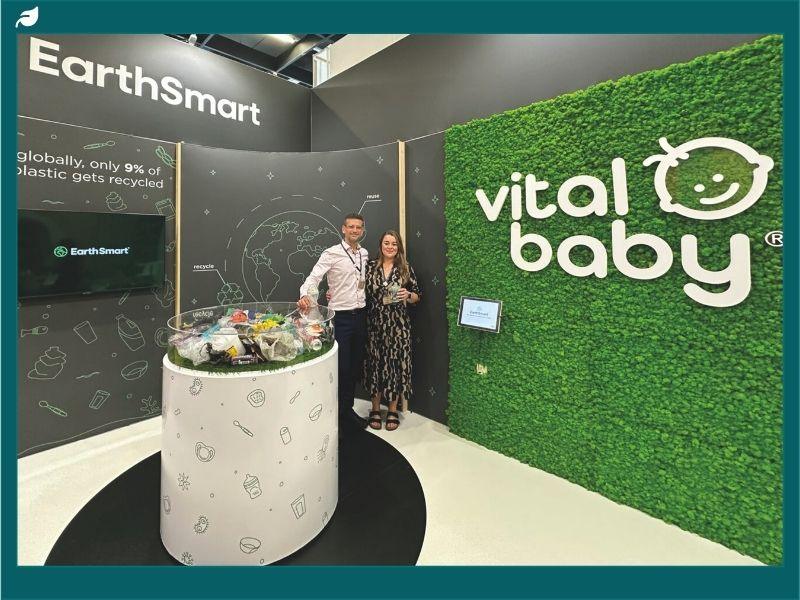
In the middle sits Vital Baby, which has developed a technology called EarthSmart that makes its everyday plastic baby products biodegrade in landfill conditions and – crucially – without passing this cost on to families. Staggeringly, this offering is the first of its kind among everyday baby products. It is not the panacea to climate change but it does eliminate ‘forever plastics’ and enables struggling families to make a more sustainable choice. However, the path is not straightforward.
The sustainability premium
Second generation CEO Dean explains that sustainable brands will not push forward the environmental agenda if only a small proportion of the population can afford their products. Where the target is cash-strapped families muddling through their lowest-income years, applying a ‘sustainability premium’ is counter-productive, he argues.
“Demand for sustainable products is on the rise with consumers willing to pay on average between 9% and 12% more for sustainably produced or sourced goods. Whilst this is reassuring, it is not a reason to charge more.
“The baby sector is a great example of the unrealistic price gap that often emerges. Some retailers approach sustainability like it’s a high-end fashion label and charge upwards of £16 – and much more – for one baby plate, or the equivalent of £4 per baby spoon, in a market where both these items are readily available at £1 each, and less. Quality and safety are paramount in this sector, but these do not need to be compromised for retailers to be realistic about what the average family can afford.
“Even if a portion of consumers are prepared to spend more, charging more makes sustainable products more exclusive and disincentivises those shoppers who would like to ‘buy eco’ but cannot absorb the additional cost. Young families often have significantly less income if one parent is working reduced hours or taking time out to care for children, or because of high childcare costs.
“We have been analysing our sales data. Like most retailers, we offer ‘pay later’ and ‘pay in 3 instalments’ options and, in the past year, more than a quarter of customers that use these are doing so for items costing £20 or less. The majority of parents do not have money to spare. If we really want to change buying habits and push forward the sustainability agenda, we have to target the larger part of the market, not the minority.”
Tollman acknowledges that more sustainable products often involve higher production costs in terms of materials used and manufacturing processes. However, to encourage the trend for more sustainable shopping habits, he believes retailers need to lead the way and be prepared to shoulder at least some of this expense to find a middle ground or search for ways to operate more cost effectively to enable lower retail pricing.
An example of this approach
Vital Baby’s proprietary EarthSmart technology is the result of over three years of intensive research and development and rigorous testing by the company. The technology enables the firm’s range of everyday baby products to biodegrade in landfill conditions within five years, according to calculations based on independent anaerobic biodegradation testing standards for plastic materials (ASTM D5511 and ISO15985). Despite the significant time and resource investment, the firm chose to keep its price point low and absorb the cost.
“Our product is not ‘perfect’ and EarthSmart is not the ultimate solution to sustainable parenting. It is important that consumers continue to reduce and reuse plastic wherever possible, but research tells us that only around 9% of all plastic is recycled across the globe each year. The majority goes straight to landfill. This is why we developed EarthSmart, so that if our products are mismanaged at end of life, we know they won’t sit in landfill for hundreds of years.”
Where EarthSmart is added to a plastic product, under landfill conditions it attracts microbes, allowing them to control their PH level, become quorum sensing and colonise on the surface of the plastic. Once the microbes, a specialised bacteria, have colonised on the plastic, they produce enzymes that allow them to break down and digest the product, leaving no microplastics behind.
“But it is an ongoing journey,” says Dean, “and we are working behind the scenes on other ways to improve the sustainability credentials of our range. The technology we have developed is the most advanced currently available in our sector, but we believe that through continued research and development much more can be achieved.”
Dean also believes it is vital for progress that businesses talk about their sustainability journeys rather than succumb to silence through fear of greenwashing. “If all businesses stopped talking about the sustainability credentials of their products and instead sold them without that label or messaging, who would stand to gain? Without the conversation, consumers don’t know what they are getting or the kind of business they are buying from, and yet surely encouraging the trend of consumers becoming more eco-conscious in their choices is a positive move.
“In the parenting space, we rightly have very high parent expectations to meet in terms of the quality and cost of our products, but sustainability is an increasingly significant part of the decision process when buying for babies. Equally, throwing a spotlight on sustainability innovations and advancements encourages healthy competition in the market, with other firms spurred to innovate and find their own sustainable niche. The key is business integrity and honesty and being clear and transparent about what the sustainability credentials truly are, where the limitations lie, and where the improvements are still being made.”
Selling sustainable
However, talking about the journey is not always straightforward when it comes to marketing biodegradable plastic across international markets.
“In the UK, authorities recognise the scientific research that proves EarthSmart allows plastic to be broken down and can therefore be labelled as biodegradable. In other markets, this is not always the case. For example, in the EU, regulations around biodegradable plastic only apply to single-use products. In order to label something as ‘biodegradable’, you have to show that it will reach 90% degradation over a period of 180 days. For plastic designed for safe and constant reuse, which is much sturdier than thin, single-use products, this is simply not possible to achieve. Consequently, whilst our range is considerably better for the environment than non-biodegradable plastic alternatives, we cannot draw attention to this fact in our packaging throughout the EU.
“The US is more in line with the UK but there are variations from state to state. For example, in California our packaging cannot refer to being biodegradable. In other markets, such as in the Middle East and South Africa, there is less of a barrier. It is a minefield to navigate confidently and avoid repercussions or costly re-packaging where local laws and interpretations vary. Whilst we support initiatives to reduce the use of plastic, it is frustrating that in certain markets we cannot communicate to families that our products are not ‘forever’ plastics.”
A family affair
Vital Baby was built on the foundations of decades of sector experience. Dean’s father, Steve Tollman, started out in the parenting space in the 1970s working with multiple household name firms, including Chicco and Heinz Baby Club, before channelling his expertise into founding Vital Baby in Europe in 2001 and later in the UK in 2005. Dean has been part of the family business since the beginning, working his way through most departments – including finance, compliance, branding, sales & marketing – before taking over the helm in 2012.
Initially built up as a white label supplier for numerous international retailers, including Walmart in the US, the business has pivoted to build up a trusted brand in its own right, supplying major retailers including John Lewis, Mamas & Papas, and Boots under its own Vital Baby label. The firm knows its market and has deliberately stayed at the affordable end to serve the majority. Embarking on a more sustainable journey has also been welcomed by its core customers.
“We’re delighted that our key clients and consumers are increasingly looking for sustainability credentials and we’re striving to fill this space. As a well-established, family-run business, we still have our feet on the ground with real people behind the brand. I think this is a real strength when it comes to innovation. We are able to pivot and try new technologies without being swept up in corporate targets and losing touch with our customers.
“There is a lot still to be done around sustainability in the baby space, and for Vital Baby, but the key is to put our customers at the centre and keep innovating, testing and talking about progress as it comes, rather than wait until we reach that distant – perhaps impossible – goal of perfection.”