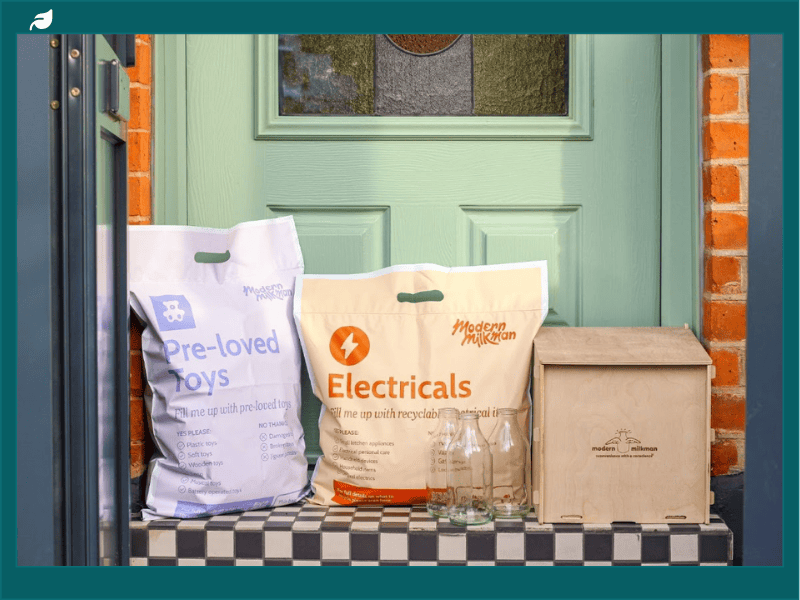
Modern Milkman has launched a new doorstep Collections Service aimed at helping households recycle toys and small electrical items that are often difficult to dispose of responsibly. The initiative expands the company’s existing closed-loop delivery model beyond reusable glass bottles, extending it into additional household categories.
The service is designed to address a common domestic challenge: what to do with unused toys, cables and small electrical items that accumulate in cupboards and drawers. By integrating collections into its regular delivery rounds, Modern Milkman is seeking to make recycling these items part of customers’ everyday routines.
Modern Milkman is working in partnership with EMR to process items collected through the scheme. Small electrical waste and mixed WEEE will be processed on site by EMR, while toys in good condition will be sold through EMR’s partner, Toys4Life.
The new offering is already available for selected items and is set to expand from the spring to include other frequently discarded household products. Each collection bag is priced at £2.50 and is available in two sizes: 16×24 inches for electricals and 18×20 inches for toys.
Simon Mellin, Modern Milkman Founder & CEO said: “Every household has the same hidden problem – a drawer full of old wires and chargers, a bag full of clothes that no longer fit, cupboards of toys and games that never get used. As parents and consumers, we care about the world and want to do the right thing, but life is busy and good intentions often sit in cupboards. Modern Milkman started with a simple mission: reduce waste by changing everyday habits.”
Extending the Closed-Loop Model
The Collections Service builds on Modern Milkman’s established doorstep delivery and pick-up system. The company’s model has focused on reducing single-use packaging through reusable glass bottles and returnable containers. The addition of take-back options for toys and electrical items uses the same logistics network, allowing customers to recycle items without making separate trips to recycling centres.
The move comes ahead of the UK’s 2026 waste collection reforms, which will introduce more standardised recycling streams nationwide and require weekly food waste collections. These reforms are intended to improve consistency in recycling practices and reduce waste sent to landfill.
By incorporating hard-to-recycle items into its delivery infrastructure, Modern Milkman is positioning the service within a broader shift in UK waste policy and consumer behaviour. Small electrical items and mixed WEEE are among the fastest growing waste streams in the UK, and collection and processing systems remain uneven across local authorities.
Under the new partnership, electrical items collected from customers will be processed at EMR facilities. Toys deemed suitable for reuse will be channelled through Toys4Life, creating a route for resale rather than disposal. This approach combines material recovery with reuse, aligning with wider circular economy principles.
Turning Recycling into Routine
The company says the aim is to remove practical barriers that often prevent households from recycling smaller items. Electrical cables, chargers and battery-operated products are frequently stored at home because they are inconvenient to dispose of and not always accepted in kerbside collections.
By offering a low-cost bag and collection alongside regular grocery deliveries, Modern Milkman is seeking to simplify that process. Customers add the collection bag to their order, fill it with eligible items, and leave it out for pick-up on their usual delivery day.
The expansion reflects a broader trend among consumer-facing businesses exploring take-back schemes as part of extended producer responsibility and circular economy models. While supermarkets and retailers have introduced in-store collection points for certain waste streams, doorstep integration remains less common.
Modern Milkman’s Collections Service represents a further step in the company’s effort to embed waste reduction into routine household habits. As regulatory reforms take effect and pressure grows to improve recycling rates for electrical waste and other complex materials, models that combine convenience with recovery infrastructure are likely to play an increasing role in the UK’s waste management landscape.