Tidalove was not founded as a response to a market trend, but through everyday health considerations. The brand was started by Penny Choi, a nutritionist who grew up in South Korea before immigrating to the United States, where her professional focus centred on how daily routines shape long-term wellbeing.
In Korean culture, oral health is often described as one of life’s five great blessings, reflecting its close link to overall quality of life. That belief became more tangible for Choi while raising children and observing how small habits are repeated daily within family life. As attention turned to simplifying routines at home and reducing unnecessary waste, toothpaste stood out as a product that was difficult to replace.
Despite being a universal household staple, toothpaste remains largely packaged in single-use plastic tubes that are rarely recycled. Conventional toothpaste formulas are typically made up of more than 70 percent water, adding weight and volume during manufacturing and transport. Across households, this routine use quietly contributes to plastic waste and transport emissions.
Tidalove began with a basic question of whether everyday oral care products could be made, packaged and used differently. Early interest in toothpaste tablets suggested a possible solution, but further research highlighted limitations in existing options. Many early products were fluoride-free, and while environmental benefits were often emphasised, performance and daily usability were not always aligned with consumer expectations.
The search for an existing alternative gradually shifted into product development. Tidalove started as a small-scale project, with Choi meeting manufacturers, reviewing formulations and testing samples. Creating a waterless toothpaste tablet presented technical challenges, as removing water altered how ingredients behaved. Texture, taste, foaming and mouthfeel all required careful adjustment to ensure the tablets functioned within familiar brushing routines.
During development, the brand consulted perfumers, ingredient specialists and oral care professionals, alongside repeated real-life testing. Initial work focused on fluoride-based formulations, reflecting common dental care standards. Continued research and expert input later indicated that carefully designed fluoride-free options could also meet user needs. Tidalove now offers both fluoride and fluoride-free toothpaste tablets, allowing consumers to choose according to personal preference.
As the formulations evolved, environmental considerations became embedded in the product design. Waterless formats significantly reduce weight and volume during shipping, which in turn lowers transport-related emissions. The solid tablet format also removes the need for traditional plastic toothpaste tubes altogether.
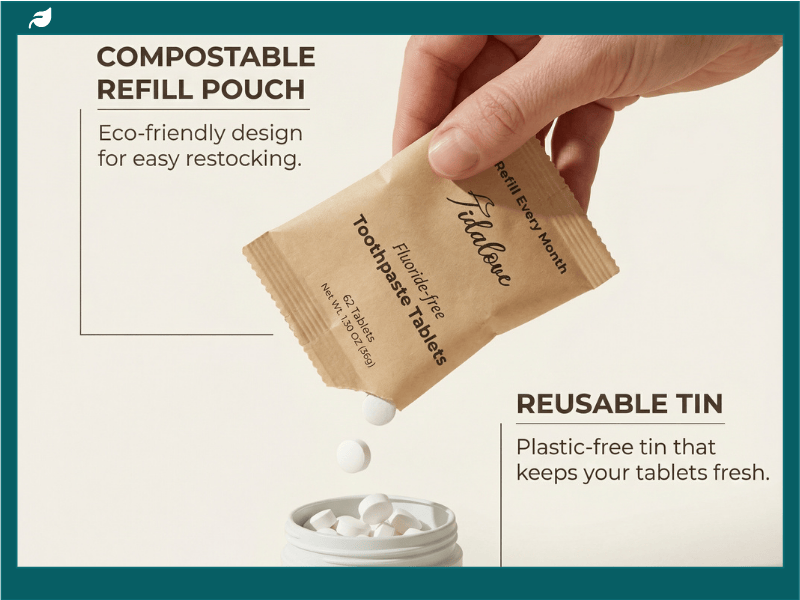
Packaging decisions were shaped by practicality rather than aesthetics. Tidalove uses a refill system built around a reusable aluminium container designed for long-term use. Aluminium was selected for its durability, light weight and recyclability. Refill packs are made from fully compostable materials, allowing customers to replenish products without discarding containers each time.
The brand has positioned these choices as incremental improvements rather than a complete solution. Tidalove does not present itself as a perfect model, instead describing its approach as one of steady progress. As a small, women-founded business, it has prioritised gradual development over rapid expansion.
Today, Tidalove is expanding beyond oral care into other waterless personal care formats. New products in development include facial wash beans, body wash sheets and solid serums. Each applies the same principles of reducing water content, limiting packaging and maintaining everyday usability across different categories.
By focusing on familiar routines rather than lifestyle statements, the company aims to integrate lower-impact personal care into daily life. Through waterless formulas and refill systems, Tidalove seeks to make changes that are practical at household level, where small adjustments can accumulate over time.