Let’s face it: the fashion industry has a waste problem. A big one.
Every year, about 40% of all new clothes never get sold. That’s one garbage truck full of textiles dumped or burned every single second. You read that right—every second.
So what’s the answer? More and more people are turning to on-demand manufacturing and small-batch production. The idea is simple: make it after someone buys it, not before.
Why the Old Model Is Broken—And Why It’s Not Anyone’s “Fault”
Here’s how fashion normally works. Brands guess what people will want months from now. Then they place huge orders based on those guesses. They make first, ask questions later.
That’s how you end up with mountains of unsold clothes. They never even make it to a customer. Straight to the dump.
But here’s something most people don’t realize. This isn’t just bad planning. It’s a structural problem. Supply chain experts have a name for it: the Bullwhip Effect.
Here’s how it works.
Imagine a small boutique. They sell 10 shirts one week. The owner thinks, “I should order 15 to be safe.” That’s a 50% bump.
That order goes to a regional distributor. The distributor sees orders going up. They don’t know if it’s a real trend or just one store being cautious. So they order 25 shirts from the factory. That’s another big jump.
The factory gets that order. They see demand rising. They think something big is happening. So they ramp up production—50, 100, 200 shirts.
By the time the signal travels from the store to the factory, a tiny 10-shirt increase has turned into a 200-shirt production run.
That’s the Bullwhip Effect. A small crack of the whip at one end turns into a huge snap at the other.
Now multiply that by thousands of stores, distributors, and factories around the world. You’re not looking at a few extra shirts anymore. You’re looking at millions of tons of unsold inventory piling up in warehouses. And eventually, in landfills.
The numbers? Staggering. The UN says the textile industry is responsible for about 10% of global carbon emissions and 20% of global wastewater. In the U.S. alone, we throw away 17 million tons of textile waste every year. Most of it ends up in landfills.
The craziest part? Most of that waste was never meant to be waste. It was just a miscalculation somewhere along the supply chain. A boutique ordered a few extra “just in case.” That small decision, amplified through the system, became a mountain of garbage.
Davis Sarmins from Printful puts it bluntly: “Overproduction has always been fashion’s biggest environmental blind spot.” His company’s fix? They don’t start production until someone actually buys something. No sale, no shirt. No unsold inventory, no waste.
On-demand manufacturing breaks the Bullwhip Effect completely. When you only produce what’s already sold, there’s no signal to amplify. The boutique orders one shirt because a customer bought one shirt. That’s it. The factory makes one shirt. No jumps. No misreading demand. No mountains of unsold clothes.
How Heat Transfer Makes One-Shirt Production Possible
So how does someone make just one shirt without losing money? The answer is pretty low-tech, actually.
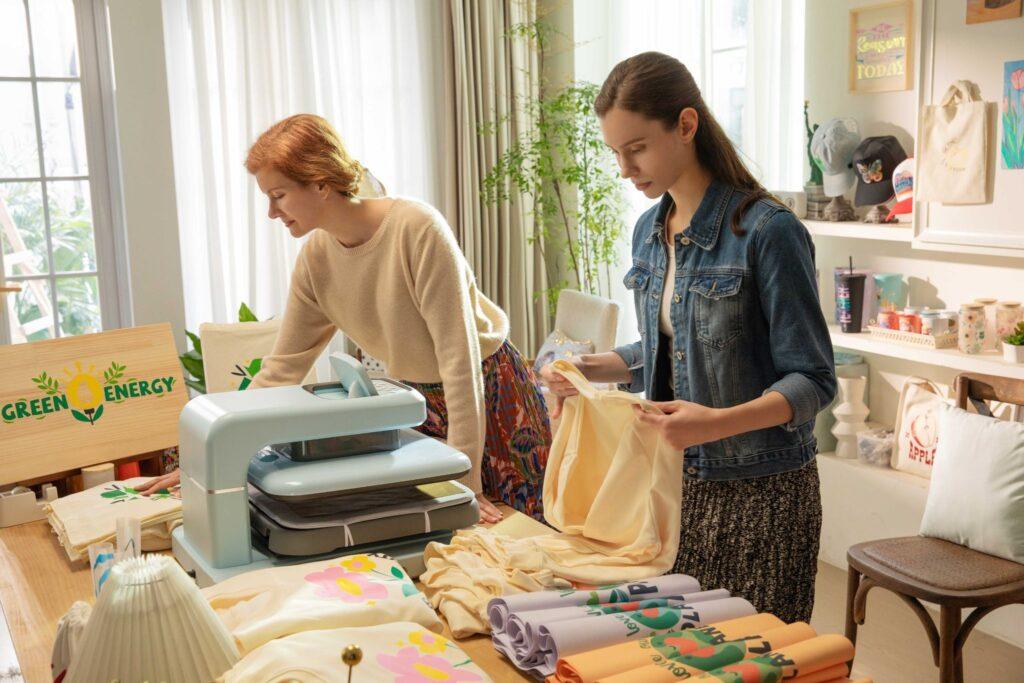
You need two things: a heat press for shirts and some heat transfer vinyl for shirts. That’s it. With that setup, you can go from an online order to a finished shirt in about 10 minutes.
Here’s why that matters. Traditional screen printing requires expensive setup and minimum orders—usually hundreds of shirts. If you’re a small business owner, that means gambling. You order 500 shirts hoping to sell maybe 100. The rest sit in your garage, then eventually go to a landfill.
Heat transfer has none of that. No setup cost. No minimum. One order? One shirt. Fifty orders? Fifty shirts. Zero inventory. Zero waste.
The process is dead simple. Cut the vinyl into your design. Peel off the extra. Put it on the shirt. Press it with the heat press—about 320°F for 30 seconds. Done. It’s durable, washable, and made only because someone actually wanted it.
Real Companies Doing It Right
Citizen Wolf (Australia)
This B Corp-certified brand built what they call a “Smart Factory” in Sydney. They partnered with Epson to run a system called ZIM—Zero Inventory Merchandise.
Here’s what that means in plain English. A charity or brand can offer dozens of design options. But nothing gets made until a customer pays. No guesswork. No Bullwhip Effect. No waste.
The numbers back it up. New South Wales alone sends 400,000 tons of textile waste to landfill every year. Epson’s local boss, Craig Heckenberg, says the Smart Factory model is a real step toward fixing that.
HTVRont (China to Global)
Then there’s HTVRont. They started in 2018 making heat presses for home users. Before that, heat presses were big, expensive industrial machines. HTVRont made them small, smart, and affordable.
In 2022, they launched an automatic heat press on Kickstarter. It had one-button operation and smart temperature control. The campaign raised nearly a million dollars in 45 days.
Today, their lineup includes a HTVRont cutting machine that works with heat transfer vinyl for shirts. You design something on your computer, the machine cuts it out perfectly, and you press it onto a shirt. No manual trimming. No special skills.
Their revenue tells the story:
7 million in 2019,
7 million in 2019, 3.5 million in 2020, over $70 million in 2021. More than 95% of their sales come from outside China. That’s a lot of people choosing to make shirts one at a time.
Three Ways On-Demand Production Cuts Waste
1. No more “made but never sold”
Think about event T-shirts. In the old model, you print 500 shirts for a festival. If it rains and only 200 people show up? You’ve got 300 shirts nobody wants. They’re trash before anyone even wore them.
On-demand flips that. You print one shirt when someone buys one ticket. No extras. No Bullwhip Effect amplifying a tiny guess into a mountain of waste.
2. Less water, less chemicals
Direct-to-garment printing uses water-based inks. No toxic baths. No massive water consumption. Plus, you can print closer to the customer. That means less shipping, lower carbon footprint.
3. Shirts can get a second life
Here’s something most people don’t know. Heat transfer vinyl for shirts can be removed. If a shirt is still good but the design is old or damaged, you can heat it up, peel off the old vinyl, and press on a new design. Suddenly, that shirt isn’t trash. It’s inventory again.
But It’s Not Perfect
Let’s be honest. On-demand has some real downsides.
Cost per shirt is higher than mass production. If you need 10,000 identical shirts for a chain store, screen printing is still cheaper. On-demand only makes sense for small runs and custom work.
Shipping emissions can be tricky. Sometimes it’s better to make 10,000 shirts in one factory and send them on one boat than to make 100 shirts in 10 different cities and ship them separately. Printful tries to solve this with multiple warehouses in the U.S. and Europe. But it’s not a perfect fix.
Material limits. Heat transfer works great on cotton. Not so much on silk, wool, or high-tech athletic fabrics. And the quality varies a lot—cheap vinyl peels off after a few washes.
Where Things Are Headed
On-demand isn’t going to replace H&M or Zara anytime soon. But it doesn’t have to.
The global DIY market is huge—about
800 billion in 2024, heading toward
800 billion in 2024, heading toward 950 billion by 2029. More people want personalized stuff. More people want to start their own small brands. And more people don’t want to feel guilty about throwing away unsold inventory.
Policymakers are paying attention too. The EU is pushing new rules that would force fashion brands to make clothes that last longer and are easier to repair. Some U.S. states are looking at similar laws.
The Bottom Line
Look, the Bullwhip Effect isn’t anyone’s fault. That’s just how traditional supply chains work. Someone orders a few extra “just to be safe.” Someone else does the same. By the time it all trickles down to the factory? Boom. A huge overproduction order.
On-demand cuts through all that nonsense. No guessing. No “just to be safe.” Just: someone bought it, so someone made it.
A heat press for shirts and some heat transfer vinyl for shirts? Not exactly high-tech. But they let you run a real business with zero waste. No boxes of unsold shirts in your garage. No guilt about tossing them in a landfill. Just shirts that actual human beings asked for.
Millions of tons of clothes get trashed every year. Breaking the Bullwhip Effect? That’s a pretty good place to start.