Whilst in principle all fibre-based packaging is recyclable, innovations in material development to cater for the breadth of use can make some products more challenging to recycle. This means basic recyclability assessments based on visual or simple compositional analysis are no longer sufficient to capture the complexities of the recycling process and accurately reflect the true recyclability of packaging. In fact, over-simplified assessment could result in unintended environmental consequences, such as packaging being sent to incorrect recycling facilities or increased waste and contamination. Such oversights could impede progress toward a circular economy and disrupt the recycling supply chain for businesses.
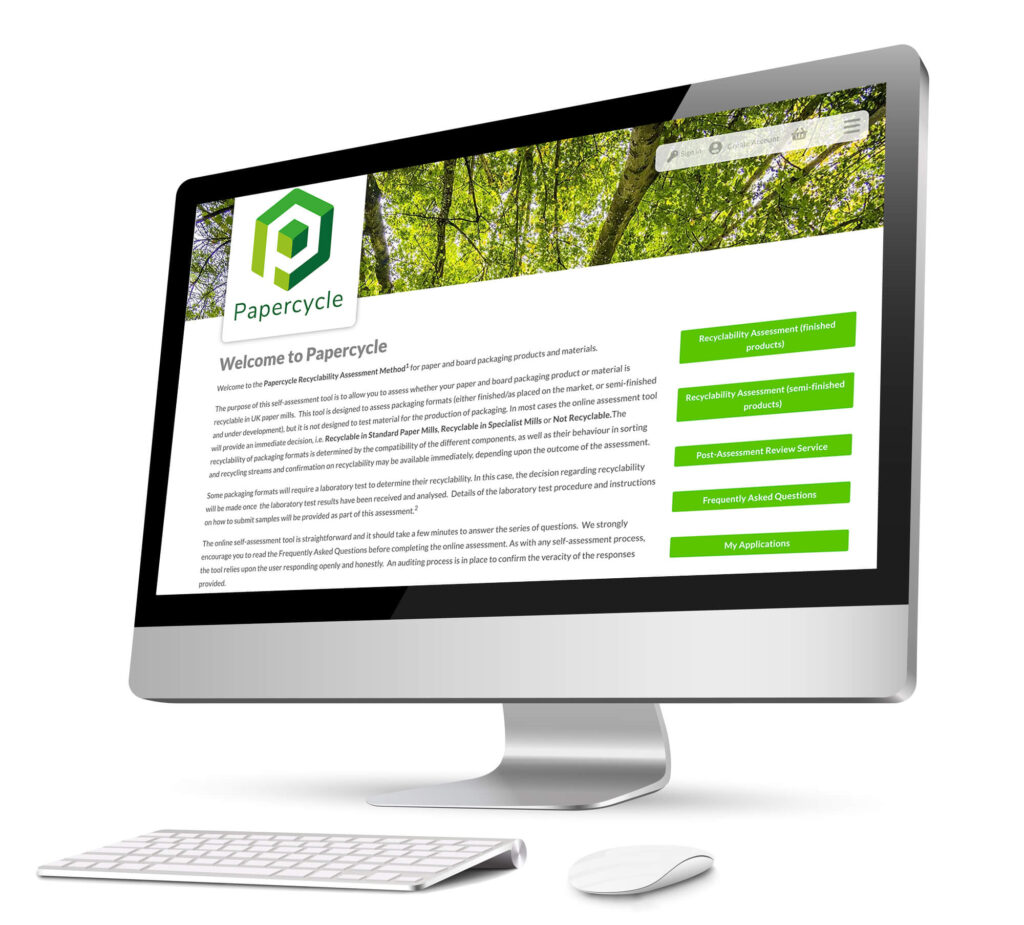
To address this, The Confederation of Paper Industries considered local and European industry standards and engaged extensively with stakeholders who are advising on permissible non-fibre levels and parameters to develop Papercycle.
Papercycle is a ground-breaking recyclability assessment and certification service for fibre-based packaging products and materials for the UK and beyond. Supported by the UK’s Paper-based Industries, it enables producers to innovate armed with ‘real knowledge’ of the recycling loop, which will help keep fibre-based materials from packaging in use for as long as possible, contributing to a more sustainable future.
Papercycle’s comprehensive, automated online tool assesses the recyclability instantly following an online assessment, in a consistent and credible way. It also identifies which type of recycling mills can reprocess them. Recyclability can be tested at any stage, be it finished or semi-finished products.
For more complex products or materials, Papercycle can conduct timely laboratory testing under the Confederation of European Paper Industries (Cepi) recyclability test method. Following a laboratory test, Papercycle can also provide a technical review service on how a product behaves under lab conditions to give an insight into how the various components interact with each other, diagnose the most critical parts and signpost potential solutions for material modification. Papercycle can thus help prepare fibre-based packaging for certification and expansion in the UK and other markets, subject to local variations and requirements.
Furthermore, with Extended Producer Responsibility (EPR) legislation on the horizon, Papercycle’s new service could not arrive at a better time. Papercycle’s certification service could enable a standardised labeling system where customers could receive a ‘recycle’ label as will be required by the UK’s mandatory recyclability labeling on packaging. Packaging certified as “recyclable” will also attract lower Producer Responsibility (modulated) Fees associated with complying with the reformed Packaging Waste Regulations. Furthermore, for consumers, Papercycle can help avoid confusion on what can and cannot be recycled.
Dimitra Rappou, CPI Director of Recycling, said: “As packaging materials have become increasingly complex, we have seen growing confusion over the recyclability of materials, with an over simplified assessment approach threatening the quality of recycling. Papercycle’s new service can remove the uncertainty faced by packaging designers, brands, retailers, and policy makers on the recyclability of fibre-based products. We see this playing a crucial role in promoting a circular economy for fibre-based packaging, helping to reduce waste and lower carbon emissions by keeping materials in use for longer. By providing accurate information on recyclability, Papercycle enables brands and manufacturers to design and develop packaging solutions that contribute to a more sustainable future.”