Sustainability in manufacturing goes beyond recycling bins on the shop floor. The real gains come from systems that reduce material waste, cut energy consumption, and produce more with fewer resources per part.

CNC machine tending turnkeys are delivering exactly that kind of impact. By automating the loading, machining, and unloading cycle, these systems eliminate the inefficiencies that waste materials, energy, and human effort on every production run.
Why Does CNC Automation Reduce Material Waste?
Consistent machining produces consistent parts, and consistent parts mean fewer rejects. When an automated system loads every blank in the same position with the same clamping force, the dimensional variation that causes scrap drops dramatically.
Manual loading introduces human variability. An operator who is tired, rushed, or distracted may position a part slightly off-center or under-clamp it. That shift of a few thousandths of an inch can push a finished dimension out of tolerance. The part becomes scrap, and the raw material that went into it is wasted.
According to the Environmental Protection Agency, manufacturing process waste accounts for a significant share of industrial environmental impact. Reducing scrap rates by even a few percentage points translates to measurable reductions in raw material consumption, machining fluid use, and disposal costs. For shops machining expensive alloys like titanium or Inconel, each scrapped part represents hundreds of dollars in wasted material.
How Does Automation Lower Energy Consumption?
Automated CNC cells run more efficiently than manually operated ones. Here is how the energy savings add up.
- Higher spindle utilization means the machine produces more parts per kilowatt-hour of electricity consumed. A machine running at 80 percent utilization uses energy far more efficiently than one idling at 30 percent while waiting for manual loading.
- Consistent cycle times eliminate the start-stop patterns that spike energy demand. Smooth, predictable machine operation reduces peak electrical loads.
- Automated systems optimize cutting parameters for each cycle rather than relying on conservative manual settings. Faster feeds and speeds where appropriate reduce total machining time and energy per part.
- Lights-out operation reduces facility-level energy use. Running machines overnight without full lighting, HVAC, and break room power cuts auxiliary energy costs.
- Predictive maintenance enabled by automation data catches worn tools and failing components before they cause energy-wasting problems like excessive vibration or repeated recutting.
- Reduced scrap means fewer parts need to be remade, eliminating the energy spent machining replacements for rejected pieces.
According to the U.S. Department of Energy, electric motor-driven systems (including CNC spindles) account for approximately 70 percent of industrial electricity consumption. Any improvement in how efficiently those motors operate creates meaningful energy savings.
What Role Does Automation Play in Lean Manufacturing?
Lean manufacturing principles target waste in all its forms: overproduction, waiting, transport, overprocessing, inventory, motion, and defects. CNC automation directly addresses at least four of these categories.
Waiting time drops because the machine never pauses for an operator to load the next part. Motion waste disappears because automated loading follows the shortest, most efficient path every cycle. Defect rates fall because consistent workholding eliminates human-introduced variation. Overproduction risk decreases because automated systems can be programmed to produce exact batch quantities and stop.
The environmental benefit of lean automation is that every eliminated waste category also reduces resource consumption. Less waiting means less idle energy use. Fewer defects mean less material waste. Lower overproduction means less excess inventory sitting in storage consuming space and resources.
How Do Turnkey Systems Simplify the Path to Sustainable Machining?
Not every shop has the engineering capacity to design an automation system from scratch. Turnkey solutions handle the complexity.
- Assessment: The provider evaluates your current parts, machines, and production volumes to design a system matched to your specific needs.
- Custom engineering: Gripper jaws, vise configurations, and part staging are designed for your exact part geometries. No generic compromises.
- Installation and integration: The system mounts on your existing CNC equipment with minimal modifications. Most installations complete in under a week.
- Program development: CNC programs include the automated loading sequence, so the entire cycle runs from a single program.
- Operator training: Your team learns to run and maintain the system independently, building internal capability rather than ongoing vendor dependence.
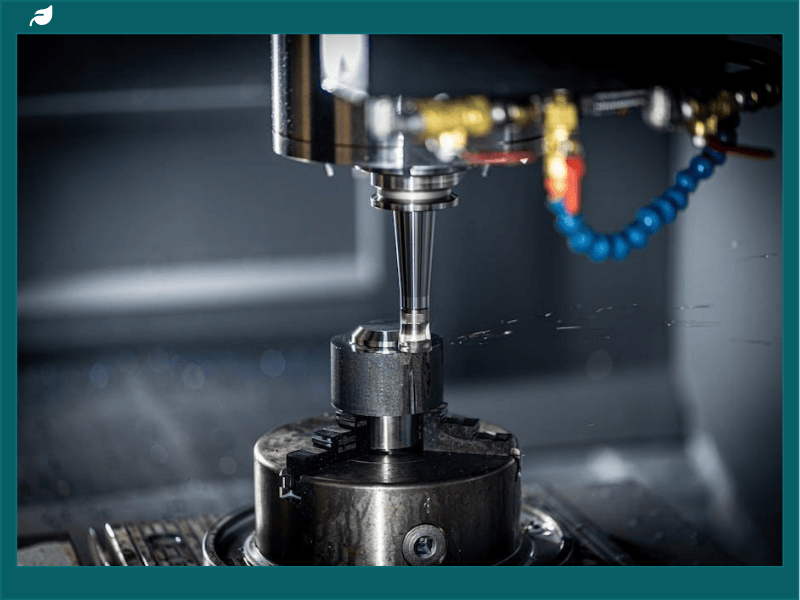
Photo by Daniel Smyth on Pexels
The turnkey model reduces the barrier to entry for shops that want automation benefits without hiring automation engineers.
Can Small Manufacturers Afford Sustainable Automation?
Yes. The misconception that automation only pays off for large operations ignores the reality that small shops often have the most to gain.
A five-person job shop that automates two CNC machines can run those machines through a second shift without hiring additional staff. The cost of a turnkey system ($15,000 to $50,000 per machine) often pays for itself within a year through increased output and reduced scrap. The sustainability benefits, less waste and lower energy per part, come as a bonus on top of the financial return.
Government incentives also help offset costs. Many states and the federal government offer tax credits and grants for manufacturers investing in energy-efficient equipment and process improvements. The Department of Energy‘s Manufacturing Extension Partnership program provides technical assistance to small manufacturers pursuing efficiency upgrades.
Sustainable Manufacturing Takeaways
- Automated CNC workholding reduces scrap by eliminating human variability in part loading.
- Higher spindle utilization means more parts per kilowatt-hour of energy consumed.
- Lean principles and automation overlap: both target waste reduction across the production cycle.
- Turnkey systems make automation accessible to shops without in-house engineering teams.
- Small manufacturers often see the fastest ROI from automation due to proportionally larger labor savings.
- Government incentives and tax credits can offset a significant portion of automation investment costs.
Building a Greener Shop Floor
Sustainable manufacturing is not about choosing between profitability and environmental responsibility. Automation proves that the two goals reinforce each other. The same systems that reduce scrap and energy waste also increase output and lower cost per part. That alignment is what makes CNC automation one of the most practical sustainability investments a manufacturer can make.
FAQ
How much scrap reduction can CNC automation achieve?
Shops typically report 30 to 50 percent reductions in scrap rates after implementing automated workholding. The improvement comes from eliminating the part-to-part variation caused by manual loading.
Does lights-out manufacturing actually save energy?
Yes. Running machines overnight without full facility lighting, climate control, and break room power reduces auxiliary energy consumption by 20 to 40 percent compared to staffed shifts.
Are there government incentives for manufacturing automation?
Many states offer tax credits for capital equipment purchases that improve energy efficiency. The federal Manufacturing Extension Partnership program also provides technical and financial assistance to small manufacturers.
How long does it take to implement a turnkey CNC automation system?
Most turnkey installations complete in two to five days of on-site work. The full timeline from assessment to production-ready operation typically runs four to eight weeks including design, fabrication, and shipping.