Epson has set out a long-term strategy to reduce the environmental impact of its products, with a focus on low energy consumption, minimal waste and high reliability. The company’s Environmental Vision 2050 includes targets to become carbon negative and eliminate the use of non-renewable underground resources.
This direction is underpinned by a design philosophy known as “Sho-Sho-Sei”, which centres on developing technologies that are efficient, compact and precise. The approach has informed Epson’s product development over several decades, with an emphasis on removing unnecessary components to improve performance and reduce resource use.
A key example of this philosophy is Epson’s PrecisionCore Heat-Free technology, used across its business inkjet printer portfolio. Unlike conventional laser printing, the technology avoids the use of heat in the ink ejection process, which contributes to lower energy consumption and fewer mechanical components.
Epson’s range of business inkjet printers has been developed to align with corporate sustainability objectives. The devices are designed to require fewer maintenance parts and service interventions, while maintaining productivity in office environments. Reduced power usage and a smaller physical footprint are also central to the design.
The printers use liquid-based pigment inks rather than traditional toner powder. This removes the need for plastic-based toner cartridges, resulting in a lower plastic footprint compared with laser printing systems. Epson states that its inks are non-toxic, fast-drying and resistant to fading.
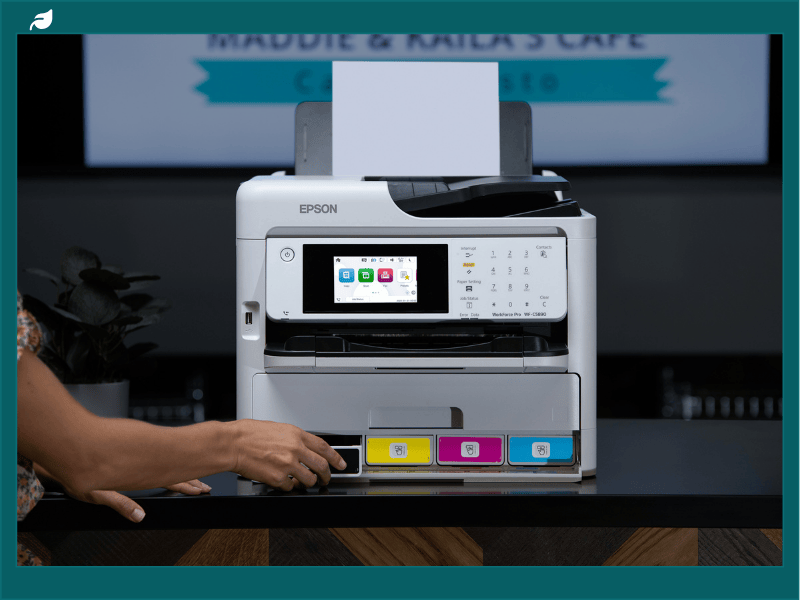
Within this portfolio, the WorkForce Pro WF-C5890 colour multifunction printer has been developed for high-volume business use. The device is designed with a limited number of moving parts, supporting lower maintenance requirements and more consistent operation in shared office settings.
The WF-C5890 incorporates a Replaceable Ink Pack System intended to reduce the frequency of consumable changes. The system enables printing of up to 5,000 ISO pages using replacement ink packs, while Epson states that businesses can achieve cost savings of up to 50% on replacement ink compared with colour laser toner, depending on usage.
The device supports print, copy, scan and fax functions, with a recommended monthly print volume of 5,000 pages. It is designed to produce high-resolution text and colour output across a range of media types, while maintaining operational efficiency through its compact form and simplified internal structure.
One customer using the WF-C5890 in an office environment reported consistent performance following the replacement of a previous laser multifunction printer. “The WF-C5890 has been a stress-free replacement for one of our office’s laser MFPs that had consistent issues and service troubles. We have roughly 20 employees using the Epson printer and it has been a reliable MFP for our office, producing high-quality surgical discharge paperwork, certificates and related documents for clients.”
The WF-C5890 has also received industry recognition. It was awarded a Buyers Lab 2025 A4 Pick Award from Keypoint Intelligence, with evaluators noting its performance, workflow capabilities and image quality. The device was also named a Platinum winner in the Spaces4Learning New Product Awards within the Technology – Printing and Imaging category, recognising its energy efficiency and suitability for high-demand environments.
As organisations face increasing scrutiny around energy use and material consumption, printing infrastructure remains an area of operational focus. Technologies that reduce power requirements, consumable waste and maintenance needs are becoming part of broader efforts to improve environmental performance across office environments.
Epson’s development of Heat-Free printing technology and its wider product strategy reflect this shift. By reducing reliance on heat and simplifying mechanical design, the company is positioning its printing solutions within a framework that links operational efficiency with environmental targets.