Sustainable Business Magazine speaks to Danielle McCartney, Head of Sustainability at the University of Technology Sydney, about how it is leveraging technology to improve the institution’s carbon footprint and social impact.
The University of Technology Sydney (UTS) was founded in 1988 and today is a large institution with approximately 45,000 students. Located within Sydney’s central business district, the campus is well connected to the city and its buildings have become a significant part of Sydney’s skyline.
Danielle McCartney is Head of Sustainability at UTS and explains to Sustainable Business Magazine how she has helped the university walk the talk on sustainability since she came on board:
“Sustainability at UTS has evolved over the past 15 years from a narrow view addressing only the environmental aspects of the university’s operations to taking a whole of institution approach encompassing the environmental, social and economic aspects of sustainability as applied to all areas of the university, particularly its core business of education, research and operations.”
“The university executive has demonstrated a high level of commitment to sustainability by ensuring that it is embedded in strategic documents, governance structures and management procedures. Equally the active support of staff, students, partners, industry and the community has led to continual improvement in all areas of sustainability.”
”As an active member of Australasian Campuses Towards Sustainability (ACTS), UTS has undertaken significant efforts to turn its presence into an environmentally and socially positive one for Australia’s biggest city.
New technology
Ms. McCartney goes on to talk about the Sustainability Strategy that the university is implementing at the moment:
“We’ve undertaken three Sustainability Strategies over the past decade, each one lasting about three to five years. Our latest Strategy was approved in 2023 and will continue until 2027. It covers three domains; education, research and operations and there are a number of priority actions in each of these domains that we are implementing. For example, embedding sustainability into the curriculum and focusing on finding practical solutions to global challenges like climate change in our research. When it comes to operations, we are focusing on reducing our carbon emissions, reducing water consumption and implementing circular economy principles.
“We also have a Climate Positive Plan with staged Net Zero targets. In 2025, we want to achieve Net Zero for scope one and scope two emissions. For UTS this is mostly emissions from our gas and electricity usage. Our other 2025 target is for the university to be supplied with 100% renewable electricity. Being based in the heart of the city UTS is mostly a vertical campus with limited roof space however we’ve installed solar arrays to seven of our buildings. We’ve maximised the amount of solar we can have on our campus rooftops, so we now have off-site Power Purchase Agreements (PPAs) with solar and wind farms. In fact UTS was the first organisation in Australia to sign a direct PPA with a solar farm back in 2015 and this has since been widely replicated by other industry sectors. All of these initiatives are helping us to meet our 2025 targets.”
Unsurprisingly, as a technology university, UTS is also trying to make use of the best technology it can to make its campus as sustainable as possible.
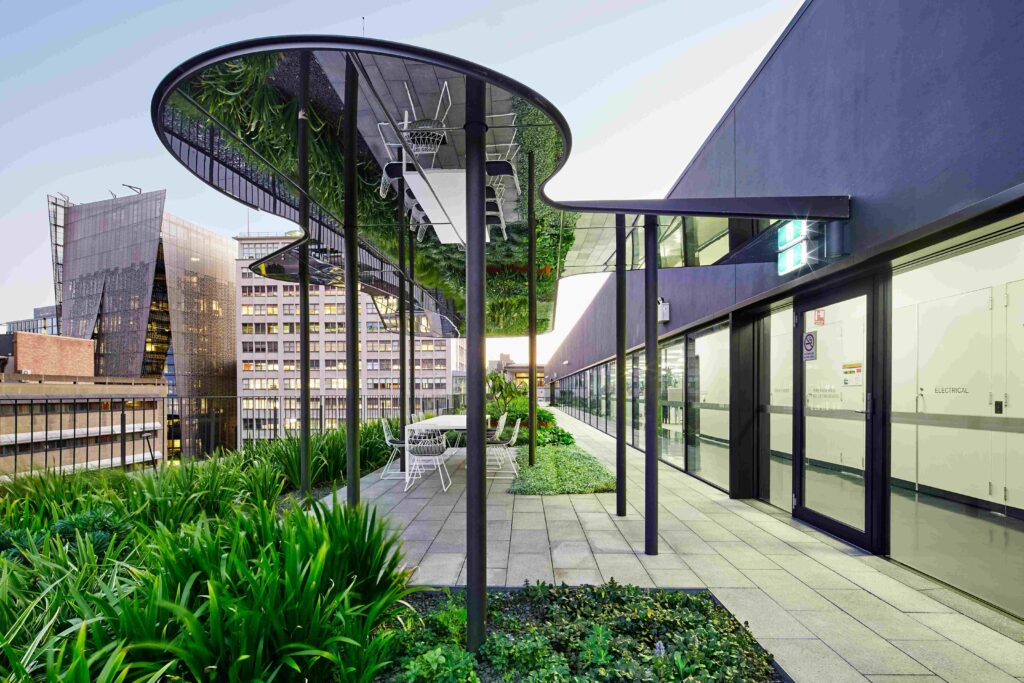
“UTS has just completed a decade long Aus$1.4B campus Master Plan, including four new 5 and 6 star Green Star certified buildings. These buildings contain a number of sustainable design and engineering features, including renewable energy, stormwater recycling systems, green roofs, district cooling, and our international award-winning plastic-free food court. Planning is now underway for the National First Nations College, the first comprehensive Indigenous residential college in Australia. As well as offering accommodation it will represent Indigenous identity and culture.”
“There are many projects underway that will help us along our journey towards Net Zero,” says Ms. McCartney. “There is a battery being installed in one of our buildings right now which will help to manage peak demand, ensuring reliable power supply during peak times, taking the pressure off the grid and lowering bills for the university.
“The other project underway currently is the upgrade of our energy and water monitoring system. The campus sub-meters are being reviewed and the central platform replaced enabling visibility over consumption right across the campus. Hopefully the new technology will bring further opportunities to reduce energy and water use and improve our carbon footprint.”
Led by the people
As well as the environmental aspects of sustainability, UTS is placing a strong emphasis on social sustainability.
“We have the Centre for Social Justice and Inclusion (CSJI) at UTS, and it has been responsible for developing a Social Impact Framework. The Framework aims to increase university access and success among equity target groups, build student agency to enact personal and social responsibility, and support staff to maximise their social impact. CSJI’s Social Impact Dashboards collate data from across the spectrum of the university’s activities to measure progress against the social justice goals outlined in the Social Impact Framework. They demonstrate UTS’s contribution to society and our own equity goals, and they identify areas where the university needs to improve. Currently available to UTS staff and students, the Dashboards offer transparency and they empower the university community to uncover issues and instigate change.
“UTS is one of two Australian universities to be awarded the prestigious Carnegie Community Engagement Classification, achieving it in 2023. The Classification allows universities to demonstrate commitment to serving communities and to share good practice in the sector. It has been the leading framework for institutional assessment and recognition of community engagement in US higher education for the past 15 years and UTS, with Charles Sturt University, co-led the Australian pilot with ten participating universities and a further seven “observer” universities. The Classification will shape an Australian framework to magnify impact nationally.
“UTS Shopfront is one of the university’s key programs championing social justice and social change. In the program students take on the role of external ‘consultants’ who work in small teams to respond to project briefs from community organisations, providing expertise and skills to address organisational capability gaps. Shopfront’s impact is far-reaching; the team has delivered 1,614 projects to 1,115 community organisations, and in 2023 the program worked with 2,185 students. Shopfront has been running for many years and is an excellent program where students gain real-world experience and make a meaningful difference.”
Ms. McCartney explains that student advocacy and campaigns on campus have assisted the university’s sustainability efforts:
“Students have an important voice and are represented on our Sustainability Steering Committee where they communicate their concerns and assist in steering the strategic direction of sustainability at UTS. In the past, the students have carried out campaigns on renewable energy that resulted in UTS declaring a 2025 target for the university to be supplied with 100% renewable electricity and also advocated for divestment from fossil fuels in UTS’s investments, which was achieved in 2022. Students are the main stakeholders of our university and they help light the way forward.
“One of the issues being discussed widely across the university is food insecurity and the high cost of food for students. Food insecurity amidst Australia’s cost-of-living crisis has consequences, including poor health due to lower dietary variety and nutrition levels, a ‘heat or eat’ trade-off, psychological distress, and poorer academic performance.
“The Bluebird Brekkie Bar was established fourteen years ago by students for students . It is a free breakfast program with food sourced locally and sustainably that’s run twice a week by the UTS Students’ Association and student volunteers The Bluebird Brekkie bar won an International Green Gown Award in 2012, demonstrating how student leadership can deliver sustainable outcomes.
“More recently, they’ve expanded that service to the Night Owl Noodle Bar, which is also free and runs twice a week. Together the Bluebird Brekkie Bar and Night Owl Noodle Bar serve around 4,000 free meals on campus per week. The students have also opened up the Bluebird Pantry, a food bank with a grocery shop-style layout, to assist students facing financial hardship.”
Staff and student engagement on sustainability is strong at UTS with events such as Green Week for students, Climate Week and the Climate Connect forum for researchers, and Global Goals Month in September which celebrates the university’s contribution to the United Nations Sustainable Development Goals. Global Goals Month first started as a week-long event 3 years ago and has now expanded into a month-long event with activities engaging students, staff and the community including a launch event, 14 Chats for the Goals, activities in the exhibition space, a scavenger hunt and photo competition.
Camaraderie and generosity
ACTS has played an important role in supporting UTS with its sustainability efforts, providing space for the university to discuss important issues and find solutions.
“ACTS is a fantastic organisation,” says Ms. McCartney. “It has come a long way in the last two decades from a grassroots effort by volunteers into the well-respected substantial member-led network that it is today. Rhiannon Boyd, the CEO of ACTS, is extremely capable and, with her dedicated team of staff members and volunteers, she recently delivered a fantastic conference and awards ceremony in Launceston, Tasmania, the first in-person conference we’ve had since before COVID-19. It was great to see everyone again, meet new people working in sustainability in tertiary institutions and strengthen our networks.
“ACTS, with its conference and member events, is a very collaborative forum. ACTS members are a network of passionate people working towards meaningful change and sustainability outcomes. Right now the Australian tertiary education sector is facing a number of challenges including the government’s proposed caps on international student enrolments at a time when universities are just getting back on their feet after COVID-19. Most of us are struggling with resources and share information and insights where we can. The sense of camaraderie and willingness to share information was a big relief and source of motivation and inspiration.
ACTS is going from strength to strength, growing the community of educators and practitioners, building cross-sector and global partnerships, and supporting institutions towards a more sustainable future.
“UTS was recognised at the 2024 Australasian Green Gown Awards winning the Sustainability Institution of the Year Award. This achievement celebrates years of effort by many within the UTS community to make a positive difference and centre the protection of the natural environment and working towards the public good in our learning, teaching and research. It also shows the importance of strategy and long-term planning in crafting an effective commitment to sustainability.“
Climate Positive
Looking forwards, UTS has plenty in the pipeline when it comes to sustainability.
It will focus on embedding sustainability into the curriculum and reducing scope three emissions..
“Scope three, that is the emissions as a result of the university’s procurement of goods and services, is a huge area of opportunity,” explains Ms. McCartney. “Our Sustainability Strategy has a priority action around strategic procurement including better understanding the university’s supply chain sustainability, updating policies and procedures to guide procurement decisions and buying behaviour, embedding sustainability requirements into tenders and new commercial and retail leases, and working with suppliers to reduce their environmental footprint.
“We’ve got a target of being Net Zero for scope one, two and three by 2029. Scope three represents a significant proportion of our emissions so we’re going to start working with our suppliers over the next few years to help reduce emissions.
“In Australia, mandatory climate-related financial disclosure legislation is imminent for the tertiary education sector so understanding climate risks and mitigation strategies is key. UTS has undertaken a Climate Change Risk Assessment and Adaptation Action Plan and is developing a management plan to respond to the identified risks.“UTS was the first Australian university to declare a Climate Emergency in 2019, taking action on climate change by developing our Climate Positive Plan. UTS has committed to achieving Net Zero for scope one, two and three emissions, and being certified Carbon Neutral by 2029. These are pretty ambitious targets that we are steadfastly working towards. Our vision
is that UTS’s net impact is positive for the
global climate.”