Turning Motorsport Waste into Fashion
When lockdown left University of Brighton student Alex Witty without a workshop, he improvised. His bedroom became a lab, complete with panini presses repurposed to melt unconventional materials like ocean plastics, seaweed, and coffee. But it was discarded motorsport tyres that would steer Witty toward a new business: sustainable sneakers made from shredded racing tyres.
Compound Footwear, founded by the 27-year-old Bath-based inventor, has now launched its first line of limited-edition trainers crafted from Formula One and motorsport racing tyres. Backed by a £25,000 Start Up Loan through SWIG Finance, Witty’s brand is marrying two high-waste industries — footwear and motorsport — into one circular product.
“Twenty-four billion shoes are made every year, while around 1.5 billion tyres are used globally,” Witty explains. “When tyres reach the end of their life, they are generally incinerated at concrete factories as an alternative source of fuel. As around 80 per cent of the shoes are made from rubber, I wondered: why not merge the two streams and try to negate the cost and the waste of tyre disposal?”
From Bedroom Experiments to Global Launch
Witty’s entrepreneurial journey exemplifies the intersection of sustainability and design. With a BSc in sustainable product design and over £100,000 raised through grants and private investment, he developed Compound Footwear while building relationships with motorsport giants like McLaren, Ferrari, Mercedes, BMW, and tyre manufacturer Pirelli.
The production process involves shredding tyres via a Northampton-based specialist. The resulting pure rubber powder is then reformed into sneaker soles. The uppers incorporate recycled leather and polyester, and subtle design cues reference Formula One’s aerodynamic features, including front and rear wings and ERS tail lights.
Manufactured in Portugal, the brand’s debut model – the Monte Carlo C1 – was soft-launched in London through a pop-up event in February 2025. Each of the first 100 pairs includes a custom swing tag embedded with genuine carbon fibre from Williams Racing Formula 1’s 2024 season cars. Buyers span as far as the USA and Australia, highlighting a global appetite for both sustainable fashion and motorsport memorabilia.
Eco Innovation in Context
Compound Footwear enters a growing market of sustainable footwear. Brands like Allbirds and Veja have gained traction using bio-based or recycled materials. But Witty’s use of motorsport tyres adds a distinctive industrial upcycling angle. According to the World Business Council for Sustainable Development, over one billion tyres reach the end of their life annually, presenting a significant environmental challenge.
While some tyres are recycled into playground surfaces or alternative fuels, transforming them into consumer fashion is relatively novel. This approach aligns with broader circular economy goals gaining ground across industries.
“Shoe production often overlooks the end-of-life stage,” notes Jane Clark, a sustainability analyst specialising in circular product design. “Using tyre rubber is not only innovative but tackles a serious waste stream while creating a premium, durable product.”
Celebrity Endorsements and Industry Links
Witty’s family background in motorsport helped open some doors. His father, Chris Witty, worked alongside Ayrton Senna in the 1980s. That legacy may have eased introductions, but Witty emphasizes the hard work required to get noticed.
“Nothing has come on a silver platter. Funding has been tough at the best of times; shoes are expensive to make, and you have to make a lot of them to get manufacturers to listen to you.”
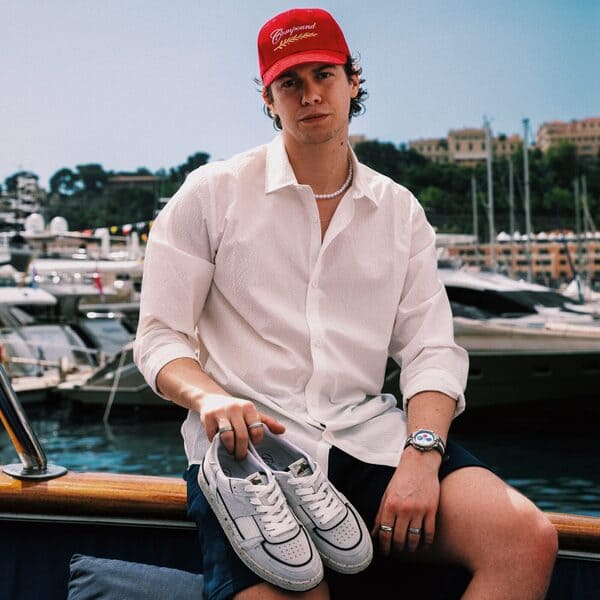
Visibility in the racing world has been a key part of Compound’s strategy. French Formula One driver Pierre Gasly has been spotted wearing the brand’s trainers at Grand Prix events. Swedish driver Joel Granfors carried the Compound logo on his car during the Le Mans 24 Hours race in June.
“With our demographic and clientele, it works well to be seen out there,” says Witty. “There are currently 20 Formula 1 drivers in the 2025 season, so to have five per cent wearing your clothes is a success story for us.”
Financing a One-Person Operation
Despite celebrity endorsements, the business remains a solo operation for now. Witty manages everything from accounting and marketing to photography and website design.
“It makes for very long days, and if I’m busy marketing, I’m slow at shipping out shoes,” he admits. “It would be nice to have a team around me and to be able to work 9 to 6 and help optimise our fulfilment.”
The Start Up Loan from SWIG Finance played a pivotal role. “I needed to upfront some cash to start generating revenue from sales, and didn’t have personal funds to draw upon,” Witty says. “I spoke to various financial outlets, and SWIG and Start Up Loans popped up constantly as the place to go for young entrepreneurs to take their first big steps in business.”
Suzy Lowe, Start Up Loans Senior Officer at SWIG Finance, worked directly with Witty. “Compound Footwear is a really exciting business – a brilliant idea and very well-executed,” she says. “Alex is the loveliest young man, very switched on and so passionate about his project. He’s been a pleasure to work with and it’s an amazing thing to be a part of.”
The loan came in two tranches: the first in February 2024, covering prototyping and market testing, and the second in March 2025, financing the initial product run.
Next Steps: Expansion and Investment
Looking ahead, Witty is developing Compound’s next model, The Sprinter. It will be lighter and more performance-oriented, designed to appeal to both athletes and motorsport fans.
He is also actively seeking external angel investment. “At the moment, it’s just me. It would be nice to have a team around me and to help optimise our fulfilment.”
Given the unique positioning of Compound Footwear within both the fashion and motorsport sectors, it presents an interesting case study in sustainable business innovation. It merges recycling, industrial design, and cultural cachet — a rare combination that might just help this one-man operation expand into a recognised global brand.