In today’s world, where sustainability concerns have taken centre stage, the insidious phenomenon of greenwashing has garnered widespread acknowledgment. This term has become a cornerstone concept for individuals deeply versed in sustainability concerns, requiring minimal introduction. Meanwhile, the repercussions of these deceitful practices extend across a broad spectrum, affecting not only consumers and investors but also exerting a profound impact on the well-being of our planet.
As we look ahead to the arrival of the EU Green Claims Directive next year, it becomes increasingly evident that companies must elevate the seriousness with which they approach their sustainability claims.
In the current landscape, numerous sustainability frameworks exist, often leaving companies puzzled about who is genuinely committed to environmentally responsible practices and whether their efforts align with the urgent need to address climate change. It’s a challenge that extends beyond simply checking boxes; it’s about the substantial and necessary actions required to safeguard our planet.
To combat the prevalence of greenwashing and empower stakeholders to make informed decisions, there is a growing need for a systematic framework to evaluate and expose greenwashing practices.
In this article, I am delighted to introduce Permutable AI’s comprehensive Greenwashing Framework: GreenProof. We will delve into the key criteria for assessing companies’ sustainability claims and explore the importance of criteria such as consistency, communication, transparency, impact, and exposure in evaluating these claims and how they collectively contribute to a company’s greenwashing score.
Scoring and Assessment
Permutable AI‘s GreenProof Greenwashing Framework is a groundbreaking solution developed in collaboration with international regulators. This proprietary framework is structured to systematically assess companies’ sustainability claims and unveil any deceptive practices. It comprises five vital criteria, each playing a pivotal role in evaluating the authenticity of these claims.
The first criterion, Consistency, focuses on assessing the alignment between a company’s sustainability claims and its actual actions. It evaluates whether a company’s practices, policies, and initiatives are congruent with its environmental and social responsibility claims. Authenticity is evident when a company’s actions consistently mirror its sustainability commitments.
The Communication criterion, the second aspect, emphasises the importance of effective communication in conveying a company’s commitment to sustainability. It evaluates how well a company communicates its sustainability efforts to its stakeholders, prioritising transparency and clarity in conveying these messages.
Transparency, the third criterion, forms a fundamental element in greenwashing assessment. It examines the extent to which a company openly shares information about its sustainability practices and the impact of those practices. Transparency is a hallmark of genuine commitment to sustainability, as it involves providing stakeholders with access to data, reports, and other relevant information.
The fourth criterion, Impact, delves into the tangible effects of a company’s sustainability initiatives. It evaluates whether a company’s actions have a measurable and positive impact on the environment, society, and governance practices, making it crucial for companies genuinely committed to sustainability to demonstrate a clear and meaningful impact through their initiatives.
The fifth criterion, Exposure, addresses the visibility of a company’s sustainability claims to stakeholders and the public. Authentic sustainability advocates ensure that their claims are accessible and readily available to those interested in their ESG efforts.
This comprehensive framework provides a comprehensive and structured approach to assess and expose misleading sustainability claims, reinforcing the principles of corporate responsibility and transparency.
Real-World Application
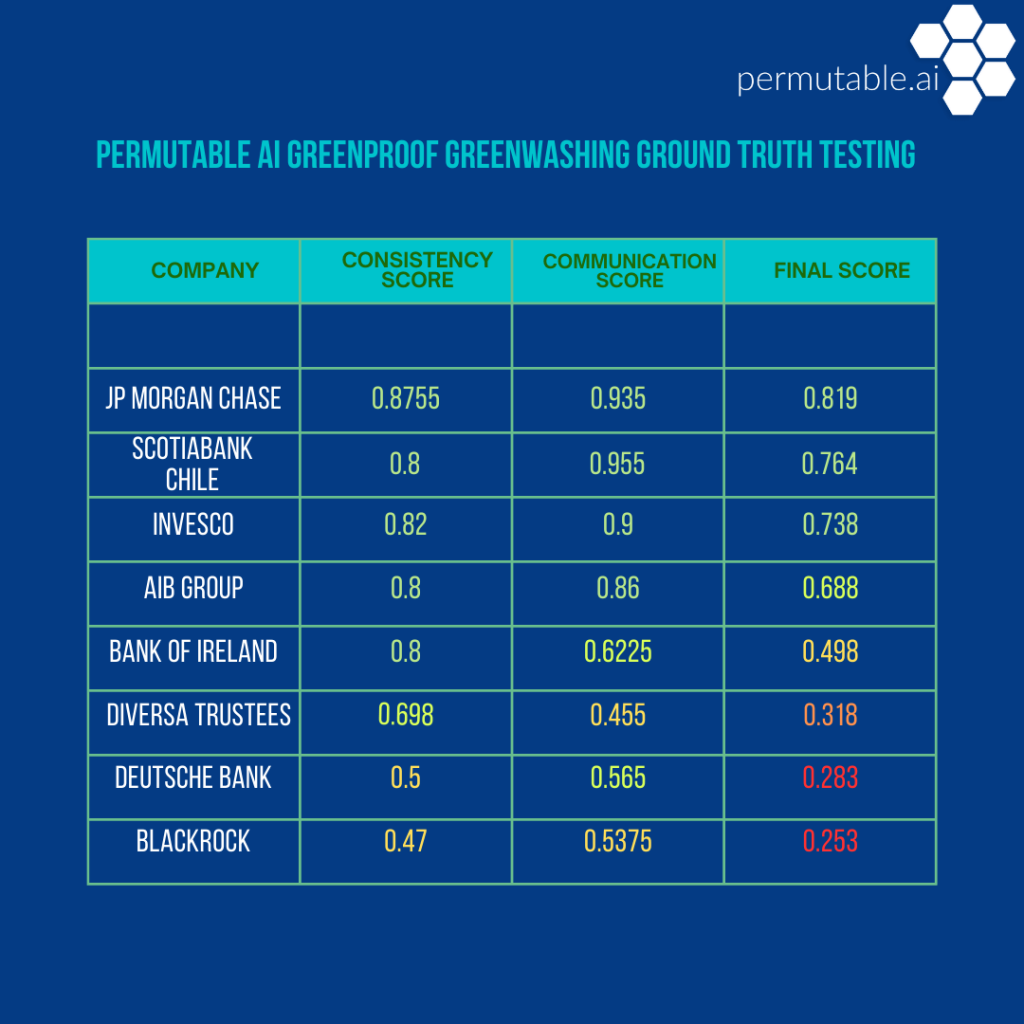
To illustrate the practical application of our GreenProof Greenwashing Evaluation Framework, we examine case studies of companies that have undergone assessment using the framework. These examples highlight the outcomes of these assessments, providing insights into which companies were exposed for greenwashing and why.
Case Study 1: Deutsche Bank
Deutsche Bank, a global financial institution, claimed in 2019 to be a founding signatory of the UN Principles for Responsible Banking. The bank also committed to having its operations powered entirely by renewable energy sources by 2025. However, in 2023, Deutsche Bank faced accusations of greenwashing its sustainable investment products.
The framework assessed Deutsche Bank’s claims and found inconsistencies between its actions and its commitments. While the bank claimed to be dedicated to sustainability, environmental groups discovered that its sustainable investment funds did not meet the standards of true sustainability. This misalignment resulted in a low score in the Consistency criterion.
Moreover, the bank’s communication about its sustainability efforts was not transparent and lacked clarity. This lack of transparency contributed to a lower score in the Communication criterion.
Overall, Deutsche Bank’s greenwashing score, as determined by the framework, reflected its misleading claims and inconsistencies in sustainability practices.
Case Study 2: Diversa Trustees’
Diversa Trustees, an investment management company, claimed to prevent investment in companies involved in polluting and carbon-intensive activities. It also stated its commitment to ethical investing and responsible corporate governance. However, in 2022, the Australian Securities and Investments Commission (ASIC) expressed concerns that Diversa Trustees’ statements regarding its investment screening were too broad and potentially misleading to consumers.
The framework assessed Diversa Trustees’ claims and found that while they aimed to be ethical and responsible investors, their claims lacked specificity and quantifiable data. This vagueness contributed to a lower score in the Communication criterion.
While Diversa Trustees aligned its corporate policies with ESG principles, the absence of clear evidence and transparency regarding its screening process resulted in a low Transparency score.
The framework’s assessment revealed that Diversa Trustees’ claims, though well-intentioned, were too vague and lacked transparency, leading to a greenwashing score that exposed these deficiencies.
Case Study 3: Apple
In contrast to the previous examples, Apple, the technology giant, has consistently received accolades for its sustainability efforts. In 2022, it was voted the 5th best ESG company by investors.com. We subjected Apple’s claims to the framework to evaluate whether they align with the company’s actual practices.
The framework revealed that Apple’s sustainability claims were strongly supported by its actions. The company’s initiatives, such as innovations in manufacturing for environmental friendliness, demonstrated a tangible and positive impact on sustainability.
Furthermore, Apple’s communication about its sustainability efforts was both transparent and highly visible to the public and stakeholders. This transparency and exposure contributed to a high Communication score.
Overall, Apple’s greenwashing score, as assessed by the framework, reflected its genuine commitment to sustainability and alignment with its claims.
The Path Forward
As we navigate the evolving landscape of corporate responsibility and sustainability, Permutable AI’s GreenProof Greenwashing Framework emerges as a vital tool for stakeholders. Its structured approach will enable consumers, investors, and regulators to scrutinize companies’ sustainability claims rigorously.
In our mission to create a more transparent and sustainable corporate world, we invite you to join us on this transformative journey. Your support and involvement are crucial as we work towards making the GreenProof Greenwashing Framework accessible to all stakeholders.
If you are passionate about sustainability, accountability, and driving positive change, we encourage you to get in touch with us today at enquiries@permutable.ai. Whether you’re an investor looking to back this important cause, a company interested in adopting our framework, or an individual eager to learn more, we welcome your inquiries and collaboration.
Together, we can empower individuals and organizations to make informed decisions, expose greenwashing practices, and pave the way for a greener, more responsible future.