As global airports face growing pressure to decarbonize, London Gatwick is working to deliver on its ambitious “Decade of Change” sustainability program, including its pledge to achieve net zero carbon emissions for Scope 1 and 2 by 2030. Central to this transition is the airport’s partnership with Carrier Commercial HVAC, a division of Carrier Global Corporation, which has been entrusted with maintaining and modernizing the airport’s cooling infrastructure.
With tens of millions of passengers passing through each year, Gatwick is the UK’s second-busiest airport. Cooling systems are vital to the functionality of terminals, control centers, and passenger areas. Carrier maintains approximately 50 chillers across both the North and South Terminals, ensuring continuous performance in an environment that cannot afford to shut down.
“As an airport, Gatwick never sleeps. Maintaining the cooling infrastructure requires precision, efficiency and a deep understanding of its needs,” said Adam Wright, Business Development Manager, Carrier Commercial HVAC UK&I. “Any servicing, repairs and upgrades must be carefully planned to avoid any disruption to daily operations. We’ve therefore structured our approach accordingly so we can keep chillers running and performing as required day in, day out.”
A Long-Term Sustainability Partnership
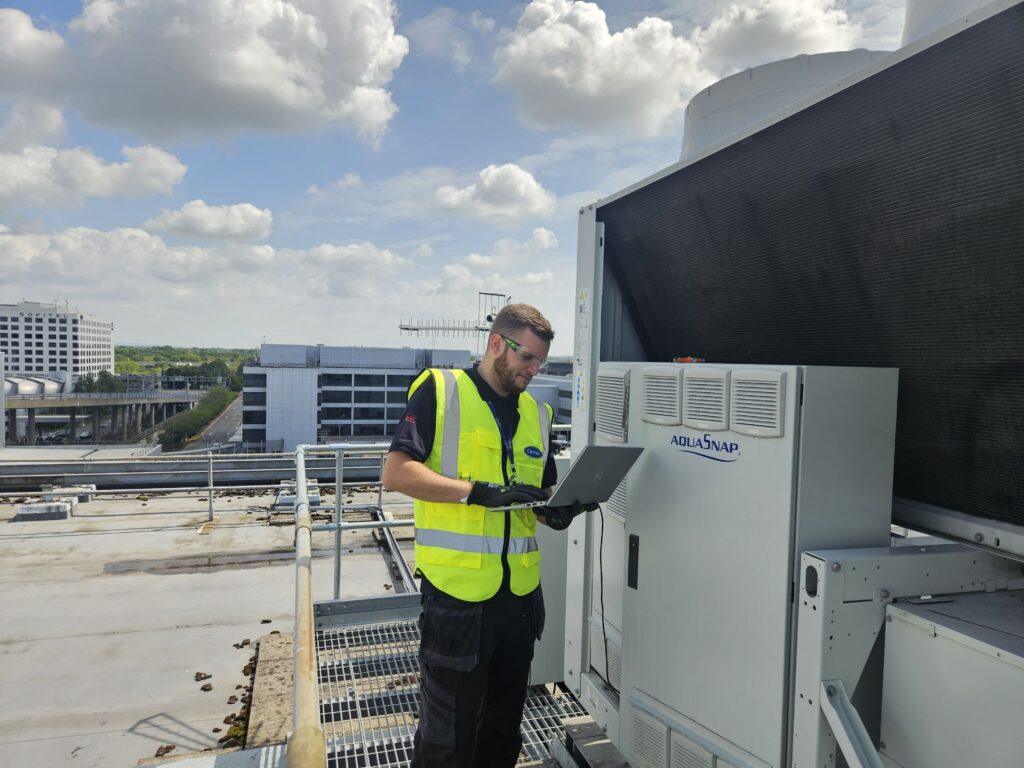
Carrier’s collaboration with Gatwick began with the district cooling plant, but its role expanded significantly in 2018 when it took over full responsibility for the airport’s chiller assets. The service includes both physical and remote support, a comprehensive asset management program, and compliance oversight related to F-Gas regulations and insurance inspections. A dedicated Carrier technician is stationed on-site every day, reflecting the complexity and critical nature of Gatwick’s infrastructure.
In recent years, Carrier’s contribution has gone beyond traditional maintenance. A notable example includes the replacement of an end-of-life chiller at Jubilee House with a Carrier AquaForce® 30XAV unit, which uses PUREtec® HFO R-1234ze – a refrigerant with an ultra-low Global Warming Potential (GWP).
This aligns with industry-wide efforts to transition away from high-GWP refrigerants and reinforces Carrier’s role as not just a service provider, but a key enabler of Gatwick’s low-carbon future.
“By managing our cooling infrastructure and providing expert guidance on F-Gas and insurance inspection requirements, Carrier is a trusted service and maintenance partner,” said Steve Kelso, Head of Engineering, London Gatwick. “Carrier’s solutions and on-going support is also helping us reduce operational expenditure and work towards our 2030 environmental target of achieving net zero for Scope 1 and 2 emissions.”
Airports and the Push for Net Zero
Airports are energy-intensive ecosystems. From HVAC to lighting, baggage handling to runway operations, Scope 1 and 2 emissions account for significant carbon output. According to Airports Council International (ACI), more than 400 airports worldwide have committed to net zero targets by 2050, and several, including Gatwick, have set even earlier deadlines.
For many, heating, ventilation, and air conditioning systems are among the biggest contributors to energy consumption. Upgrading or retrofitting these systems with lower-emission alternatives has become a cornerstone of many airport sustainability strategies.
Carrier’s support fits into this broader global movement. Its remote monitoring capabilities, modern refrigerants, and proactive maintenance services help facilities extend equipment lifespan, reduce leaks, and minimize unplanned energy spikes – all of which contribute to operational efficiency and emissions reduction.
Strategic Upgrades with Long-Term Impact
The modernisation of Gatwick’s HVAC systems also reflects a key shift happening across infrastructure-heavy industries: moving from reactive maintenance to predictive and sustainable asset management.
Carrier’s service model includes digital diagnostics and predictive analytics, allowing for smarter scheduling of repairs and replacements. This reduces downtime risk and ensures systems run at optimal efficiency. While these upgrades offer short-term cost savings, they also set the foundation for long-term environmental gains.
The integration of refrigerants like R-1234ze is another signal of progress. With a GWP of less than 1, this refrigerant offers similar performance to older hydrofluorocarbons (HFCs) but with a dramatically reduced climate impact. As the European Union continues to phase down high-GWP HFCs under the F-Gas Regulation, early adopters like Gatwick stand to benefit from regulatory compliance, reduced carbon footprint, and future-ready infrastructure.
Looking Ahead to 2030
The next phase of Carrier’s engagement will center on helping Gatwick meet its 2030 targets, with more sustainable HVAC solutions likely on the horizon. Carrier has confirmed it will continue offering support not just through equipment upgrades, but also through bespoke sustainability planning.
This partnership is indicative of the broader role HVAC providers are beginning to play in sustainability transitions across critical infrastructure sectors. As airports, hospitals, data centers, and commercial buildings work toward net zero goals, the role of system-level solutions – especially around cooling and energy use – is becoming central.
Carrier’s ongoing work with London Gatwick offers a clear case study of how service providers can become long-term decarbonization partners, supporting complex facilities as they modernize not only for performance, but also for climate responsibility.