Introduction to the Barn Swallow
Watch a barn swallow work a summer field and you’ll understand immediately why people have been writing poems about this bird for three thousand years. It doesn’t just fly. It carves the air into something purposeful, banking hard at the last possible moment, skimming a pond’s surface, then rocketing upward in a move that looks less like a hunting run and more like showing off. The barn swallow is one of the most widespread birds on the planet, found on every continent except Antarctica, and yet it never feels ordinary. research published in ScienceDirect reports that tracking data from a studied population reveals that the annual migration distance for barn swallows is 5280 to 6200 km, with the autumn leg averaging 2980 km and running significantly longer than the spring return journey.
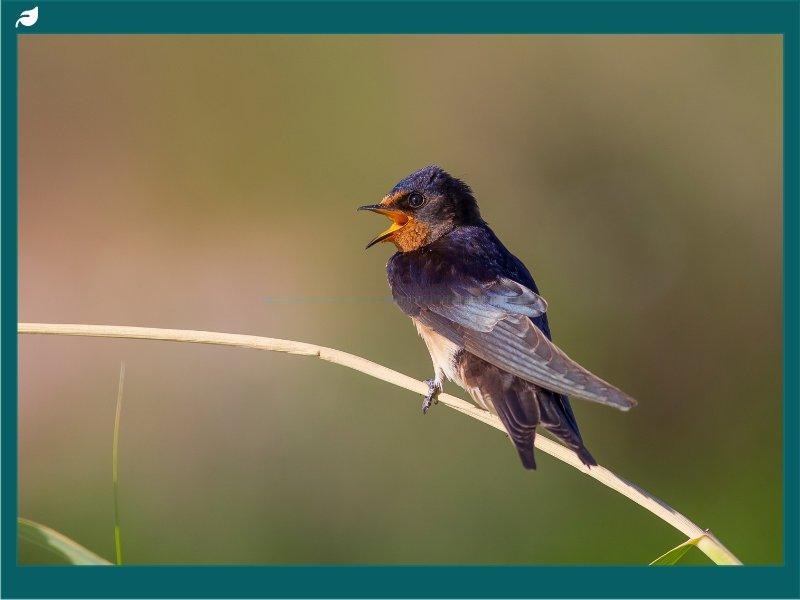
Glossy blue-black above, warm rufous at the throat, with a tail so deeply forked it looks almost architectural. You know this bird the second you see it.
What makes the barn swallow genuinely remarkable isn’t just the looks. It’s the whole package: the migration that covers thousands of miles, the mud-built nest tucked onto a barn rafter, the aerial agility that lets it catch every meal on the wing. These birds have threaded themselves so thoroughly into human landscapes that they arguably benefit from our farms, our open fields, our drafty old buildings. And we benefit from them, in ways that are easy to take for granted until you start counting the insects a single swallow eats in a day.
This article covers all of it: who the barn swallow is, where it goes, what it eats, how it nests, why it matters, and what you can do to make sure it sticks around.
Identification and Distinct Features of Swallow Species
The barn swallow is the most common swallow species on Earth, and once you’ve learned to read its field marks, you won’t confuse it with anything else. The upper body is a deep, glossy blue-black that catches the light differently depending on angle, shifting from midnight blue to an almost greenish sheen. The forehead and throat are rufous, a warm brick-red that sits in sharp contrast to the dark back. Below that, the underparts grade from buff to cream.
Clean, elegant, unmistakable.
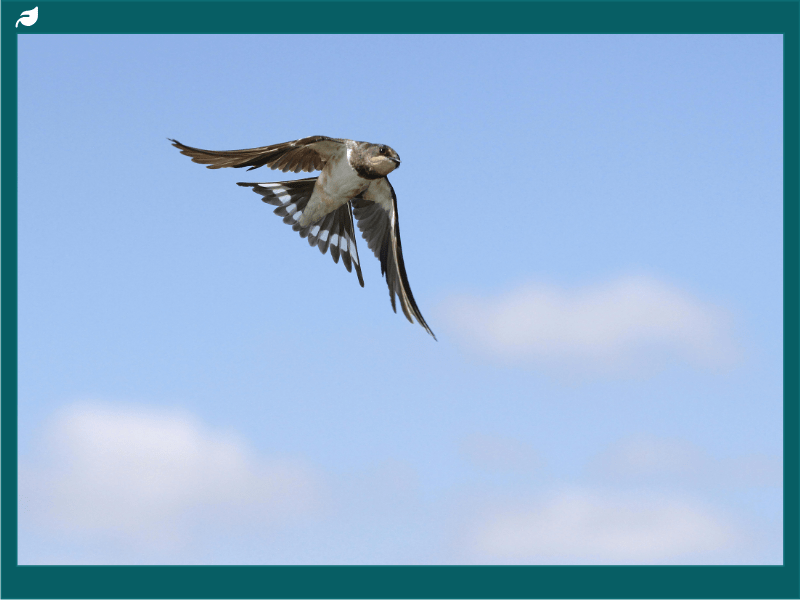
The tail is the real signature. That deep fork, long enough that the two outer streamers look almost impractical, sets the barn swallow apart from related species immediately. In flight, look for small white spots near the tail’s inner edges. They’re easy to miss when the bird is stationary, but they flash into view the moment it banks or spreads its tail to brake.
Males carry more saturated color than females, with deeper blue and a richer rufous throat. Females are similar but softer, slightly paler overall.
Juveniles are worth knowing too. Young barn swallows look like washed-out versions of adults: shorter outer tail feathers, duller plumage, less defined contrast between back and throat. That coloring sharpens as they mature, but in the weeks after fledging you might see a flock that seems oddly muted compared to the adults working the same field. That’s the new generation, learning the ropes.
Comparing barn swallows to cliff swallows is a question that comes up often at birdwatching events. Cliff swallows carry a pale, squared rump patch that is completely absent in barn swallows, whose rumps are dark and whose tails are unmistakably forked rather than squared off. Tree swallows are glossy green-blue above with clean white underparts and a much shallower tail notch. Once you’ve placed those differences in your memory, identification becomes second nature.
Habitat and Distribution
The barn swallow isn’t fussy, which is a large part of why it’s everywhere. Open farmland, river meadows, coastal marshes, suburban parks near water, the airspace above reservoirs and lakes: all of these work. What the bird needs is open sky for hunting, a reliable insect supply, and a solid surface on which to anchor a mud nest. Human agriculture has handed it all three on a global scale, and the barn swallow has taken full advantage.
Their distribution isn’t random, though. It follows a logic shaped by temperature, insect availability, and the architecture of migration routes built up over thousands of generations. Studying where barn swallows appear and when tells you something genuine about the health of the landscapes they move through.
Global Range and Migration Patterns
Barn swallows hold the title of the most widely distributed species in the Hirundo group, and the numbers behind that claim are staggering. They breed across the whole of North America, Europe, and Asia, exploiting warm-season insect abundance wherever it appears. When the season turns, they don’t tough it out. They leave, following food south across entire hemispheres.
North American barn swallows winter primarily in South America, many of them reaching Argentina. European birds cross the Sahara and push deep into sub-Saharan Africa. The round-trip distances involved run into the tens of thousands of miles per year for an individual bird that weighs less than three quarters of an ounce. That is not a small thing.
That is one of the great physical feats in the natural world, repeated every year by millions of individual birds, each navigating by a combination of magnetic cues, star patterns, and memory.
Around July, the southward push begins in earnest across the Northern Hemisphere. Adult birds often lead the way, with juveniles following later in loose, flickering flocks. They travel by day, feeding as they go, pausing at traditional stopover sites where insects concentrate near water. These stopovers are not arbitrary rest breaks.
They are critical refueling points, and when a historically reliable stopover is drained, drained for development or dried out by shifting weather patterns, it creates a gap in the journey that costs birds energy and survival odds.
Migration routes align with major flyways, hugging coastlines and river valleys where the combination of thermals, food, and geography makes the journey fractionally easier. Along the way, barn swallows exploit whatever structures are available for overnight roosts. Reed beds are a classic choice. So are barns, bridges, and the eaves of agricultural buildings, which is how European birds in particular cemented their association with farm structures that gave the species its name.
The “bird barn” connection is older than most people realize. Barn swallows were nesting in human-built structures well before modern agriculture, using caves and cliff faces before that. The barn was simply an upgrade: more sheltered, more stable, and surrounded by the kind of insect-rich open ground that makes foraging efficient. That relationship has shaped both the bird’s range and its cultural footprint across centuries.
Climate shift is now redrawing those range maps in real time. Breeding distributions in Europe and North America are moving northward as temperatures rise. Spring arrival dates are shifting earlier, sometimes faster than the insect hatches that birds need for successful breeding. These are not abstract trends.
They show up in decades of field data, and they sit at the center of conservation conversations about what the barn swallow’s world looks like in fifty years.
Behavior and Communication
Barn swallows are extroverts by design. They feed in loose groups, nest in colonies, and spend the breeding season in a state of near-constant social negotiation that is fascinating to watch once you know what you’re looking at. Their vocal and visual communication is rich and layered, running from the soft conversational twittering of a pair at the nest to the sharp, agitated alarm calls that ripple through a colony when a predator appears. These birds are not quiet.
And they are not solitary.
Understanding that social architecture helps explain almost everything else about their behavior. The way they nest, hunt, and raise young all flows from the same fundamental trait: barn swallows function best in community.
Social Interactions and Courtship Rituals
A barn swallow colony at peak breeding season is controlled chaos, and it’s worth sitting near one long enough for your eyes to adjust. What looks like random swooping resolves, with time, into distinct individuals: paired birds coordinating mud-gathering runs, juveniles from earlier broods still loitering near the nest, neighbors engaging in brief territorial skirmishes that end almost as quickly as they begin. The whole operation runs on communication that never fully stops.
Vocalizations do a lot of the work. The barn swallow’s song is a rapid, liquid warble, often delivered in flight, sometimes from a perch at the nest entrance. It carries information about identity, territory, and readiness to mate. Alarm calls are sharper and travel faster, triggering rapid responses from birds across the colony.
When one swallow spots a sparrowhawk, the reaction spreads in seconds. That collective vigilance is one of the genuine advantages of colonial nesting: more eyes, faster warning, better survival odds for every bird in the group.
Courtship is where the aerial ability really gets put on display. Males perform extended flight sequences designed to show off the qualities that matter most to female barn swallows: agility, stamina, and tail length. The outer tail streamers are not just ornamental. Research has shown that females consistently prefer males with longer streamers, and that streamer length correlates with parasite resistance and overall health.
So the display is honest signaling, a flying advertisement of genetic quality.
A male that catches a female’s attention will shift from general aerial display to something more focused: following her in flight, calling constantly, bringing insects as courtship gifts. Nest building often begins as a shared activity, with the pair making hundreds of mud-gathering trips together. That cooperation establishes the partnership before eggs are laid, and it continues through incubation, chick-rearing, and the second or sometimes third brood that productive pairs attempt within a single season.
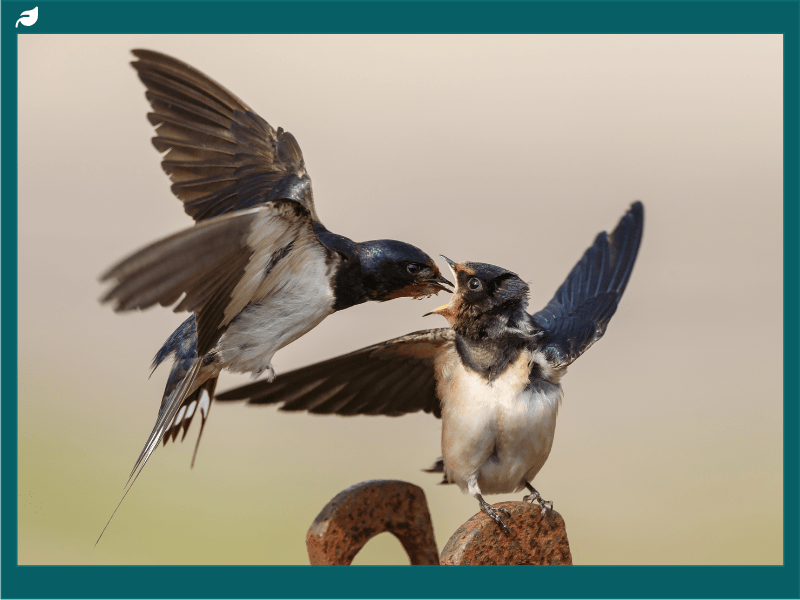
Post-breeding social dynamics are equally interesting. Once chicks fledge, they don’t immediately disappear. Young birds often stay near the natal colony for days, begging from their parents while beginning to practice the hunting skills they’ll need for migration. The adults continue to feed them while simultaneously preparing for the journey south.
Watching that handoff, from dependence to independence, plays out in the airspace above a barn or a hayfield over the course of a few late-summer weeks. It’s one of the quieter spectacles of the bird world, easy to overlook, genuinely worth your time.
Diet and Feeding Patterns
Every meal a barn swallow eats happens in midair. That’s not a casual fact. It defines the bird’s body shape, its flight style, its daily schedule, and its relationship with the landscapes it moves through. The streamlined torso, the wide gape, the long pointed wings built for sustained agility rather than raw speed: all of it is optimized for catching small flying insects, one at a time, hour after hour, day after day.
Insect Hunting Techniques
The basic technique is deceptively simple. A barn swallow flies fast and low, scans constantly for flying insects, and makes rapid course corrections to intercept them. The execution is anything but simple. The bird is adjusting its trajectory dozens of times per minute, reading air currents, tracking prey that is also moving, and doing all of this while maintaining enough altitude to avoid obstacles.
High-speed video of barn swallows hunting shows movement that looks almost liquid, the body folding and extending through turns that seem to violate geometry.
Different conditions produce different hunting strategies. In warm, calm weather, insects concentrate in columns over sun-warmed ground, and barn swallows work these columns systematically, sometimes circling upward into them like tiny hawks. In cooler or windier conditions, insects stay lower, and the swallows follow them down, skimming within inches of grass tops or water surfaces. They’ll skim ponds and rivers to drink without landing, another trademark behavior that combines efficiency with the kind of visual elegance that stops people in their tracks.
Dawn and dusk are prime hunting periods. Insect activity peaks at these times, and barn swallows exploit the overlap between good light and abundant prey. A productive session can cover considerable ground, with a bird ranging over fields, hedgerows, and water margins in a single unbroken foraging circuit. The prey list includes flies, aphids, beetles, moths, mayflies, and dozens of other small flying invertebrates.
A single barn swallow can consume hundreds of insects per day. Scaled across a colony of fifty birds over a breeding season, that represents enormous quantities of agricultural pest insects removed from the local ecosystem without a drop of pesticide.
Communal hunting adds another layer of effectiveness. When one bird finds a concentrated swarm of insects, its flight behavior changes in ways that are visible to other birds nearby. The group converges on the resource, individuals taking turns diving through the swarm. This isn’t coordinated in any complex way, but it works.
The Audubon Society has documented this collective foraging behavior extensively, noting how it makes barn swallows particularly effective in environments where insect abundance is patchy and unpredictable.
The mud connection matters here too. Barn swallows favor hunting areas near mud-edged ponds and slow rivers, partly because those environments support high insect densities, and partly because the same mud becomes building material. A pond that provides both hunting and nesting resources is, from the bird’s perspective, a prime piece of real estate. Protecting such habitats has concrete, measurable payoffs for barn swallow populations.
Nesting and Breeding
The breeding season is when the barn swallow’s relationship with human structures becomes impossible to ignore. Come late April or May across much of the Northern Hemisphere, pairs that successfully wintered in South America or Africa are back, scouting the same beams and rafters they used the previous year. Nest site fidelity is strong. Birds that bred successfully in a particular barn will return to it year after year, adjusting and rebuilding the same structure rather than starting fresh.
That loyalty is not sentiment. It’s efficiency. A known site that worked before is statistically more likely to work again than an untested one. And the effort required to build a mud nest from scratch is substantial enough that reusing a solid foundation makes practical sense.
Role of Barns in Nesting Sites
Before humans built barns, barn swallows nested on cliff ledges, in cave mouths, and on the undersides of rock overhangs. Those habitats are still used by populations in regions without much human infrastructure. But wherever agriculture took hold, the barn became the dominant nest site, and it’s easy to understand why. Barns offer structural stability, overhead cover from rain, low predator pressure (most ground predators can’t reach a nest placed on a rafter four meters up), and a location almost always surrounded by insect-rich open ground.
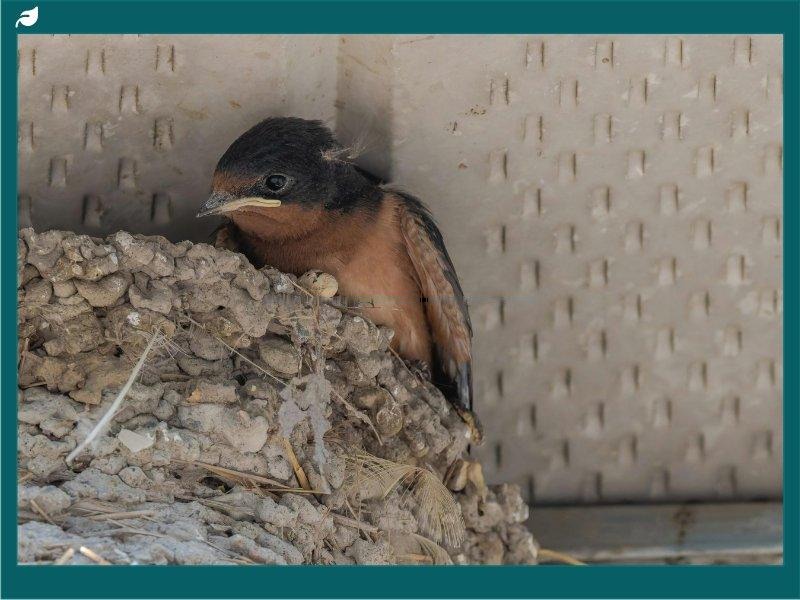
The nest itself is a feat of construction worth examining up close if you ever get the chance. It starts as a collection of mud pellets, each one carried to the site individually in the bird’s bill. Males and females both gather mud, making repeated trips to the nearest mud-edged pond or puddle, loading up a small pellet, flying back, and pressing it into place. The basic cup shape goes up relatively quickly, but the birds continue adding material and fine-tuning the structure for days.
The interior is lined with feathers, soft plant fibers, and grass, creating an insulated cup that stays warmer than the ambient air around it. Feathers seem to be particularly prized lining material, and barn swallows will sometimes snatch them from the air or pull them from other birds.
Nest placement inside the barn is deliberate. Beams and rafters are strongly preferred over open wall surfaces, because a beam provides support from below and makes it harder for snakes or climbing mammals to reach the eggs from the side. The open entrance of a traditional barn, wide enough for a cow to walk through, is exactly wide enough for a swallow to exit at full flight speed without touching the frame. That spatial relationship is not coincidence.
It reflects thousands of years of barn swallows selecting buildings whose dimensions match their flight parameters.
Colonies inside barns develop their own social order. Individual pairs defend a small zone around their nest while tolerating the close presence of neighbors. Information flows freely within the colony: when one pair returns successfully from a foraging run, others notice and may follow. When one nest is threatened by a predator, the alarm travels instantly through the group.
Clutch size typically runs four to five eggs. Incubation lasts around two weeks, with the female doing most of the sitting while the male maintains territory and continues to bring food. After hatching, both parents feed the chicks, making hundreds of delivery runs per day at peak demand. Chicks fledge at roughly three weeks old, but as noted earlier, they continue to be fed by parents for some time after that first flight.
Productive pairs often attempt a second brood. In good years, with a reliable food supply and stable weather, some pairs in southern parts of the range manage three. Each additional brood requires the adults to work through the heat of summer, maintaining condition while raising young and preparing for migration. The energy budget is tight.
Years when insect abundance crashes, due to drought, pesticide use, or cold snaps, show up clearly in reduced brood success and lower chick survival rates.
Barns that have been converted to other uses, sealed up, or demolished represent a direct loss of nesting habitat. Conservation guidance consistently recommends leaving a gap or small entrance in renovated agricultural buildings specifically to maintain barn swallow access, a simple, low-cost intervention with measurable outcomes for local bird populations.
Field Guide to Observing Swallows
There are easier birds to watch than barn swallows. Herons stand still. Owls sit in the same tree for hours. Barn swallows do not cooperate in that way.
They are fast, they are constantly moving, and they spend most of their lives in open airspace rather than perched conveniently on a branch at eye level. But that movement is exactly what makes watching them worthwhile. Once you tune in to what you’re seeing, a field of barn swallows working the evening air becomes one of the best free shows in nature.
A few specific habits make observation more productive, and knowing when and where to show up dramatically improves your chances of seeing interesting behavior rather than just distant specks.
Tips for Birdwatching Events
July sits at a compelling intersection in the barn swallow calendar across much of the Northern Hemisphere. Breeding is either finishing up or producing second broods, depending on latitude. Fledglings from early clutches are already on the wing. Adults are moving into pre-migration condition.
Activity is high, the birds are concentrated around successful nest sites, and the long summer evenings give you extended observation windows. It’s no accident that many organized birdwatching events focused on swallows and other aerial insectivores fall around this period.
Attending organized events brings benefits beyond the birds themselves. Experienced guides can orient you to specific behaviors that are easy to miss if you don’t know what to look for. The difference between a normal foraging flight and a courtship pursuit, or between a standard alarm call and the specific vocalization that signals a raptor overhead, is the kind of knowledge that transfers from experienced observers to newcomers efficiently in a group setting. A good field guide covers the basics of barn swallow identification and behavior, but a knowledgeable person standing next to you in the field accelerates learning faster than any book.
When selecting observation locations, follow the swallows’ priorities rather than yours. Barn swallows concentrate where insects concentrate, and insects concentrate where there is open water, lush vegetation, and minimal pesticide use. Farm ponds edged with mud, river meadows, and the open ground around traditional agricultural buildings are the places to be. Nature reserves that include wetlands or mixed farmland often provide reliable sightings, and many now run specific swallow-watching programs during peak periods.
Check local wildlife trust or Audubon chapter listings well in advance of July, because popular events fill quickly.
Timing your visits within the day matters too. The early morning hours, especially on warm days when insects become active quickly, often produce intense hunting activity. Evening sessions, particularly in the hour before dark, show barn swallows at their most dynamic: feeding hard, calling frequently, sometimes performing display flights as the light softens. Midday on hot summer days can be quiet by comparison, with birds resting during peak heat.
Photography is a natural extension of swallow watching, and it teaches you things about the bird that casual observation misses. Working through images of wing position, tail spread, and gape angle shows you just how precisely these birds are controlling their bodies through each hunting run. You don’t need expensive equipment to start, though a fast lens helps. More important is patience and practice in anticipating where a hunting barn swallow will be in half a second, which takes time to develop and is immensely satisfying when it clicks.
Keep records. Date, location, number of birds, behaviors observed, weather conditions. Even informal notes, kept consistently, build into something valuable over years. Long-term citizen records of barn swallow arrival and departure dates have contributed genuinely useful data to researchers tracking climate-driven shifts in migration timing.
Your observations matter more than you might think.
Conservation Status and Efforts
The barn swallow is not currently at immediate risk of global extinction, and it would be wrong to suggest otherwise. But its populations are declining across significant portions of its range, and the reasons for that decline are not mysterious. They are the same reasons that aerial insectivore populations broadly are shrinking: fewer insects, fewer suitable nest sites, more barriers along migration routes, and a climate that is shifting the timing of biological events faster than migration schedules can track.
Getting ahead of that trajectory requires understanding the specific pressures these birds face, and it requires organized effort at scales from individual farm policy to international treaty.
Challenges Faced by Swallow Populations
Habitat loss is the headline issue, but “habitat loss” covers a lot of ground and benefits from being specific. For barn swallows, the losses come in several distinct forms. Old farm buildings are converted or demolished, removing nesting sites. Hedgerows that once created insect corridors between fields are cleared.
Wet meadows with mud-edged ponds get drained and improved for intensive agriculture. Each individual change seems minor. Cumulatively, they represent a substantial reduction in the landscape features that barn swallows need.
Pesticide use hits swallows from both ends. Insecticides directly reduce the prey available to hunting birds, sometimes dramatically in the days following aerial application. Herbicides reduce the diversity of plant species in field margins, which in turn reduces insect diversity, which narrows the dietary options available to swallows and the species that depend on the same food base. Research across Europe has linked intensification of agricultural practice to measurable declines in barn swallow breeding success, with reduced chick-fledging weight and lower survival to adulthood in areas of high pesticide use compared to organic or low-input farms. A study published in the Journal of Field Ornithology found that the annual survival rate for barn swallows in northeastern North America is just 0.374, a figure directly tied to modern farming techniques and reduced insect prey availability. That number puts the population pressure these birds face in stark, measurable terms.
Conservation policy is where these pressures intersect with what governments and landowners actually do. Agri-environment schemes that pay farmers to maintain field margins, retain old buildings, and reduce chemical inputs have documented positive effects on barn swallow populations. The challenge is scale and uptake. These schemes exist in various forms across Europe and North America, but participation rates and payment levels vary enormously, and in many areas the incentives for intensive production still outweigh the incentives for wildlife-friendly management.
Organizations like the Audubon Society have been central to building the evidence base for effective policy, combining long-term monitoring data with advocacy work aimed at making barn swallow-friendly farming practices the norm rather than the exception. Audubon’s citizen science programs, particularly breeding bird surveys and swallow monitoring counts, generate population trend data that would be impossible to collect through professional research alone. That data directly informs policy arguments at state and federal level in the US, and equivalent programs operate across Europe and beyond.
Climate change introduces a particular kind of challenge that policy tools are only beginning to address. The core problem is phenological mismatch. Barn swallows return to breeding grounds on a schedule shaped by evolutionary history, cued partly by day length, which hasn’t changed. Insect emergence is cued by temperature, which is rising.
When springs warm early, insects emerge before the birds arrive. When birds arrive to find the insect peak already passed, chick survival rates drop. This mismatch is already measurable in long-term datasets from multiple European countries, and the effect is expected to intensify as temperatures continue rising.
Addressing it requires more than protecting individual nest sites. It requires maintaining the landscape-level insect abundance that gives barn swallows a buffer against bad timing. That means reducing pesticide loads, retaining habitat diversity, preserving wetlands, and managing farmland in ways that support insect populations year-round rather than just tolerating them during summer. It’s a bigger ask than leaving a gap in a barn wall, but the evidence for its importance is solid.
Ecosystem Connections and Impact
Pull barn swallows out of an ecosystem and something changes. It’s not always visible immediately, but it shows up eventually in insect pressure on crops, in the reduced diversity of the broader bird community, and in the loss of what ecologists call a bioindicator: a species whose population trends reliably signal the health of the wider system it inhabits. Barn swallows are deeply embedded in the food webs of the landscapes they occupy. Their removal would not be trivial.
Swallow Contributions to Biodiversity
The most direct contribution is insect control, and the numbers are substantial enough to take seriously. A single barn swallow consumes somewhere between 850 and 1,000 insects per day during the breeding season, when the energy demands of feeding chicks push foraging intensity to its peak. Scale that across a colony of thirty breeding pairs, both adults and fledglings included, and you’re looking at tens of thousands of insects removed from the local ecosystem every day. The species removed include many that are significant agricultural pests: aphids, crane flies, and various beetles and flies that damage crops at high densities.
This is natural pest management with no input costs and no environmental side effects. Farmers who maintain barn swallow nesting habitat are effectively running a pest control service. Studies comparing insect loads on farms with active swallow colonies against farms without them have found measurable differences in certain pest species. The relationship is real, even if the magnitude varies by location and crop type.
Beyond direct pest control, barn swallows influence the structure of the wider bird community. In regions where swallows are abundant, the overall diversity of insectivorous birds tends to be higher. This is partly because the same conditions that support barn swallows, namely insect-rich open landscapes with water and varied vegetation structure, also support other aerial and gleaning insectivores. The swallows themselves contribute to this diversity by competing with some species and creating foraging opportunities for others by flushing insects during their low-level hunting runs.
The bioindicator function is perhaps the most strategically important contribution from a conservation standpoint. Barn swallow populations respond sensitively and relatively quickly to changes in landscape quality, insect abundance, and climate conditions. Monitoring them gives researchers and conservationists an early warning system for deteriorating ecosystem health, one that is far cheaper and more responsive than attempting to measure insect diversity directly at large scales. When Audubon data shows barn swallow numbers declining in a particular region, it flags something worth investigating.
That flag has repeatedly pointed researchers toward pesticide use, habitat degradation, and wetland drainage that might otherwise have gone undocumented until the damage was much harder to reverse.
The swallow’s role in pollination support is indirect but worth noting. By keeping populations of pest insects in check, swallows reduce pressure on the plant communities that support pollinators. Healthy, diverse plant communities support diverse pollinator populations. Healthy pollinator populations support the fruit set of both wild plants and crops.
All of this makes the case for barn swallow conservation not as a sentimental exercise in protecting a pretty bird, but as a practical investment in the functioning of agricultural and natural ecosystems. These are not separate concerns. They are the same concern, looked at from different angles.
Cultural Significance of Barn Swallows
Long before anyone thought to count barn swallows or track their migration routes, people noticed them. The return of swallows in spring is one of the most consistent natural events in the temperate world, reliable enough across centuries to become a cultural anchor. Different societies attached different meanings to that arrival, but the attention itself was universal. This is a bird that humans have been watching, painting, writing about, and building myths around for as long as records exist.
That cultural weight isn’t just historical curiosity. It connects to conservation in a direct way: species that people care about, for whatever reason, are easier to protect.
Swallow Symbolism in Different Cultures
In ancient Greece, the barn swallow was associated with Aphrodite, goddess of love, and its spring arrival was read as a sign of renewed abundance. Greek texts from the fifth century BCE reference swallows in ways that suggest their appearance was a commonplace of daily life, something everyone noticed and recognized. The association with love and return persisted into Roman culture, where swallows appearing around domestic buildings were considered auspicious, a sign of household harmony and protection.
Across much of Europe well into the modern period, harming a swallow or destroying its nest was considered bad luck, sometimes seriously so. This wasn’t purely superstition. In agricultural communities where the birds’ contribution to insect control was directly observable, there was practical logic beneath the cultural prohibition. Whatever the reasoning, the effect was protective: swallow nests in barns were left undisturbed, which meant populations in human-dominated landscapes faced less direct persecution than many other bird species.
In Chinese tradition, swallows carry meanings of luck, fertility, and marital happiness. They appear frequently in classical poetry as symbols of seasonal change and the bittersweet passage of time. A swallow that chooses to nest in your house brings good fortune. That belief encouraged tolerance of nesting pairs in domestic settings, which again had a conservation function, however unintentional.
In various African cultures, the barn swallow’s arrival signals the approach of the rainy season, a fact with immediate practical significance for farming communities dependent on seasonal rainfall. The bird became a calendar, a natural marker of when to plant and when to expect water. That practical significance elevated the swallow’s status beyond mere decoration in cultural memory, embedding it in agricultural ritual and seasonal ceremony.
Among seafarers, swallows held a particular place. European sailors traditionally associated them with land, since swallows don’t fly over open ocean. Spotting a swallow from a ship meant the coast was near. Tattoo traditions among sailors used swallow imagery to mark nautical miles traveled, with specific numbers attached to specific milestones.
That tradition persists today in the vocabulary of tattoo culture, largely severed from its practical origins but still carrying a faint echo of the bird’s original symbolic weight.
In contemporary media and wildlife photography, barn swallows remain featured subjects. Their visual appeal is obvious, but the best swallow photography captures something beyond aesthetics: the concentrated purpose of a bird in full hunting flight, or the barely-controlled chaos of a nest full of gaping chicks. These images do real work in conservation communication. They make the abstract argument for protecting aerial insectivores concrete and immediate.
A sharp photograph of a barn swallow feeding chicks, shared widely, does more to build public support for swallow-friendly farming policy than any position paper.
The cultural thread running through all of these traditions is attention. Humans have paid attention to barn swallows across enormous spans of time and geography, finding meaning in their movements, their returns, their nesting choices. That attention is a resource. Conservation efforts that tap into existing cultural affection for this bird start with an advantage that more obscure species lack.
Get Involved in Conservation Efforts
Knowing about barn swallows is satisfying. Actually doing something for them is better. The good news is that the actions most likely to help these birds are accessible to individuals, not just governments or large institutions. Some of them cost nothing.
Some require modest financial commitment. All of them connect you to a broader network of people paying attention to the same things you’re now paying attention to.
How to Help Protect Swallow Species
Start with your local Audubon chapter. Audubon runs or coordinates barn swallow monitoring programs across North America, and the data collected through these programs directly informs conservation policy at state and federal levels. Becoming a member is the most direct way to support that work financially, and membership also connects you to events, expert-led field trips, and the broader community of people working on bird conservation. Many chapters run specific programs focused on aerial insectivores, including barn swallows, that welcome participants with all levels of experience.
Citizen science is where individual observation turns into collective knowledge. Apps and programs that allow you to log barn swallow sightings, arrival dates, and breeding behavior contribute to databases that researchers actually use. Tracking arrival dates over multiple years from the same location produces the kind of long-term phenological data that is genuinely hard to collect any other way. You don’t need advanced ornithological training.
You need consistency, a willingness to record what you see accurately, and a basic ability to identify a barn swallow, which by now you have.
If you have access to farmland or agricultural buildings, the single most impactful direct action is maintaining access for nesting birds. If a barn or outbuilding is being renovated, advocate for leaving at least one small opening. Swallows need a gap of roughly 50 by 75 millimeters to enter a building, which is small enough to maintain weatherproofing while still allowing access. Fitting a small nest cup on a beam inside, in advance of the breeding season, can attract prospecting pairs in spring.
These are inexpensive, reversible interventions with documented success rates.
At a landscape scale, support for organic and low-input farming practices has measurable benefits for barn swallow populations by maintaining the insect abundance these birds depend on. This can mean buying from farms that operate those practices, supporting policy changes that make agri-environment funding accessible and attractive to more farmers, or both. The connection between what you put in your shopping basket and what a barn swallow finds to eat over a cornfield in July is real, if not always immediately visible.
Climate action matters here in the same way it matters for most of the natural world. Barn swallows are already experiencing phenological mismatch between their migration schedules and insect emergence timing, and that mismatch will deepen as temperatures rise. Supporting the full range of climate policy actions, from local land use decisions that protect wetlands and carbon-storing landscapes to national and international emissions reduction commitments, is directly relevant to whether barn swallows continue to find viable breeding conditions across their range.