The environmental case for rethinking a product billions of people throw away twice a year.
Every year, roughly 4.7 billion plastic toothbrushes end up in landfills and oceans. Electric models fare slightly better — their handles last longer — but the fundamental equation remains the same: a plastic stick with nylon bristles, used for a few months, discarded, replaced. Multiply by every bathroom on Earth. The waste accumulates faster than any recycling system can manage.
But the sustainability problem in oral care runs deeper than toothbrush disposal. It extends to what a toothbrush cannot do — and all the additional plastic products we buy to compensate.
The interdental gap — the narrow space between adjacent teeth — is where over 80% of cavities originate. Toothbrush bristles are physically too wide to enter these spaces. So we purchase floss in plastic dispensers, single-use floss picks, interdental brushes, and water flossers with their own power supplies and disposable tips. Each product addresses a shortfall of the primary tool. Each adds its own manufacturing footprint, packaging, shipping weight, and eventual landfill volume.
A toothbrush that could clean interdentally — without relying on these supplementary disposables — would represent a genuine sustainability gain. And it would do so not by making incremental material improvements to the same old design, but by reimagining what a toothbrush actually does.
Rethinking the Mechanism
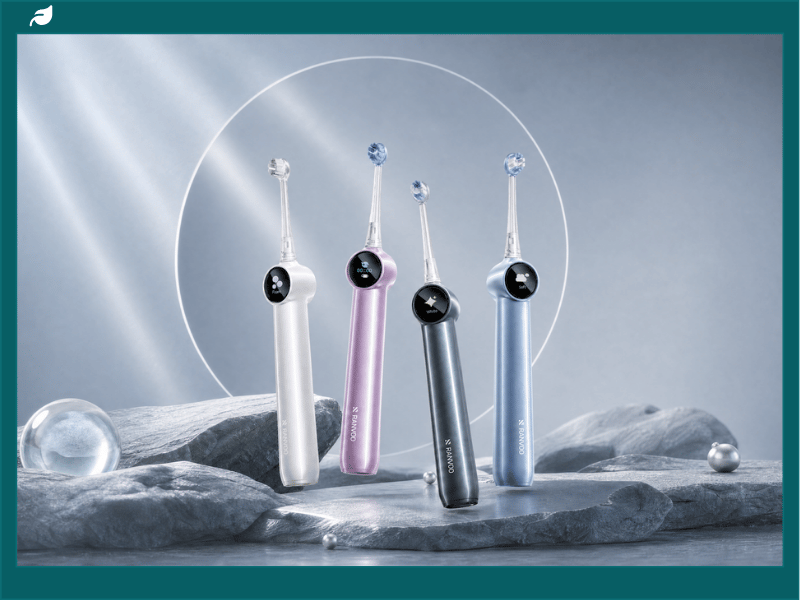
The RANVOO AirJet X5 is built around a technology platform called AirJet 2.0, protected by 20 granted patents. Its central premise is simple enough that the environmental implications almost sneak up on you: instead of relying on bristles to clean between teeth — a geometric impossibility — the device uses fluid dynamics to carry the cleaning action where mechanical contact cannot go.
Inside the handle, a Boosted Bubble Chamber aerates the water-toothpaste mixture into a dense stream of microbubbles, each measuring tens of microns across. These bubbles are small enough to flow naturally into interdental spaces. A brush head shaped using computational fluid dynamics exploits the Coanda effect — the tendency of a fluid jet to adhere to a curved surface — to guide the bubble stream along tooth contours without any special technique required from the user.
When the bubbles reach the tight gaps between teeth, they undergo acoustic cavitation: asymmetric collapse that generates microscopic liquid jets, physically dislodging plaque biofilm from enamel. The principle is the same one used in industrial ultrasonic cleaning, precisely calibrated for oral use.
What makes this relevant from a sustainability perspective is not just the clever physics. It’s what the physics eliminates.
Attachment:
Capture_d_ecran_2026-05-04_a_20.55.59.png
The Consolidation Dividend
A single bathroom cabinet can easily contain three or four oral care devices and consumables: an electric toothbrush, a pack of floss or floss picks, perhaps a water flosser, and a tube of specialized toothpaste. Each item arrives in its own packaging. Each has its own supply chain. Each needs replacing or replenishing on a different schedule.
The AirJet X5 consolidates functions. Because the microbubble system handles interdental cleaning as part of the regular brushing routine, the daily flossing requirement — and the associated plastic waste stream — is significantly reduced. RANVOO is careful not to claim that occasional flossing becomes unnecessary for all users, but for the majority who struggle with daily floss adherence, the practical outcome is fewer disposable interdental products purchased and discarded.
The device itself is designed for longevity. An IPX7 waterproof rating means it survives complete submersion. A silicon carbide anti-mold coating — certified to Grade 0, the highest mold-resistance standard — prevents the microbial degradation that often sends bathroom electronics to an early landfill. The included magnetic wall mount doubles as a wireless charger and stores the brush vertically, allowing gravity to drain moisture and air to circulate. The brush dries completely between uses. No pooled water. No biofilm accumulation. No premature replacement triggered by a grimy handle base.
A 1,600 mAh battery delivers up to 60 days of operation per charge — roughly 4 to 5 charging cycles per year. Over the device’s lifespan, that translates to meaningfully lower energy consumption compared to brushes requiring weekly dock charging.
Beyond the Device: The Preventive Healthcare Angle
There is a sustainability argument for preventive health that doesn’t always make it into product reviews. Every cavity filled, every root canal performed, every crown placed involves energy, materials, sterilization cycles, disposable barriers and instruments, patient travel, and clinical waste.
A toothbrush that achieves a verified 97% plaque removal rate and Grade 1 cleaning efficiency — the highest classification in standardized dental testing — and specifically targets the interproximal sites where disease most often begins, contributes to a reduction in restorative dental interventions over time. That is a difficult metric to quantify on a product-by-product basis, but the direction of travel is clear: better daily prevention means fewer resource-intensive treatments.
The technology also addresses gum health — 40% of adults experience interdental gingivitis — through a deliberately low-frequency design. The AirJet X5 operates at a maximum of 21,600 strokes per minute, significantly below the 31,000 to 62,000 range of premium sonic brushes. Bristle tips are polished to a 99.99% end-rounding rate at 0.01 millimeters. A thermoplastic elastomer backing absorbs stray vibration. The result is a device that protects soft tissue while cleaning effectively, reducing the cumulative gum trauma that drives patients toward periodontal treatment.
The Materials Question
No consumer electronics product can claim perfect sustainability. The AirJet X5 contains a lithium-ion battery, ABS plastics, a TFT display, and electronic components — all of which carry extractive and manufacturing footprints that deserve honest acknowledgment.
What distinguishes a more sustainable electronic product from a less sustainable one is not the absence of impact, but the intentionality around durability and lifespan. A device engineered to last five years, requiring only replaceable brush heads, represents a fundamentally different waste equation than one designed for replacement every 18 to 24 months. RANVOO’s investment in anti-mold materials, waterproof sealing, and a battery rated for hundreds of cycles suggests a product built for retention, not churn.
Attachment:
a hand holding airjet x5.png
The replaceable brush heads themselves represent a smaller material footprint than the disposable interdental tools they partially replace. A single brush head, used for months and then recycled where facilities exist, versus dozens of plastic floss picks or multiple spools of floss in plastic packaging over the same period. The math is directionally favorable even before accounting for the packaging and shipping differences.
What This Means for the Category
The oral care industry has a sustainability problem it rarely discusses openly. The core product — the toothbrush — is functionally unchanged from its 1938 nylon-bristle ancestor. Incremental improvements in handle materials (bamboo, recycled plastic) and packaging reduction are worthwhile, but they leave the fundamental waste equation intact: a tool that cannot do its whole job, propped up by an ecosystem of disposable supplements.
By addressing the mechanical limitation at the heart of toothbrush design — the inability of bristles to reach between teeth — the AirJet platform offers a different kind of sustainability story. Not one built on material substitution alone, but on functional consolidation. One device. One routine. Less plastic entering the bathroom, and less leaving it.
For consumers who think about the environmental footprint of their daily habits, that’s a proposition worth examining closely. The most sustainable product is often the one that replaces several others. The AirJet X5 makes a credible case that it does exactly that.