Introduction to Lanternflies in Southeast Asia
Picture an insect that looks like someone glued a peanut to a stained-glass window and then taught it to suck the life out of grapevines. That’s your lanternfly. And right now, researchers are finding brand-new ones.
The recent discoveries of new lanternfly species from Vietnam and Cambodia have pulled these insects back into the scientific spotlight, and for good reason. According to the European Journal of Taxonomy, the genus *Zanna* now officially contains 37 species total, a count updated after the formal description of four new species from Cambodia and Vietnam, including *Z. chartieri* and *Z. limbourgi* from Cambodia’s Tatai and Phnom Aural sanctuaries. Southeast Asia has always been the evolutionary heartland for the family Fulgoridae, but the pace of new finds is accelerating in ways that genuinely surprise entomologists. We’re not talking about minor variations here. We’re talking about species with distinct morphology, different host plant relationships, and ecological footprints researchers are only beginning to map.
At the same time, halfway around the world, the spotted lanternfly is tearing through vineyards and apple orchards in Pennsylvania. The two stories are connected. Understanding where this lineage comes from, how it diversifies, and what it does to the plants it feeds on matters enormously, both for biodiversity science and for the farmers already fighting losing battles against invasive insects.
So let’s get into it properly. The genus Zanna, the genus Lycorma, the broader order Hemiptera Fulgoromorpha, the specific terror of Lycorma delicatula in American agriculture: all of it connects back to this one corner of the world. Vietnam and Cambodia are not incidental to this story. They are the story.
Every new lanternfly species from Vietnam and Cambodia that researchers formally describe adds another data point to a picture that pest managers, ecologists, and agriculture departments around the world are desperate to complete.
Unique Characteristics of Lanternflies
Here’s the thing about lanternflies: they look wrong in the best possible way. The species from the genus Zanna, which sits within the order Homoptera Auchenorrhyncha and more precisely within Hemiptera Fulgoromorpha, have heads that extend forward into bizarre elongated snouts, lobes, and protrusions that look less like evolved anatomy and more like something an illustrator invented for a fantasy novel. According to the [Miami Herald](Miami Herald), reporting on a peer-reviewed study in the *European Journal of Taxonomy*, the newly described species *Zanna bidoupana* exemplifies this to a striking degree, with an elongated head constituting exactly 35% of its total body length and hindwings that are “milky white” with darkened veins. The function of these structures is still debated. Some researchers think the odd head shapes mimic seed pods or bark protrusions well enough to confuse predators.
Others argue the structures play a role in sensory perception, helping the insect detect vibrations through plant stems. Either way, they work. These insects have persisted for millions of years in dense, predator-rich tropical forests, and that strange head is part of why.
The family Fulgoridae sits within Hemiptera Fulgoridae, a grouping that includes some of the most visually elaborate insects on the planet. Walk through a museum collection and you’ll find Fulgoridae specimens pinned next to hand-written Victorian labels describing them as “lantern bearers,” a name based on the wildly inaccurate but charming early belief that the inflated head structures actually glowed at night. They don’t. But the hind wings, revealed only when the insect takes flight, often blaze with reds, yellows, and electric blues that genuinely do stop you cold.
This flash coloration startles predators long enough for the insect to escape. It’s a trick shared across Hemiptera Fulgoromorpha, and it’s spectacularly effective.
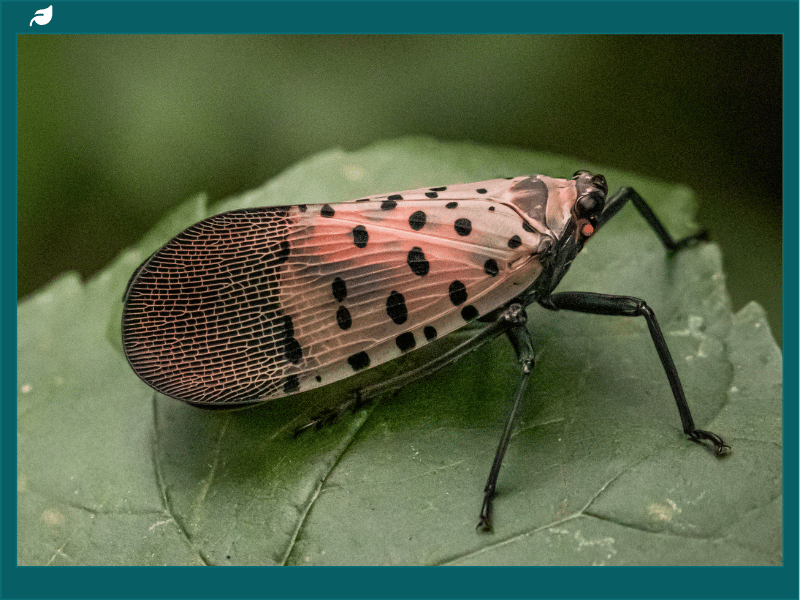
Now add the spotted lanternfly to that picture. Lycorma delicatula, the spotted lanternfly, shares this lineage. Its forewings are grey with bold black spots, and the hind wings glow red and black when it opens up. You could put a spotted lanternfly specimen next to a Zanna species from Cambodia and see the family resemblance immediately in the wing architecture, the body posture, the way they press flat against a stem.
The spotted lanternfly is, in many ways, just a very successful, very mobile cousin of insects that evolved quietly in Southeast Asian forests for tens of millions of years.
The feeding biology ties everything together. All lanternflies pierce plant tissue with a needle-sharp proboscis and extract phloem sap. It sounds relatively benign until you understand the scale. A dense population of spotted lanternfly on a single tree of heaven can coat the bark with so much sticky honeydew, the excretion left after sap processing, that sooty mold colonizes the entire plant within weeks, blocking photosynthesis and eventually killing the host.
In Vietnam and Cambodia, where different Fulgoridae species feed on native host plants adapted to tolerate some herbivory, this relationship is more balanced. But the moment a lanternfly lands on a host plant with no evolutionary history of this kind of attack, as the spotted lanternfly did when it arrived in the United States, the damage can be catastrophic. This is precisely what makes invasive Fulgoridae so dangerous: the absence of any co-evolutionary braking system on the new host’s side.
In Vietnam and Cambodia specifically, the host associations of newly documented lanternfly species are highly specific. Certain Zanna species feed almost exclusively on one or two plant genera. This specificity is both a constraint on their spread and a window into their evolutionary history. The plant and the insect have been dancing together long enough to reach a kind of armed truce.
Studying where that truce holds and where it breaks down tells researchers a great deal about what makes certain lanternfly species dangerous when they travel. It also explains why invasive lanternfly establishment so often follows the presence of that species’ preferred host plant in the new territory.
The wings also do social work. The vivid patterns visible when a lanternfly opens its wings are not random. Research on Fulgoromorpha species consistently points toward wing coloration playing a role in mate recognition, particularly in dense forest canopies where acoustic signals scatter and visual cues become more reliable. The spotted lanternfly, Lycorma delicatula, aggregates in large numbers during late summer and early autumn, and the visual density of those aggregations may itself function as a signal, advertising fitness to potential mates and warning to predators through sheer numbers.
It’s a behavioral complexity you wouldn’t expect from an insect most people in Pennsylvania know only as something to stomp on.
Understanding these physiological and behavioral traits is not academic indulgence. It’s the foundation of any serious attempt to manage spotted lanternfly populations, predict which new lanternfly species might become invasive, and protect the ecosystems in Vietnam and Cambodia where this entire lineage evolved. Every trait that researchers document in a new lanternfly species from this region, whether it’s head shape, wing pattern, host plant preference, or aggregation behavior, chips away at the biological ignorance that lets invasive species catch agriculture departments flat-footed.
Historical Context and Discovery
Entomologists have been tripping over spectacular Fulgoridae specimens in Southeast Asia since the early colonial era of natural history, and the documentation goes back further than most people realize. The genus Zanna was formally described in the nineteenth century, and specimens collected during Victorian expeditions through Indochina ended up in European museum collections where they sat, occasionally re-examined, occasionally revised. Early naturalists captured the visual drama of these insects in meticulous hand-colored illustrations, but they had no tools to understand the evolutionary relationships between species, no molecular techniques, no modern phylogenetics.
The region that is now Vietnam and Cambodia was recognized early as a zone of exceptional insect diversity. Dense tropical forests, complex altitudinal gradients, river systems cutting through karst landscapes: all of this created conditions for rapid speciation. But political instability across much of the twentieth century interrupted systematic entomological surveys for decades. Collections were disrupted.
Field access was restricted. The baseline catalog of species in these countries remained incomplete in ways that still surprise researchers today.
The modern chapter of lanternfly discovery in Vietnam and Cambodia accelerated significantly after political normalization allowed greater scientific access. International collaboration became possible. Local universities built capacity in taxonomy and molecular biology. And the scientific journals that publish this work, from Zootaxa to various entomological society publications, began receiving a stream of new Fulgoridae descriptions from the region that continues to this day.
Many of those journal records are now accessible through open-access repositories at sites ending in .org, making species descriptions available to researchers in Phnom Penh, Hanoi, and Washington simultaneously, a change that has meaningfully accelerated collaborative taxonomy work.
Lycorma delicatula itself became the lens through which the broader public suddenly cared about all of this. The spotted lanternfly was first detected in Berks County, Pennsylvania in 2014, having arrived almost certainly on stone imported from Asia. By 2020, it had spread to multiple states. By 2021, the US Department of Agriculture had issued emergency responses and quarantine orders across a swath of the eastern seaboard.
By 2022, the spotted lanternfly had appeared in states where agricultural economists started calculating losses in the hundreds of millions of dollars. Suddenly, the question of where this insect came from, what its relatives look like, and what its natural range encompasses became urgent for reasons beyond pure science.
That urgency redirected funding and attention toward Southeast Asian Fulgoridae research. If you want to understand spotted lanternfly biology deeply enough to control it, you need to understand the full genus Lycorma. And if you’re cataloging Lycorma, you’re working in the same collections and the same field sites as researchers documenting new Zanna species in Vietnam and Cambodia. The communities overlap.
The knowledge cross-pollinates. A 2022 paper in a specialist entomological journal describing a new Cambodian lanternfly species might not make national news, but it feeds directly into the biological understanding that pest managers in Delaware depend on. That journal entry, retrievable through a doi link and hosted on a publisher’s .org platform, is a permanent scientific record that pest risk analysts can cite for decades.
The cultural dimension matters too. In parts of Southeast Asia, large Fulgoridae species appear in traditional textile patterns, in oral folklore, and occasionally in medical traditions where parts of the insect were used in local remedies. These cultural records are not trivial. Ethnobiological accounts sometimes point researchers toward populations of insects in areas not yet formally surveyed.
A village elder who knows exactly which tree a spectacular lanternfly species favors has information that can save a field team weeks of searching. The history of lanternfly research in Vietnam and Cambodia is inseparable from the communities living alongside these insects, and the best modern research programs recognize that explicitly.
As of 2024, the catalog of Fulgoridae species from Vietnam and Cambodia is still growing. Each field season adds names. Each genetic analysis reshuffles relationships slightly. And each new species described is a small but real contribution to understanding the family whose most notorious member is currently costing American farmers money every single season.
The cumulative scientific record, assembled across years of journal publications each with its own doi and each retrieved by researchers on multiple continents, is finally becoming comprehensive enough to support serious predictive work on invasion risk and ecological impact.
Taxonomy and Classification of New Species
Taxonomy sounds dry until you realize it’s actually an argument. Every new lanternfly species described is a claim about the history of life, a statement that this insect’s evolutionary path diverged from its relatives at a specific point, for specific reasons, in a specific place. And those claims get challenged, revised, and refined constantly.
The order Fulgoromorpha, which contains the family Fulgoridae, is itself a subject of ongoing debate within Hemiptera systematics. Hemiptera Fulgoromorpha has historically been grouped under the older term Homoptera, a classification now considered polyphyletic and abandoned by most modern systematists. You’ll still see Homoptera cited in older literature and in some reference databases, but contemporary taxonomy places lanternflies firmly within Hemiptera, specifically Hemiptera Fulgoridae for the true lanternflies of family Fulgoridae, and more broadly within Fulgoromorpha Fulgoridae for the larger grouping. Getting this right matters when you’re building a phylogenetic framework that connects a new Cambodian species to its relatives in Vietnam, Japan, China, and the eastern United States.
The act of formally describing a new species is more demanding than most people outside taxonomy appreciate. A researcher who collects what looks like an undescribed lanternfly in northern Cambodia can’t simply declare it new and publish a name. They have to compare it morphologically against every known species in the relevant genus, confirm genetic divergence through molecular analysis, designate a type specimen that will serve as the permanent physical reference for the species name, and publish the description in a peer-reviewed journal with a doi that becomes the permanent record. That journal publication is itself subject to review by specialist referees who may have spent careers working exclusively on Fulgoridae and who will scrutinize every measurement and every comparative statement with real skepticism.
Getting through that process successfully is genuine scientific work, and the researchers doing it in Vietnam and Cambodia deserve more recognition than they typically get outside specialist circles.
The naming landscape for Southeast Asian Fulgoridae has shifted considerably since molecular tools became standard. Species that were lumped together on the basis of superficial morphological similarity have been split when genetic analysis revealed deep divergences. Species described from single specimens collected a century ago have been re-evaluated against new material and sometimes synonymized. The genus Lycorma, which includes Lycorma delicatula, the spotted lanternfly, contains several species whose boundaries were debated for years before molecular work clarified the picture.
Understanding those boundaries correctly matters for predicting invasion risk: a species that is actually two cryptic species might have very different host preferences or climate tolerances, and managing them as a single entity would mean getting the risk assessment systematically wrong.
The new lanternfly species from Vietnam and Cambodia described in recent years reflect this improved methodological standard. Morphological descriptions are more detailed, molecular data is routinely included, and the comparative frameworks situate new species within revised, phylogenetically informed genus concepts rather than older, geography-based groupings. This quality improvement in species descriptions directly benefits the agriculture departments and invasive species managers who rely on accurate taxonomy to identify specimens intercepted at borders or detected in new territory.
Differences between Vietnamese and Cambodian Species
Vietnam and Cambodia share a border and a great deal of biogeographic history, but their lanternfly faunas diverge in ways that tell a clear evolutionary story. The differences are not random. They reflect millions of years of geographic separation, habitat divergence, and independent adaptation to local ecological pressures.
Vietnamese lanternfly species, including those within the genus Lycorma, tend toward habitats that range from lowland agricultural zones to mid-elevation forest edges. This broad habitat tolerance is one reason Lycorma delicatula, the spotted lanternfly, is so effective as an invasive species. Its native range includes exactly the kind of disturbed, edge-habitat environments that agricultural landscapes resemble. Vietnamese Lycorma species have, in other words, been pre-adapted by millions of years of exposure to disturbed habitats for precisely the kind of environment they encounter when they arrive as invasive insects in North America or Europe.
The lesson for state and national agriculture departments monitoring potential new invasive threats is clear: pay close attention to Fulgoridae species from disturbed or edge habitats in Southeast Asia. Those are your highest-risk candidates.
The spotted lanternfly, Lycorma delicatula, has been studied intensively enough that its host plant preferences are now documented in considerable detail. In its native range, it uses tree of heaven (Ailanthus altissima) as a preferred late-season host, but it will feed on dozens of plant species. Grapes, apples, hops, peaches, cherries: the list of crops affected in the United States alone runs to over 70 plant species according to state department of agriculture assessments. The Vietnamese relatives of the spotted lanternfly show similarly broad host tolerances in some cases, though species with narrower niches exist too.
The breadth of that host range is precisely what makes spotted lanternfly such a potent invasive organism: it doesn’t need a specific plant to survive. It just needs plants.
Cambodian lanternfly species paint a different picture. The dominant habitat in Cambodia’s lanternfly-rich zones is tropical dry forest and semi-evergreen forest, particularly in the northern and northeastern provinces. Species documented from these areas tend to show more restricted distributions and tighter host plant associations than their Vietnamese counterparts. Wing patterns among Cambodian Fulgoridae species often skew toward cryptic browns and greens rather than the bolder contrasts seen in some Vietnamese species, a pattern consistent with adaptation to the denser, more visually complex forest understorey.
Morphological differences extend beyond wing coloration. Body size varies significantly between Vietnamese and Cambodian populations of what were once considered the same species, and in several cases, detailed morphological analysis backed by genetic sequencing has revealed that what looked like a single widely distributed species is actually two or more cryptic species with non-overlapping ranges divided by the landscape between the Mekong corridor and the Vietnamese central highlands. This kind of cryptic diversity is common in tropical insects and is one reason the species count for Southeast Asian Fulgoridae keeps rising.
The ecological context of Vietnamese species also differs in important ways from what researchers find in Cambodia. Vietnam’s longer coastline and more varied topography, running from tropical lowlands in the south through cooler highland plateaus to the northern mountains bordering China, creates more distinct ecological zones and therefore more opportunities for geographic isolation and speciation. Cambodian species, by contrast, have evolved mostly in flatter, more homogeneous terrain dominated by the Mekong drainage basin, which produces a different kind of diversity: fewer altitudinal specialists but more interesting variation in species adapted to seasonal flood cycles and the distinct soil types those cycles create.
This biogeographic contrast has practical implications. A Vietnamese lanternfly species adapted to montane forest edges might tolerate temperature ranges that overlap with temperate North American or European climates. A Cambodian species adapted to tropical lowland conditions might not establish outside tropical or subtropical zones. State biosecurity agencies screening Hemiptera imports need to factor in the origin ecology of intercepted specimens, not just the taxonomic identity.
A spotted lanternfly intercepted on cargo from a Vietnamese highland port represents a different climate-match risk profile than the same species intercepted on cargo from a lowland Cambodian warehouse. Getting these distinctions right requires exactly the kind of ecological documentation that comparative work on new lanternfly species from Vietnam and Cambodia is producing.
The implications for understanding invasive spotted lanternfly populations are real. If the closest relatives of Lycorma delicatula show narrow host specificity and restricted distributions, that tells you something about what natural constraints lanternflies face in their home range. It also tells you what those constraints are NOT when the insect arrives in a new country with no evolutionary relationship to it, no natural predators calibrated to it, and no parasitoids that track it. Every piece of comparative data on Vietnamese and Cambodian lanternfly ecology feeds directly into the invasive species risk modeling that state and federal agriculture departments use to plan responses.
From a department of agriculture perspective in any country now monitoring spotted lanternfly spread, this comparative taxonomy work is not abstract. It helps predict which management approaches might transfer from the insect’s native range to new invasion zones and which won’t. It also helps identify which other Fulgoridae species currently restricted to Vietnam or Cambodia might follow spotted lanternfly’s trajectory if global trade patterns shift.
Research Methods and Findings
The tools available to lanternfly taxonomists in 2024 are unrecognizably more powerful than what researchers had twenty years ago, and the difference shows in the rate and depth of new species descriptions emerging from Vietnam and Cambodia.
Field collection remains the foundation. Researchers conduct timed visual surveys along transects, deploy light traps (since many Fulgoridae species are attracted to ultraviolet light at night), and collect specimens by hand in targeted searches on known host plants. Local field partners are essential. A researcher parachuting in from Europe or North America for a two-week collection trip will find a fraction of what a team with local guides and multi-year site familiarity can locate.
The collaborative model, pairing international taxonomic expertise with local ecological knowledge, consistently produces better species inventories.
Once specimens are collected, morphological analysis is the first step. Researchers measure body length, head proportions, wing venation patterns, the geometry of male and female genitalia (which in Hemiptera are often the most reliable diagnostic characters for distinguishing closely related species), and the fine structure of the tegulae and thoracic features. High-resolution digital imaging and scanning electron microscopy now allow these characters to be documented and shared globally within days of a collection, meaning taxonomists in London or Washington can contribute to a description of a specimen collected in Phnom Penh without ever handling the physical insect.
Genetic analysis has transformed this field. COI barcoding (cytochrome oxidase I, the standard molecular marker for insect species identification) can confirm or challenge morphological identifications in days. More comprehensive phylogenetic analyses using multiple gene regions or whole-genome approaches situate new species within the broader Fulgoromorpha tree with a precision impossible through morphology alone. A 2022 paper in a peer-reviewed entomological journal combining morphological redescription with molecular phylogenetics of Cambodian Fulgoridae specimens revealed relationships that directly revised the understood diversity of the family Fulgoridae in mainland Southeast Asia.
The doi for that study circulated widely through research networks, and the findings fed into updated pest risk assessments for lanternfly species in neighboring countries. Researchers retrieved the full dataset from the journal’s .org repository, and it has since been cited in multiple state department of agriculture planning documents.
Environmental DNA (eDNA) sampling has begun appearing in Southeast Asian lanternfly research as well, particularly for monitoring species presence in protected areas where traditional collection methods are restricted. By filtering water from streams running through forest habitats or extracting DNA from soil and leaf litter samples, researchers can detect the presence of lanternfly species without capturing individuals. This approach is still being refined for Fulgoridae, but early results from projects in Vietnam look promising. The retrieved data from these eDNA surveys is increasingly informing distribution maps used by state and national agriculture departments across the region.
The findings emerging from this research are reshaping the known catalog of Fulgoromorpha Fulgoridae in Southeast Asia. Multiple new species have been described in the past several years from Vietnam and Cambodia alone. The descriptions appear in scientific journal publications including Zootaxa, the Journal of Natural History, and various national entomological society journals. Each description follows a strict format: formal Latin name, type locality, holotype designation, detailed morphological description, comparison with related species, and increasingly a molecular diagnosis with a doi record that permanently anchors the publication in the global scientific literature.
These journal records become the permanent scientific foundation for everything that follows, from pest risk assessments to conservation planning.
Many of these journals are now hosted on .org domains operated by academic societies or open-access publishers, making the original descriptions freely available to agriculture department staff across Vietnam, Cambodia, and the countries now managing invasive lanternfly populations. A researcher in Hanoi and a pest manager in New Jersey can retrieve the same original journal paper through the same doi link within seconds. That connectivity is genuinely new. A decade ago, access barriers meant that critical taxonomic work done in one country rarely reached the practitioners in another who needed it most.
The work of building open, interoperable taxonomic databases for Hemiptera has paid dividends specifically in lanternfly research, where rapid cross-referencing between newly described species and known pest biology has become a standard part of biosecurity screening.
The pace of discovery also raises a sobering question: how many species are going extinct before they’re ever described? Habitat loss in Cambodia and Vietnam, driven primarily by agricultural expansion and logging, is occurring faster than taxonomic surveys can document the species being lost. Researchers working on Fulgoridae in these countries are acutely aware that they are racing against habitat destruction. A species known from a single forest patch that gets cleared before a formal description is published is a species lost to science permanently.
This urgency shapes not just research priorities but funding arguments and conservation policy advocacy.
Collaboration between university department teams and government agriculture department offices has also improved the translation of academic findings into practical outcomes. When a university department publishes a new species description, the parallel notification of relevant state and national agriculture department contacts ensures that the new taxonomic knowledge enters biosecurity databases quickly rather than sitting in journal archives for years before being retrieved by practitioners. This pipeline from discovery to application has shortened considerably in 2024 compared to even five years earlier, and the people doing the work to keep that pipeline open deserve recognition for the unglamorous but essential coordination effort it requires.
In 2024, several international collaborative projects are working to accelerate Fulgoridae documentation in Vietnam and Cambodia through intensive joint field seasons, rapid publication pipelines with cooperating journals, and open data sharing agreements between university departments, national agriculture agencies, and international natural history museums. The original goal of these programs is complete regional species inventories, but the practical output, pest risk data, biocontrol candidate identification, conservation priority mapping, serves a much wider audience than academic entomology alone.
Ecological Role and Host Associations
Every lanternfly species is embedded in a web of relationships that extends far beyond the plant it feeds on. The newly documented species from Vietnam and Cambodia are no exception. Their host associations, their interactions with natural enemies, their role as prey for birds and spiders and parasitic wasps, and their indirect effects on plant communities through honeydew deposition all make them significant ecological actors. Understanding these roles is not just intellectually satisfying.
It’s operationally necessary for anyone trying to predict whether a new species might become a problem outside its native range.
Impact on Local Ecosystems
The sap-feeding behavior that defines all lanternflies has consequences that ripple outward from the individual plant being fed on. At low population densities, the impact of Fulgoridae species on host plants in their native range is generally tolerable. Plants have evolved various responses to phloem-feeding insects, from chemical defenses to physical barriers, and in ecosystems where lanternflies have been present for millions of years, host plants carry at least some evolved tolerance.
But population dynamics can shift. When natural enemy populations crash due to habitat loss or pesticide use, lanternfly numbers can spike dramatically. In agricultural zones of Vietnam, where pesticide use is intensive and natural predator diversity has declined, reports of Fulgoridae species reaching pest-level densities have increased in recent years. The honeydew produced by dense feeding populations coats stems and leaves, creating ideal growth conditions for sooty mold fungi.
Sooty mold reduces photosynthetic efficiency, weakens plants over multiple seasons, and in severe cases contributes to plant death. Fruit trees and plantation crops are particularly vulnerable because they’re managed for yield, not for resilience to herbivore pressure.
The spotted lanternfly in the United States has provided a kind of terrible natural experiment in what happens when these dynamics play out without the buffering effects of evolved host-plant tolerance or calibrated natural enemies. Spotted lanternfly populations in Pennsylvania, New Jersey, and New York state reached densities by 2022 that shocked even researchers who had been tracking the invasion since 2014. Trees of heaven loaded with thousands of spotted lanternfly individuals at a time, dripping honeydew, covered in black mold, were a common sight in suburban and agricultural landscapes across multiple states. The US Department of Agriculture and state department of agriculture agencies in affected regions spent tens of millions of dollars on monitoring, quarantine enforcement, and control research.
The numbers are not abstractions. They represent the real-world consequence of a single Lycorma species landing in an ecosystem with no evolutionary history of it. By 2024, every state department of agriculture from Maine to North Carolina had active spotted lanternfly response programs, a scale of institutional mobilization that reflects how seriously the invasive species threat is now taken.
For the newly documented species in Vietnam and Cambodia, the conservation calculus runs in two directions simultaneously. On one hand, these species are part of functioning ecosystems that have co-evolved with them. Their ecological role supports a suite of interactions, including feeding by specialized parasitoid wasps, which themselves may be candidates for biocontrol introduction in regions suffering from invasive lanternfly pressure. On the other hand, the disruption of those ecosystems through habitat loss can turn a benign native species into a locally significant agricultural pest simply by removing the natural controls that kept it in balance.
Vietnam’s national agriculture department has documented exactly this pattern in several plantation regions where forest clearance preceded local Fulgoridae population explosions on adjacent crops.
The interaction between lanternflies and ants is worth flagging specifically. Many Fulgoridae species in Southeast Asia maintain facultative mutualistic relationships with ant species that tend them for honeydew. The ants protect the lanternflies from some predators in exchange for reliable sugar access. This relationship complicates biocontrol thinking considerably.
An intervention that reduces ant populations to release natural predators of lanternflies might disrupt other mutualistic networks those ants support. Ecology rarely offers clean levers. This is especially relevant when considering how natural enemy release programs designed to suppress invasive spotted lanternfly populations might interact with native ant communities in North American ecosystems that have no prior experience with Fulgoridae-tending ant relationships.
The broader food web effects of spotted lanternfly establishment in the United States have attracted increasing research attention since 2020. Several studies have examined how the sudden abundance of spotted lanternfly nymphs and adults affects native predator communities. Wheel bugs, certain spiders, and some bird species have been observed feeding on spotted lanternfly in the US, suggesting that native predators can incorporate the new prey item even without evolutionary history of it. But the question of whether these generalist predators can regulate spotted lanternfly populations at meaningful levels remains open.
The evidence from 2022 field studies suggests they can dampen local outbreaks modestly but cannot prevent the kind of landscape-scale population growth that causes serious agricultural damage.
Long-term monitoring programs in Vietnam and Cambodia, some running since the early 2000s, are beginning to generate datasets robust enough to track population trends in Fulgoridae communities over meaningful time scales. These datasets are archived with national agriculture institutions and shared with international research networks, and they will become increasingly valuable as climate change alters the distribution and abundance of both host plants and lanternfly species across the region. Several of these monitoring programs now publish annual state-of-population reports accessible through .org portals maintained by regional biodiversity networks, creating a publicly retrieved record of how these communities change year on year.
The ecological ripple effects of spotted lanternfly invasion in the United States have also generated new research on soil chemistry, plant community composition, and invertebrate diversity in affected areas. Honeydew deposition at high spotted lanternfly densities alters soil microbial communities in measurable ways. The loss of tree canopy where spotted lanternfly contributes to host plant death changes light and moisture regimes that affect understory plant communities. These cascading effects were not anticipated when spotted lanternfly first arrived, and they underscore why understanding the full ecological context of Fulgoridae species in their native range, before a potential invasive event rather than after, is so important.
State environmental agencies in the US now routinely collaborate with agriculture department colleagues on spotted lanternfly impact assessments precisely because the effects cross the boundary between agricultural and natural ecosystems.
Tracking the spread of invasive spotted lanternfly has also revealed something important about landscape connectivity. The insect moves efficiently along transportation corridors, river valleys, and forest edges, and its egg masses, flat grey slabs of waxy material that resemble dried mud, get transported on vehicles, outdoor furniture, and construction materials with alarming ease. By 2024, state biosecurity departments have invested heavily in public education about spotted lanternfly egg mass identification, and the January-through-March period each year has become a critical window for egg mass removal campaigns that reduce population size before nymphs hatch in spring. These campaigns work, but they require sustained public engagement that’s genuinely difficult to maintain year after year.
Spotted lanternfly fatigue is real among homeowners and farmers who have been scraping egg masses every winter for years. Keeping that engagement alive is as much a communication challenge as a biological one, and the state department of agriculture agencies doing this work are navigating it with varying degrees of success.
Potential as Agricultural Pests
The word “potential” in this heading deserves scrutiny. For the spotted lanternfly in the United States, the potential has been thoroughly realized. As of 2024, Lycorma delicatula is confirmed in more than twenty states. The US Department of Agriculture classifies it as a significant invasive pest.
State department of agriculture agencies from Connecticut to Virginia maintain quarantine programs. Growers of grapes, hops, tree fruits, and hardwood timber have all documented economic losses. The invasive pressure shows no sign of abating, and the eastern expansion of spotted lanternfly territory continues to track closely with the distribution of tree of heaven in the landscape.
For the newly described species from Vietnam and Cambodia, the pest status question is more nuanced. Most are not invasive outside their native range. Many have narrow enough host plant associations and limited enough geographic distributions that agricultural impact is local and manageable. But the category of “native Fulgoridae species with pest potential in their home country” is real and documented.
Several Vietnamese Fulgoridae species are already listed in national agriculture pest databases. Their populations are monitored by provincial agriculture departments. And the methods developed to manage spotted lanternfly in the United States are informing, and being informed by, pest management work on related species in Vietnam and Cambodia.
What makes spotted lanternfly the template case for this entire discussion is the speed and scale of its invasive spread. From a single confirmed detection in Berks County, Pennsylvania in 2014, it reached 2020 with multi-state distribution and active state department of agriculture emergency programs in place. The 2021 federal quarantine expansions added new counties and states to regulated zones every few months. By 2022, the agricultural losses and management costs had drawn Congressional attention and substantial new USDA funding.
By 2024, the spotted lanternfly is simply a permanent feature of the northeastern United States agricultural landscape, and the work has shifted from containment optimism to long-term coexistence management. That trajectory, from first detection to permanent establishment in roughly a decade, should inform how seriously every state and national agriculture department takes the biosecurity screening of Hemiptera imports from Southeast Asia.
The agricultural economics of spotted lanternfly invasion deserve more attention than they typically get in the general press. Grape growers in Pennsylvania and New Jersey reported significant yield reductions by 2021, with some vineyards in heavily infested areas losing a substantial portion of their harvest to weakened vines. Hop growers, a smaller but economically significant agricultural community in the affected states, documented similar pressures. Hardwood foresters watching spotted lanternfly feed on oak, maple, and walnut trees raised