Introduction to Hammerhead Sharks
That wide, alien head isn’t a quirk of evolution. It’s a precision instrument. Hammerhead sharks have spent millions of years refining a design so effective that it turns their skull into a sensory supercomputer, letting them detect a stingray buried six inches under sand before they’ve even seen it. No other shark pulls that off quite so cleanly. According to research published in the ICES Journal of Marine Science, scalloped hammerhead sharks aggregate in shallow-water habitats during days with higher lunar illumination, suggesting they use these areas as refuges for resting and thermoregulation after nocturnal foraging, a behaviour linked to predator avoidance and energy conservation.
There are ten recognised hammerhead species, ranging from the massive great hammerhead to the compact bonnethead, and each one carries a version of that signature cephalofoil, shaped and sized for its particular corner of the ocean. The scalloped hammerhead shark schools in the hundreds off seamounts and underwater ridges. The smooth hammerhead hunts temperate coastlines from Australia to the Atlantic. The great hammerhead patrols tropical shallows largely alone, following stingray trails through the sand.
Same family blueprint, radically different lives.
But here’s the thing that gets overlooked every time someone talks about hammerheads purely as predators: these sharks are load-bearing parts of the ocean. Remove them, and the ecosystems they regulate start to fray. Fish populations that were kept in check begin to overshoot. Prey species that were scattered by predator pressure bunch up and strip their own food sources.
The cascade runs further than most people expect, which is exactly why the endangered status now attached to several hammerhead species is not just a conservation talking point. It’s an ecological alarm.
This piece walks through what makes hammerheads genuinely remarkable, species by species, behaviour by behaviour, and then looks honestly at where they stand right now and what’s actually being done about it.
The Unique Anatomy of the Hammerhead
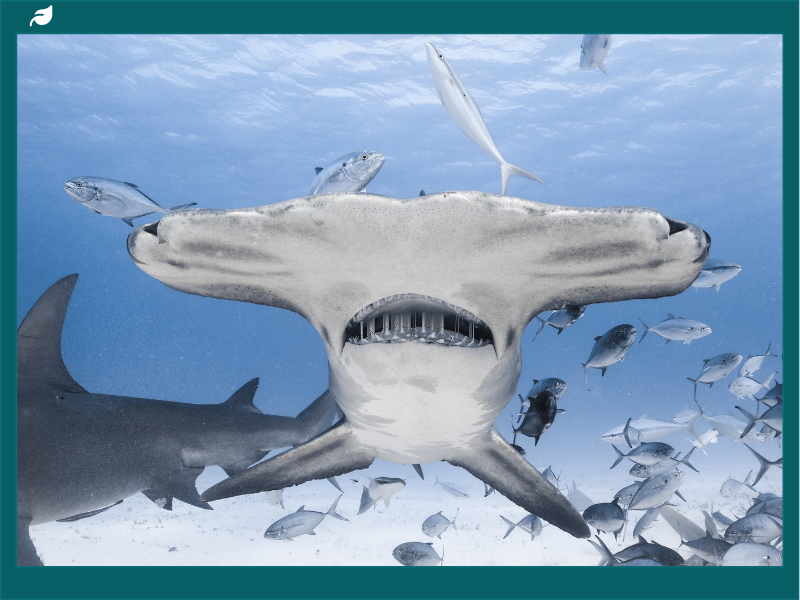
Start with the head, because everything else follows from it. The cephalofoil, that broad, flattened extension of the skull, is lined along its underside with ampullae of Lorenzini: tiny electroreceptor pores that pick up the faint bioelectric fields generated by living animals. Every muscle twitch, every heartbeat, every gill movement produces a small electric signal. The hammerhead shark reads those signals the way you’d read a text message.
A stingray lying flat under the sand, perfectly camouflaged, is still broadcasting. The great hammerhead, whose cephalofoil can span well over a metre on a large adult, essentially sweeps the seafloor like a metal detector, pinpointing prey before making contact.
The width of that head also separates the eyes further than in any comparable predator. Placed out on the tips of the hammer, those eyes give hammerheads a nearly 360-degree visual field. Think about that. Almost no blind spots at all.
They can watch what’s directly in front of them and directly behind them simultaneously, which matters enormously when you’re chasing agile prey through a coral reefs or trying to avoid a larger predator in open water. For a hunting animal operating in complex, visually busy environments like reef edges or kelp forests, that panoramic vision is a genuine competitive advantage that narrower-headed species simply can’t match.
Then there’s the hydrodynamics. A wider head generates more lift. Hammerheads use that lift the way a wing generates lift, keeping themselves buoyant with less muscular effort. That energy saving is real and significant for an animal covering large distances during seasonal migrations.
The scalloped hammerhead, which undertakes some of the longest documented migrations of any hammerhead species, benefits directly from this built-in efficiency. Researchers tracking individuals via satellite have recorded movements of hundreds of miles within single migration cycles, and that kind of sustained long-distance travel is only economically viable for an animal whose body is already working to minimise the energy cost of staying afloat.
And maneuverability. The broad head acts like a rudder. Hammerheads can execute tight, fast turns that a narrower-headed shark simply cannot match. The great hammerhead uses this to corner stingrays in shallow bays, pinning them with a bite from the cephalofoil before swallowing them whole.
Researchers have documented great hammerheads with stingray barbs lodged in their jaws and throats, apparently causing little distress. They seem almost designed to eat the one creature most other predators avoid.
The scalloped hammerhead shark and smooth hammerhead share these core anatomical advantages but apply them differently depending on habitat. The scalloped hammerhead’s cephalofoil has a distinctive notched front edge that gives the species its name, and that notching increases the surface area available for electroreceptor pores, giving scalloped hammerheads a particularly dense sensory array relative to their body size. The smooth hammerhead’s is, predictably, unnotched and slightly less laterally extended, which suits its preference for temperate, more open-water hunting. Even within the same family, the anatomy fine-tunes itself to the environment.
Varieties Within the Hammerhead Shark Species
Ten species. One family. And the differences between them go well beyond head shape. Each hammerhead species occupies a distinct ecological niche, prefers different water temperatures and depths, pursues different prey, and responds to human pressure in different ways.

Understanding that variety matters because a conservation strategy that works for one species may do nothing for another.
Notable Differences Among Hammerhead Species
The great hammerhead, Sphyrna mokarran, is the giant of the family. Adults regularly reach five and a half metres, and large individuals can exceed six. Solitary and wide-ranging, they gravitate toward tropical coastal waters and coral reef edges, hunting primarily at dawn and dusk. Their cephalofoil is the most dramatically angular of all the hammerhead species, with a nearly straight front edge.
That shape, combined with the dense concentration of ampullae of Lorenzini packed into it, makes them unmatched at detecting bottom-dwelling prey. Stingrays are the preferred target. The great hammerhead has been filmed actively pinning stingrays to the seafloor with its hammer before manoeuvring the ray into a position where it can bite off a wing. It’s methodical, almost surgical. According to the University of Miami Shark Research Institute, great hammerheads have also been observed employing a technique called “grasp-turning,” where they burst-swim at tight turning angles while grasping prey, using water force to manoeuvre it into their jaws, followed by a post-predation recovery period of maintaining a head-first orientation to facilitate respiration.
What’s particularly striking is that great hammerheads appear to show individual prey preferences, with some individuals specialising so heavily in stingrays that stingray material dominates their stomach contents almost exclusively, even in areas where other prey is abundant.
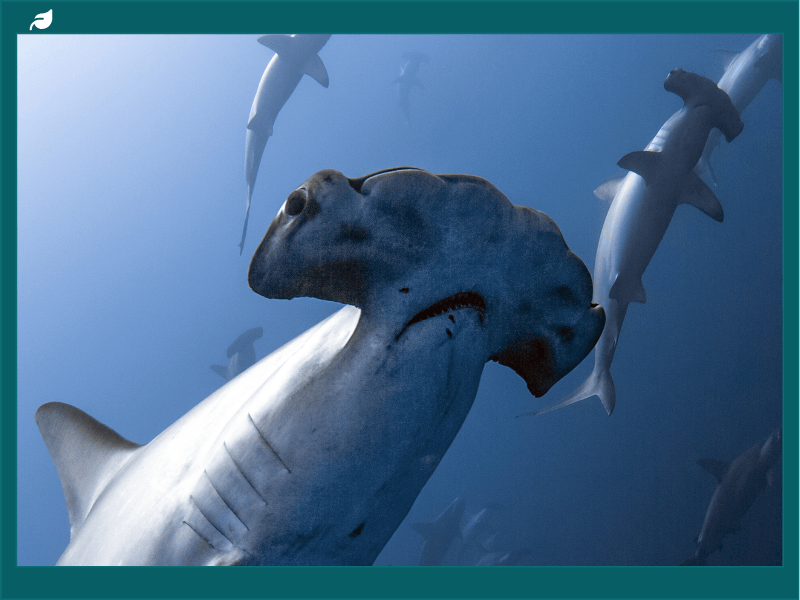
The scalloped hammerhead, Sphyrna lewini, is arguably the most studied of all the hammerhead species, and for good reason. Scalloped hammerheads aggregate in extraordinary numbers, sometimes forming schools of several hundred individuals around seamounts and underwater ridges during the day, dispersing to hunt individually at night. The reasons for this schooling behaviour are still debated among researchers. Some evidence points to social bonding and mate selection; other research suggests the seamounts serve as navigational reference points during long-distance migration.
Whatever the reason, the spectacle of a few hundred scalloped hammerheads spiralling around a submerged peak in the Pacific is one of the most striking sights in the ocean, the kind of scene that marine photographers travel weeks to reach and that dive operators in the Galápagos and Hawaii have built entire businesses around.
The scalloped cephalofoil, that distinctive notched front margin, is less angular than the great hammerhead’s, which gives scalloped hammerheads slightly different hydrodynamic properties. They tend to inhabit deeper water along continental shelves, using their sensory array to detect pressure changes and electric signals in low-visibility conditions. They’re also more broadly distributed than many people realise, appearing in the Atlantic, Pacific, and Indian Oceans, including around Australia and across parts of the Mediterranean.
Sphyrna tudes, the smalleye hammerhead, is a very different animal. Small, relatively slender, and adapted to turbid estuarine and coastal environments along the western Atlantic, it operates in shallow water where visibility can be near zero. Its cephalofoil is streamlined compared to the great hammerhead or scalloped hammerhead, favouring speed and agility over raw sensory coverage. This makes it effective at ambushing fast-moving prey in tight, murky spaces, the kind of environment that would frustrate a larger, less manoeuvrable species.
The smooth hammerhead, Sphyrna zygaena, is the temperate specialist. Where the great hammerhead and scalloped hammerhead favour tropical and subtropical waters, the smooth hammerhead ranges into cooler seas, turning up regularly off southern Australian coastlines, through the Atlantic, and into the Mediterranean. Its cephalofoil is the least laterally extended of the larger hammerhead species, and its front edge lacks the notching of the scalloped. This gives it a more streamlined profile suited to open-water hunting across diverse habitats, from coastal shallows to pelagic zones.
Smooth hammerheads are also more tolerant of cooler water temperatures than most hammerhead species, which explains their broader latitudinal range. That tolerance cuts both ways: it opens up habitat unavailable to their tropical relatives, but it also brings smooth hammerheads into contact with temperate net fisheries that operate largely outside the public and regulatory attention focused on tropical shark fishing hotspots.
What links all these species is the fundamental genius of the hammerhead design. The cephalofoil is not one solution to one problem. It’s a platform that different species have customised through millions of years of evolution to solve very different problems in very different environments.
The Bonnethead Shark: A Distinct Member of the Hammerhead Family
The bonnethead breaks most of the rules people assume apply to sharks. It’s the smallest of the hammerhead family, rarely exceeding 1.5 metres. It prefers warm, shallow estuaries and bays along American coastlines. And it eats seagrass.
Not occasionally, not accidentally. Deliberately, in significant quantities.
Sphyrna tiburo is technically omnivorous, which makes it genuinely unusual among sharks. Studies have confirmed that seagrass can make up more than half of the bonnethead’s gut contents at certain times of year, and that the species has digestive enzymes capable of breaking down plant matter and extracting nutrients from it. This isn’t a shark accidentally swallowing vegetation while chasing a crab. The bonnethead actively grazes seagrass beds and digests what it eats.
It also disperses seeds through its digestive process, which means it’s functioning as a partial ecosystem engineer in seagrass habitats in the same way that certain fish and turtles do. That seed dispersal role is not trivial: seagrass meadows are among the most productive and carbon-storing habitats in coastal marine environments, and the bonnethead is quietly helping to maintain them.
Its cephalofoil is the most rounded of all the hammerhead species, closer to a shovel or spade shape than the angular or notched designs seen in its larger relatives. That shape improves hydrodynamic efficiency in the tight, shallow environments the bonnethead prefers, where sharp turns around mangrove roots or through seagrass meadows matter more than long-distance sensing range.
For its primary prey, crustaceans and small fish, the bonnethead uses the same electroreceptive system that makes larger hammerheads such effective hunters. The sensory advantage scales down but doesn’t disappear. A shrimp buried under a centimetre of silt is still giving off a detectable electric signal, and the bonnethead finds it. Given the turbid, low-visibility conditions the bonnethead frequently operates in, that electroreceptive ability is arguably more important to its hunting success than vision is, which makes the electroreceptor-dense cephalofoil just as critical to a 1.2-metre estuarine omnivore as it is to a six-metre apex predator on a tropical reef.
What the bonnethead illustrates is how much adaptive range exists within a single family blueprint. The great hammerhead is a six-metre apex predator pinning stingrays on tropical reefs. The bonnethead is a 1.2-metre omnivore grazing seagrass in a Florida estuary. Both are hammerheads.
Both are using variations of the same fundamental skull design. The breadth of ecological roles the Sphyrna genus fills across marine environments is striking, and the bonnethead sits at one of its most unexpected extremes.
Ecological Role and Behavior of Hammerhead Sharks
Hammerhead sharks are not just interesting animals. They’re functional components of the ecosystems they inhabit, and when their numbers drop, those ecosystems feel it.
How Hammerhead Sharks Contribute to Marine Ecosystems
Apex predators regulate prey populations. That’s the simple version. The longer version is that the great hammerhead, scalloped hammerhead, smooth hammerhead and their relatives each sit near the top of their respective food webs, keeping prey species at population levels the ecosystem can support. When hammerhead numbers fall through overfishing or bycatch, prey species that were previously kept in check can surge.
Those surging species then overconsume their own food sources. The destabilisation runs down multiple trophic levels, and rebuilding a disrupted food web is far harder than maintaining a functioning one. Some marine ecologists describe this kind of top-down regulation as a keystone function, meaning the predator’s presence is disproportionately important to overall ecosystem stability relative to its actual biomass. Remove the keystone, and the arch collapses.
Beyond population regulation, hammerheads move nutrients around. The scalloped hammerhead’s long seasonal migrations carry biological material across large stretches of ocean, connecting ecosystems that would otherwise remain nutrient-isolated. When a large shark feeds in one area and defecates in another hundreds of miles away, it’s performing a nutrient transport function that no other mechanism replicates at that scale. Marine science has increasingly recognised this as a genuine ecosystem service, not a metaphor.
The same logic applies to the great hammerhead’s movements across reef systems: a single large individual ranging between reef complexes is redistributing phosphorus and nitrogen in ways that subtly but measurably affect the productivity of the reefs it visits.
The scalloped hammerhead’s schooling behaviour has attracted more research attention than almost any other aspect of hammerhead biology. These aggregations are not random. Individuals in large schools at seamounts display clear social hierarchies, with larger females typically occupying the centre of the group and smaller, younger animals on the periphery. The mechanisms by which hundreds of sharks coordinate their movements without apparent communication are still being studied.
What’s clear is that these groupings serve functions beyond simple safety in numbers, and disrupting them through fishing pressure has consequences for the social structure of the population that extend beyond the individuals removed. Younger animals that learn migratory routes partly through association with older, more experienced individuals in school aggregations may lose that navigational knowledge when the older individuals are removed. The effect is difficult to measure directly, but the concern is taken seriously in current research.
NOAA Fisheries has documented how heavily hammerhead populations have been affected by both targeted fishing for fins and incidental bycatch in longline fisheries. The scalloped hammerhead in particular appears frequently in bycatch data because its migratory routes take it through areas of intense commercial fishing activity. Each individual lost to bycatch is not replaced quickly: hammerheads are slow to mature and produce small litters, which means populations rebuild slowly when fishing pressure eases, and sometimes don’t rebuild at all if that pressure is sustained. A scalloped hammerhead female doesn’t reach sexual maturity until around fifteen years of age, and produces litters of between fifteen and thirty pups after a gestation period of around nine to ten months.
Compare that reproductive rate to the fish species hammerheads prey on, which can produce thousands of offspring per spawn, and you start to understand why the maths of population recovery is so unfavourable.
The smooth hammerhead faces similar pressures in its temperate range. Australian fisheries have recorded significant bycatch of smooth hammerheads in net fisheries, and the species turns up regularly in the fin trade despite its temperate habitat keeping it out of the most heavily patrolled tropical fishing zones. Because smooth hammerheads aren’t associated in the public imagination with the dramatic schooling images of scalloped hammerheads or the sheer size of great hammerheads, they attract less conservation attention, and less attention means less pressure on the fisheries management bodies responsible for their oversight.
What makes hammerhead sharks particularly valuable as indicators of marine ecosystem health is their position at the top of the food web combined with their sensitivity to habitat degradation and fishing pressure. A healthy population of hammerheads in a given marine area is a reasonable signal that the ecosystem below them is functional. A declining hammerhead shark population is a signal that something beneath them is wrong.
Conservation Status and Efforts
Several hammerhead species are in serious trouble, and the numbers make that clear. The scalloped hammerhead has been listed as endangered by the IUCN and by NOAA, with population estimates suggesting declines of more than 80 percent in parts of its range over the past few decades. The great hammerhead carries a critically endangered designation from the IUCN. The smooth hammerhead sits at vulnerable.
These are not precautionary classifications made on thin evidence. They reflect documented, measured population crashes driven overwhelmingly by fishing pressure, both targeted and as bycatch.

The scalloped hammerhead’s endangered status became one of the more significant flashpoints in international shark conservation when it was listed under CITES Appendix II in 2013, a move that required international trade in its fins and products to be monitored and regulated. That listing didn’t stop the trade, but it created an enforcement framework that hadn’t existed before, and it put the scalloped hammerhead’s name into international trade law in a way that made ignoring its plight considerably harder. Enforcing that framework at ports and processing facilities remains difficult, partly because fins from different species are hard to distinguish once dried and processed, and partly because the volume of the global fin trade makes thorough inspection impractical with current resources. The scalloped hammerhead is endangered in much of its range, and that endangered classification carries real legal weight in the countries that have chosen to act on it.
NOAA Fisheries has implemented a series of measures targeting hammerhead shark conservation in US waters, including catch limits, gear restrictions designed to reduce bycatch, and the designation of essential fish habitat areas where certain fishing methods are restricted. The Endangered Species Act in the United States gives NOAA authority to impose these restrictions on listed species, which the scalloped hammerhead gained in 2014. That listing under the act required NOAA to develop a recovery plan, conduct regular status reviews, and consult on any federal action that might affect the species. The act also mandates consultation on fishing permits in relevant areas, which means a new fishing permit in scalloped hammerhead habitat cannot be issued without an explicit assessment of the impact on the listed species.
This creates a procedural obstacle to the kind of quietly expanded fishing effort that has historically eroded shark populations before anyone noticed. The act’s consultation requirement has real teeth, and the scalloped hammerhead’s endangered listing has triggered it repeatedly in practice. Beyond the scalloped hammerhead, the broader act framework provides a template for protecting other hammerhead species if their status deteriorates to the point where listing becomes necessary.
The IUCN’s assessments have consistently pointed to inadequate management within global fisheries as one of the primary drivers of hammerhead population declines. The original stock sizes for most hammerhead species are now extremely difficult to reconstruct because systematic data collection didn’t begin until populations were already substantially reduced. Trying to set meaningful recovery targets when the baseline is uncertain is one of the hardest problems in shark conservation science, and the hammerhead case illustrates it sharply. Without a reliable original population estimate, it’s genuinely difficult to say whether a recovering population is approaching 30 percent of its former size or 5 percent, and that uncertainty makes the design of effective management measures significantly harder.
Australian fisheries management has had to grapple specifically with the smooth hammerhead and, to a lesser extent, the scalloped hammerhead in its northern waters. Australian regulations have progressively tightened over the past two decades, with prohibited species lists expanded and bycatch reporting requirements strengthened. Marine protected areas established off the Australian coastline have provided some refuge, though the migratory nature of hammerheads means no single MPA captures more than a portion of an individual shark’s annual range. The Australian approach has also increasingly incorporated Indigenous ecological knowledge in the identification of critical habitat areas, which has in some cases identified seasonal aggregation sites that scientific surveys had missed.
Marine protected areas are part of the solution but not the whole of it. A scalloped hammerhead that spends part of the year inside a protected area and part of the year in international waters where fishing is largely unregulated gets only partial protection. Effective conservation for a migratory species requires international coordination, which is slow, politically difficult, and expensive to enforce. The Regional Fisheries Management Organisations that cover the high seas have adopted some measures protecting hammerhead species, but compliance and enforcement remain inconsistent.
In 2020, updated IUCN assessments reinforced the urgency of the situation for multiple hammerhead species, with the great hammerhead’s status elevated to critically endangered based on continued population decline data. The 2020 reassessments drew on improved survey methods and longer data series than previous evaluations, making the conclusions harder to dispute. The science was clearer. The news was worse.
And the 2020 findings fed directly into subsequent negotiations at international fisheries bodies, with conservation organisations citing them in arguments for stricter high-seas protections that are still working their way through the relevant policy processes.
Public education has become an increasingly important lever in hammerhead conservation. Shark fin soup demand, which drives much of the targeted fishing pressure on large hammerhead species, has declined in some markets following sustained consumer awareness campaigns. China, the dominant market for shark fin, saw measurable reductions in fin consumption in the years following high-profile campaigns tied to cultural events and celebrity endorsements. The trajectory is not linear and the trade remains substantial, but the direction of change in some key markets has shifted.
Hotels and airlines removing shark fin from their menus may seem like a symbolic gesture in isolation, but the cumulative effect of those decisions on the social acceptability of fin consumption in key markets is real and measurable.
Ecotourism has created direct economic incentives for hammerhead conservation in some locations. The Galápagos Islands, where scalloped hammerheads aggregate in large numbers, generate significant revenue from dive tourism built around shark encounters. A live hammerhead swimming over a seamount is worth considerably more to a local economy than the same hammerhead dead in a finning boat. That economic argument doesn’t automatically translate into better fishing regulations, but it creates constituencies with financial reasons to advocate for protection, which matters in policy processes.
The dive tourism industry in the Galápagos has explicitly lobbied for stronger marine protection in that region, and the expansion of the Galápagos Marine Reserve in recent years reflects, at least in part, the economic weight of that constituency.
Research continues to build the biological and ecological knowledge base that effective conservation depends on. Satellite tagging studies have mapped migration routes for scalloped hammerheads across the Pacific and Atlantic with a precision that wasn’t possible twenty years ago. That route data is directly useful for identifying which stretches of ocean need the strongest fishing restrictions. Genetic studies are clarifying how distinct regional populations are, which matters for management: a heavily fished Australian population and a recovering Pacific population may look like the same species on a map but be genetically isolated, meaning recovery in one place doesn’t substitute for collapse in another.
The combination of satellite tracking, genetic analysis, and improved bycatch reporting is giving fisheries science a clearer picture of hammerhead movements and vulnerabilities than it has ever had before, and that improved picture is increasingly feeding into specific regulatory proposals at both national and international levels.
The honest summary is this: hammerhead sharks, particularly the scalloped hammerhead and great hammerhead, are declining, the declines are driven by fishing, and the conservation measures in place are insufficient to reverse those declines in most parts of the world. The endangered classifications are accurate. The tools to address the problem exist. The science is solid.
These sharks have been refining a remarkable design for tens of millions of years. It would be an extraordinary failure of imagination, and of stewardship, to lose them to a few decades of poorly managed fishing.