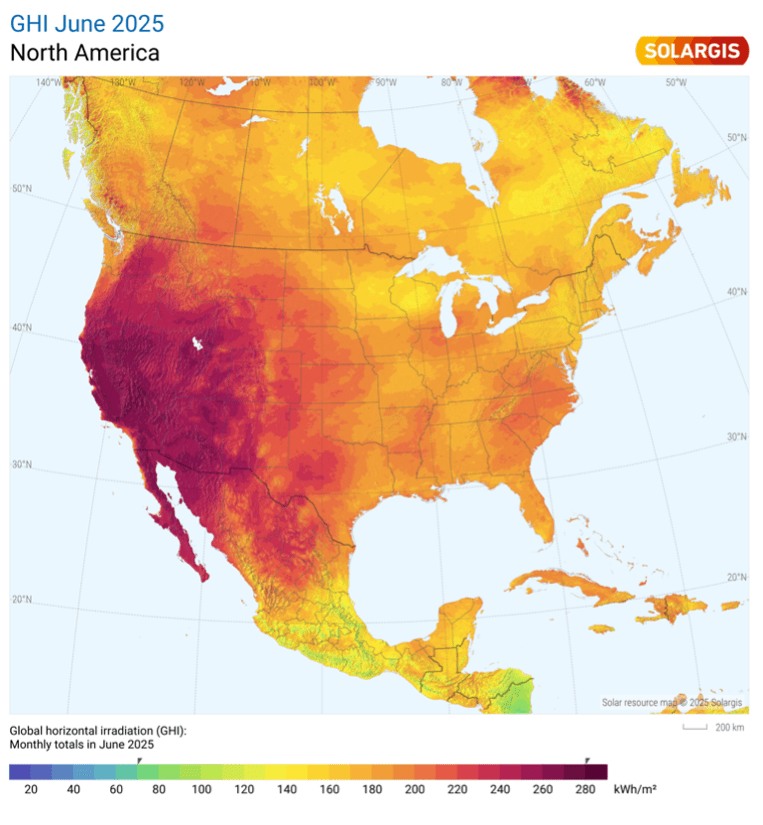
This summer’s extreme heatwave across the U.S. Northeast, Midwest, and Southeast has laid bare critical weaknesses in utility-scale solar operations. According to a new analysis by Solargis, rising ambient temperatures and volatile real-time energy markets are testing the limits of current forecasting tools, storage strategies, and asset resilience – especially in merchant-exposed markets.
The June heat dome caused real-time electricity prices to spike above $2,000/MWh in several key Independent System Operators (ISOs), such as NYISO and MISO. Meanwhile, Day-Ahead prices remained under $500/MWh, creating dangerous gaps in planning and profitability. For solar operators, even slight forecasting errors under these conditions resulted in steep financial penalties.
At the heart of the issue is an emerging disconnect between current operational models and the intensifying variability of climate events.
Battery Storage as a Grid Stabilizer
While much of the Northeast was caught unprepared, regions like Texas demonstrated the stabilizing effect of robust battery energy storage systems (BESS). ERCOT’s battery fleet, which now exceeds 7.5 GW of capacity, helped absorb demand spikes and generation shortfalls during peak stress periods. This capability has proven vital: ERCOT’s risk of issuing a summer Energy Emergency Alert dropped from 15% in 2024 to just 3% in 2025, according to the latest Federal Summer Reliability Assessment.
During June, average evening battery discharges in ERCOT jumped from 238 MW to 714 MW, peaking at over 4 GW. These discharges not only averted grid emergencies but highlighted the necessity of storage investments in regions still lacking them.
The contrast underscores a growing divide: storage-rich states are building climate resilience into their systems, while others face increasing exposure to price spikes and reliability issues.
Forecasting Challenges in a Warming World
For solar assets operating in merchant or quasi-merchant positions, the margin for forecasting error is narrowing fast. Long-term Power Purchase Agreements (PPAs) are becoming less common, placing greater importance on real-time performance and price responsiveness. Yet, forecasting models still largely rely on static assumptions and “typical year” datasets that can’t capture today’s intensifying variability.
“Traditional Day-Ahead generation forecast data based on basic solar irradiance and meteorological data are no longer sufficient on their own,” said Giridaran Srinivasan, CEO, Americas, at Solargis. “What’s needed is a more integrated view that accounts for not just solar resource variability, but also ambient temperature fluctuations, aging asset performance, and the historical patterns of market price volatility.”
Solargis advocates for using decades-long Time Series datasets and volatility-weighted models to anticipate performance deviations, particularly under high-risk conditions like heatwaves. Their work with asset operators aims to improve both the accuracy of forecasts and the criteria used to evaluate project viability from the outset.
Aging Infrastructure, Elevated Risk
While modern plants face environmental variability, older installations confront an additional layer of risk: technological limitations. As ambient temperatures rise, so too does the module temperature – a factor that can cause output to degrade in real time. Aging inverters and narrower Maximum Power Point Tracking (MPPT) voltage ranges further exacerbate these losses, especially under extreme heat.
“Heat dome conditions highlight how a reliance on conventional forecasting models, which often fail to fully capture the impact of extreme weather variability on solar performance, leaves operators exposed to high levels of financial risk,” said Srinivasan. “In high-temperature conditions, older assets with narrower MPPT voltage ranges are particularly vulnerable to output degradation, which is an operational reality that must now be factored into forward-looking forecasts.”
The combination of degraded module efficiency and outdated inverter behavior under stress conditions is becoming increasingly consequential, especially as the economics of solar shift toward real-time market exposure.
Data as a Strategic Asset
Improved forecasting isn’t just about operational efficiency. It also enables deeper diagnostics. According to Solargis, analyzing post-event performance with context-aware datasets allows operators to distinguish between weather-related variability, technical issues, and operational shortcomings.
“We’re working closely with traders and asset operators to improve the forecasting inputs used for day-ahead and real-time market participation,” Srinivasan explained. “This also includes refining how they evaluate project design in the first place by helping them factor in temperature anomalies and historical patterns of extreme weather at specific sites. Our enhanced models integrate real-world generation data and apply volatility-weighted adjustments, providing a more accurate forecasted generation in uncertain conditions.”
Such tools are being increasingly adopted not only for bidding strategies but also for broader asset management, particularly in repowering or performance optimization scenarios for legacy systems.
Global Implications of Regional Heat
The U.S. heat dome is not an isolated phenomenon. Similar trends were observed earlier this year in Europe. Spring 2025 marked one of Western Europe’s sunniest on record, with some regions recording up to 50% more Global Horizontal Irradiation (GHI) than 30-year averages. While beneficial for energy yield, these anomalies stress the need for enhanced forecasting tools that can keep pace with a rapidly changing climate.
As solar penetration deepens and PPAs decline, the sector’s exposure to real-time price volatility, performance uncertainty, and climatic stress will only increase. Solargis’ findings suggest that legacy approaches to forecasting and asset evaluation are insufficient in this new environment.
To remain competitive -and operationally resilient – solar operators must evolve beyond conventional tools. Integrated, high-resolution, and volatility-weighted forecasting systems are no longer a luxury, but a necessity for navigating an era of climate uncertainty.
Looking for a solar installer?
Compare MCS-certified solar panel installers across the UK in our directory, with ratings, reviews and free quotes, listed by county.
Related solar guides: