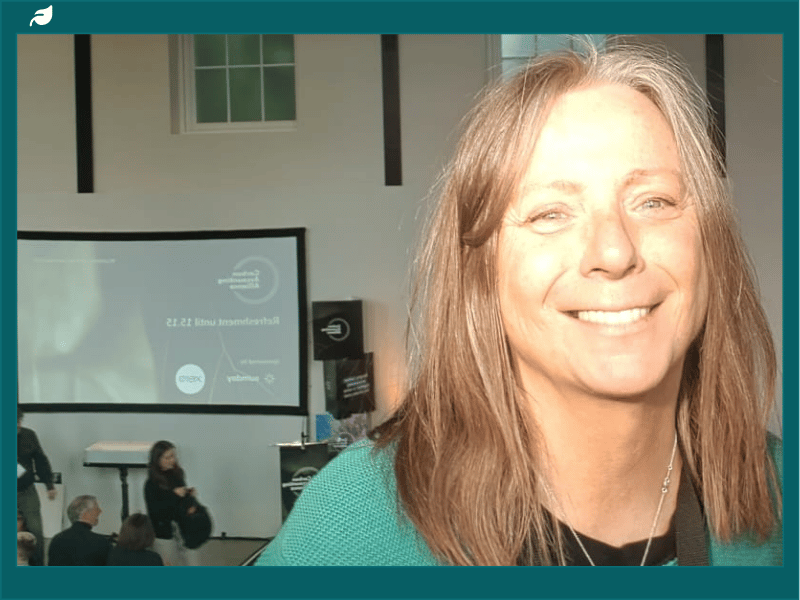
I’m Emma Littlewood, Director of Policy and Research at 51toCarbonZero. I’ve spent over 15 years working in carbon accounting, climate risk and sustainability and ESG strategy, including designing and developing one of the first web-based carbon measurement tools.
At 51toCarbonZero, my work focuses on climate policy and sustainability strategy, as well as advancing the methodologies and frameworks that underpin how organisations measure, manage and reduce emissions and climate risks. That includes areas such as GHG inventory modelling, climate risk analysis and alignment with frameworks like SBTi and the CSRD – making sure that what we’re doing in the platform reflects best practice and keeps pace with evolving standards.
What is 51toCarbonZero and how does the platform help organisations move from climate ambition to measurable action?
51toCarbonZero is a climate technology and advisory platform designed to help organisations move from ambition to action. It consolidates an organisation’s full carbon footprint into a single, structured view, providing real-time data, compliance-ready reporting and clear, actionable insights to drive decarbonisation.
The gap we see most often isn’t intent, it’s execution. Organisations know they need to act, but struggle to understand where their emissions really sit, what to prioritise, and how to move from data into decisions. The platform addresses this by combining automated measurement with modelling, target-setting and reduction tracking, all backed by advisory expertise.
The result is that sustainability stops being a standalone reporting exercise and becomes embedded into core business functions such as procurement, operations, and strategy, rather than treating sustainability as a standalone reporting exercise.
You have over 15 years of experience in climate risk and carbon management – what initially drew you to this field?
It was a combination of values and aptitude. I’ve always been driven to try to make the world a better place – for people, animals and the planet. When I started to really understand the scale of the negative impacts humans were having on the environment, it felt both urgent and natural to apply my skills in maths and science to that challenge. The climate and nature arena offered a place where technical work could have genuine real-world consequences, and that felt important.
You were involved in developing one of the first carbon accounting SaaS platforms – how has carbon measurement technology evolved since then?
I developed one of the first web-based carbon accounting tools back in 2012 because there simply wasn’t anything suitable available at the time. We were working from a standalone Access database, and most of the tools on the market were unwieldy, locally installed systems that relied heavily on manual data entry.
Since then, the space has evolved significantly. There are now hundreds of carbon accounting tools, and the technology has shifted from static, database-driven systems to fully integrated SaaS platforms. These can connect directly with ERP systems and live data sources via APIs, offering dynamic dashboards and far more sophisticated modelling capabilities.
More recently, AI has begun to play a meaningful role in streamlining data collection and surfacing insights. Used carefully, it can significantly reduce the burden of data gathering and improve the quality and speed of decision-making.
Overall, carbon measurement has moved from being a manual, time-consuming exercise to something far more automated, integrated and actionable.
What are the biggest challenges organisations face when trying to accurately measure and manage their emissions?
The biggest challenge is still data – particularly for scope 3 emissions, which typically account for the majority of a company’s footprint but sit outside direct control. Organisations often rely on inconsistent or incomplete supplier data, and methodologies are still evolving across sectors, which can make like-for-like comparison difficult.
There is also a tendency to over-focus on measurement at the expense of action. Many organisations invest significant time in building a detailed baseline, but struggle to translate that into prioritised, operational decisions.
In practice, the challenge is not just technical, but organisational – aligning sustainability, finance, procurement and operations around a shared view of emissions and the responsibility for reducing them.
How does 51toCarbonZero simplify complex sustainability data and turn it into actionable insights for businesses?
The platform consolidates fragmented data sources into a single, coherent system, allowing organisations to move from multiple spreadsheets and estimates to a structured, auditable view of emissions.
Crucially, it doesn’t stop at measurement – which is where a lot of tools fall short. It identifies emissions hotspots, models reduction scenarios and tracks progress against targets, so businesses can prioritise the actions that will have the greatest impact rather than trying to do everything at once.
Combining this with advisory support, means organisations can move more quickly from insight to implementation – embedding sustainability into day-to-day decisions rather than treating it as a periodic reporting cycle.
Can you explain the importance of science-based targets and how organisations can successfully align with SBTi requirements?
Science-based targets are important because they provide a clear, credible framework for reducing emissions in line with climate science. They ensure that organisations are not setting arbitrary targets, but are aligning their reductions with what is required to limit global warming.
To successfully align with SBTi requirements, organisations need to start with a robust and well-defined emissions baseline across all scopes. From there, it’s about setting targets that are consistent with the relevant pathways and developing a practical plan to reduce emissions over time.
A key focus area is scope 3 emissions, which typically represent the largest share of a company’s footprint but are also the most complex to address. This means engaging suppliers, improving data quality and embedding emissions considerations into procurement and operational decisions.
Alignment with SBTi is not just about target-setting – it requires ongoing measurement, transparency and integration into core business strategy to ensure that progress is both credible and sustained.
Having sat on the SBTi Technical Advisory Group, what insights did you gain about the future direction of corporate climate targets?
One of the headline changes in the forthcoming Corporate Standard v2.0 is the introduction of new scope 3 mitigation options, including the use of Environmental Attribute Certificates (EACs). This concept is already well established in scope 2 accounting through Renewable Energy Certificates.
In practice, this means companies tackling value chain emissions may be able to demonstrate reductions through the use of lower-carbon products and services, rather than relying solely on year-on-year absolute emissions reductions. The intention is to make it easier for organisations to apply leverage within their supply chains, using market-based mechanisms to drive change.
At the same time, there will be tighter rules around the use of RECs in scope 2, alongside alignment with the updated GHG Protocol Standard – reflecting a broader shift towards more robust and practical approaches to corporate climate target-setting.
As an ESOS Lead Assessor, what practical steps can organisations take to reduce energy consumption and carbon emissions across operations?
The range of practical options is broader than many organisations realise, and it varies significantly depending on how much of a building you occupy and what your operations involve.
For organisations in shared buildings, the most effective starting points are often behavioural: switch-off campaigns, lower-carbon IT procurement, timers on equipment, training staff on heating and cooling controls, and solar shading where there are large glass areas. These are typically low- or no-cost interventions that can deliver immediate impact.
For whole-building occupiers, there are more substantial opportunities including optimising building management systems, removing dead bands, raising data centre temperatures to around 23°C, and transitioning away from fossil fuel heating towards air source heat pumps or radiative systems. Solar PV is worth exploring even in locations without high levels of direct sunlight.
For fleets, the priority is electrification, supported by on-site charging infrastructure and salary sacrifice schemes where appropriate.
In industrial settings where natural gas is a major energy source, full fuel switching can be challenging. But audits consistently identify efficiency improvements that deliver meaningful reductions in the near term, even where larger transitions aren’t yet feasible.
How do you approach decarbonisation across complex areas such as supply chains, manufacturing and logistics?
These areas are inherently complex because they involve multiple actors, geographies and data sources, often with limited visibility or control.
The starting point is always to establish a clear, practical view of where emissions sit, and then prioritise the highest-impact areas. In most cases, that means focusing on a relatively small number of activities or suppliers that account for a large proportion of emissions.
From there, it becomes a question of engagement and integration; working with suppliers to improve data quality and performance, and embedding emissions into procurement and operational decision-making. The most effective organisations treat decarbonisation as a cross-functional process, rather than something owned solely by sustainability teams.
What role does climate risk play in business decision-making today, and how should companies be responding?
Climate risk is increasingly material to business performance, both in terms of physical risk – such as extreme weather and supply chain disruption – and transition risk, including regulation, market shifts and changing customer expectations.
What we’re seeing now is a shift from climate being viewed as a reputational issue to being recognised as a financial and operational one. That means it needs to be quantified, understood and integrated into core decision-making processes.
Companies should be incorporating climate risk into their strategic planning alongside other significant business risks – in scenario analysis, investment decisions and long-term strategy. The companies that get ahead of this will be better placed; those that don’t are accumulating exposure they may not yet fully appreciate.
How is regulation, such as CSRD, shaping the way organisations approach sustainability and reporting?
Regulation is fundamentally changing the way organisations approach sustainability. Frameworks like CSRD are moving the conversation from voluntary disclosure to mandatory, standardised reporting, with a much stronger emphasis on accountability and auditability.
The concept of double materiality is particularly significant. It requires companies to assess not only how climate change affects their business, but how their activities impact the environment and society. That’s a genuinely different frame, and it’s pushing sustainability into core governance structures rather than sitting alongside them.
The practical effect is increased demand for robust data, coherent systems and genuine internal alignment, which is exactly where a platform like 51toCarbonZero becomes essential rather than optional.
51toCarbonZero recently integrated Green Element – how has this strengthened your offering and capabilities?
The integration of Green Element has been a really significant development for us. Green Element was founded in 2004 and spent two decades building deep expertise in science-based sustainability advisory – supporting hundreds of organisations across sectors including marketing and advertising, professional services, food and beverage and healthcare.
What the integration brings is a step change in advisory depth. We now have enhanced capability across climate risk analysis, lifecycle assessments, materiality assessments, and CSRD reporting – areas that go beyond pure carbon reduction and allow us to support businesses with the full breadth of their sustainability challenges.
For clients, the combination of Green Element’s expertise and 51-0’s AI-powered platform means they get both high-level strategic counsel and the scalable technology to execute on it. It also means we’re now one of the largest and fastest-growing climate technology and advisory platforms in the UK, with a genuinely integrated proposition – something that was previously hard to find in a single partner.
You are deeply involved in initiatives such as Tech Zero, AdNetZero and the Carbon Accounting Alliance – how important is collaboration in accelerating climate action?
Collaboration is absolutely essential. Climate change and carbon management are still relatively nascent fields – for practitioners, and even for scientists to an extent. We are continuously developing methods for measuring and managing emissions, as well as climate-related risks and opportunities. Many sector-specific methodologies are still evolving or, in some cases, not yet fully developed.
AdNetZero is a strong example of what collective effort can achieve. It has brought together experts from across the industry to develop a robust and practical set of formulae for calculating emissions across all types of advertising – print, digital, OOH, DOOH and audio. This has required extensive collaboration within the Climate Science Expert Group, of which I’m a member, and across the wider AdNetZero community to ensure the methodology is both credible and workable in practice.
Tech Zero is also a valuable network, enabling members to share ideas, insights and practical solutions from reducing the energy and carbon embedded in software and hardware, to developing approaches for emerging areas such as AI.
And the Carbon Accounting Alliance, of which we were a founding member, has grown into a global community focused on establishing best practice in carbon measurement, reduction and target-setting. It plays an important role in developing and interpreting new standards, including areas such as land use and removals. The recent introduction of a formal certification is a significant step forward in ensuring consistency and credibility across the industry.
How can businesses move beyond compliance and start seeing sustainability as a driver of competitive advantage?
The shift happens when sustainability is integrated into how the business operates, rather than being treated as a reporting requirement.
Organisations that make this transition well use sustainability data to inform decisions on procurement, operations, product development and investment. That can drive efficiencies, reduce risk and strengthen relationships with customers, investors and suppliers.
Increasingly, it’s also becoming a commercial necessity. Sustainability credentials are actively influencing procurement decisions and access to markets, which moves it firmly out of the ‘nice to have’ category. Done well, it becomes a source of differentiation and resilience – not a cost centre.
What role do technology platforms play in embedding sustainability into everyday business decisions?
Technology platforms like 51toCarbonZero play a critical role in making sustainability data usable and actionable across an organisation. Without this, sustainability often remains a periodic reporting exercise rather than something that actively informs decision-making.
By consolidating emissions data into a single, structured view and integrating it with existing business systems, platforms enable organisations to understand where their impact sits and how different decisions affect their footprint. That could be anything from procurement choices and supplier selection to operational changes or investment decisions.
Importantly, they make this information accessible beyond the sustainability team. When emissions data is visible and embedded into day-to-day workflows, it allows finance, procurement and operations teams to factor sustainability into their decisions in a practical way.
In that sense, technology platforms are not just about measurement – they are an enabler of behaviour change, helping organisations move from insight to consistent, organisation-wide action.
How do you see the relationship between sustainability, human rights and climate justice evolving in corporate strategies?
We’re starting to see more integration between sustainability, human rights and climate, particularly as frameworks evolve. With developments like CSRD, financial and environmental impacts are being brought together through concepts such as double materiality, and risks are increasingly being assessed not just in terms of climate, but also nature. ESG standards are also becoming more sophisticated, and climate justice is beginning to appear more frequently in reporting and questionnaires.
However, it’s still not well understood in practice. The negative impacts of fossil fuel extraction, pollution, mining, industrial agriculture and even some climate solutions are often borne by populations with the least power and smallest voice. Multinational corporations can factor environmental risks into financial planning in a way that limits accountability, leaving affected communities with little influence.
Climate justice recognises that climate change directly impacts fundamental rights such as life, health, food and water, particularly for vulnerable and marginalised populations who contribute least to the crisis. While awareness is growing, these principles are not yet meaningfully embedded in most corporate strategies, and there is still a long way to go before a truly just transition is realised.
What advice would you give to organisations at the beginning of their Net Zero journey?
There’s a common mantra that you can’t reduce what you haven’t measured, but I don’t entirely agree with this. In many cases, the first steps are already obvious – if your company has vehicles, you can look at decarbonising your fleet, optimising routes, and improving driver behaviour. If you operate buildings, you review heating and power sources, make better use of natural ventilation and lighting, and rationalise IT equipment.
Start by identifying the low-hanging fruit – the practical actions that are feasible now. Taking action doesn’t need to wait for a perfect, fully comprehensive carbon footprint, particularly as baselines often evolve over time as data improves.
At the same time, it’s important to put the right foundations in place. Choose a web-based easy-access transformation tool that provides target-setting, carbon measurement, and carbon reductions and tracking all in one place, and takes the pain out of data ingestion through automated bill reading, APIs and AI-driven document reading.
Finally, engage people across the organisation and supply chain. Ask for their input on where improvements can be made. Bringing colleagues and suppliers into the process helps turn Net Zero from an ambition into a shared, collaborative effort.
What are the most common misconceptions businesses have about achieving Net Zero?
One of the most common misconceptions is that achieving Net Zero is inherently expensive and a drag on business performance. In reality, the opposite is often true. Many of the actions that reduce emissions such as improving energy efficiency, optimising operations or making better procurement decisions, also reduce costs and improve resilience. In practice, more sustainable businesses tend to be more efficient and better positioned commercially.
Another misconception is that organisations need a perfect, fully comprehensive carbon footprint before they can start taking action. Many of the highest-impact reduction opportunities are already clear, and waiting for perfect data can delay meaningful progress.
There is also a tendency to see Net Zero as a reporting or compliance exercise. While measurement is essential, it is only the starting point – real progress comes from embedding sustainability into how decisions are made across the business.
Finally, scope 3 emissions are often seen as outside an organisation’s control. In reality, they represent the largest share of emissions for most businesses, and engaging suppliers is critical to achieving meaningful reductions.
Looking ahead, what trends do you expect to shape the future of carbon management and climate action over the next five years?
Climate risk is going to drive the biggest shifts over the next five years. Physical and transition risks are beginning to be genuinely priced into assets, insurance and lending decisions rather than treated as future externalities – and that changes the dynamic considerably. Insurers are already sounding alarms, with large numbers of properties, regions and business models becoming harder to insure.
Regulation will accelerate this further. Frameworks like the ISSB standards and evolving requirements across the UK, EU and APAC will force companies to quantify and act on climate exposure with real rigour. Carbon markets and offsets will face intensifying scrutiny, shifting focus toward verifiable emissions reductions and credible transition plans.
For companies, climate action will increasingly move from a reputational consideration to a core financial and operational discipline, with capital flowing toward resilient, low-carbon business models. The organisations that build that capability now, will be better positioned as expectations continue to tighten.
Dietary habits are also an important part of the picture, and one area where individual choices can have a genuine collective impact. Shifting toward alternative proteins is fundamental to limiting global heating. Although science suggests 1.5°C may no longer be achievable, getting to 2°C with low or no overshoot will require changes to how we produce and consume food. Plant-based diets are significantly lower in emissions than animal-based ones, and the environmental impacts of large-scale animal farming extend well beyond carbon to include land use, deforestation, pollution of waterways, soil degradation and ammonia emissions.
We’re already seeing clients act on this, from removing meat in staff canteens, to food and beverage clients expanding plant protein options, and I expect the shift toward alternative proteins to accelerate considerably over the next five years.
Personally, I remain focused on what all of this means for people – particularly those most vulnerable to climate breakdown who have contributed least to it. I hope the next five years bring not just faster action, but fairer action.