How Key Stakeholders Can Play Their Part
Sylvester Bamkole, a Sustainability Associate, at Czarnikow, speaks about the challenges ahead to deliver on COP28 and how supply chain partners, producers, buyers, and traders, can align their efforts to support the global transition of the food and agricultural sector towards a nature positive and climate resilient future.
In my role as a Sustainability Associate at CZ, I lead our global efforts on VIVE Climate Action – a science-based decarbonisation solution for food & beverage raw material supply chains, creating carbon transparency, identifying opportunities, and developing critical partnerships for carbon reduction. In simple terms, VIVE Climate Action leverages CZ’s supply chain
expertise to implement a commercially viable pathway for carbon reductions and drive continuous improvement. Resultantly, I engage with several stakeholders in the F&B supply chain (farmers, mills, processors, buyer, multinationals, distributors), etc. who have various sustainability focused ambitions, which all need to align, if the prospect of 1.5°C alignment, in line with the Paris Agreement, is to be realised. For example, producers seek to improve the sustainability credentials of their operations to gain competitive advantage and secure long-term business with the global multinationals, many of whom have allocated budgets for sustainable procurement. On the other hand, many multinationals have set publicly available, ambitious Scope 3 targets, which can only be achieved through carbon transparency in the supply chain and traceability. Hence, within the context of a wider societal sustainability transformation,the importance of food systems transition cannot be overstated.
Research demonstrates that food systems may be responsible for a third of global greenhouse gas emissions
However, with a growing global population, ongoing political tension, and increased pressures on addressing long term food security, simplistic solutions such as output reductions are not viable. So how can key players involved in the F&B sector help drive the drastic emissions reductions needed in line with the Paris Agreement? This was a key question at COP28 and is high on the agenda for the global F&B sector.
December 2023 saw the public announcement of the COP28 UAE Declaration on Agriculture, Food Systems and Climate Action which demonstrates the shared focus on climate resilience. Signed by 152 attending countries at the summit, the declaration stressed the need for common action on climate change, which adversely affects a large portion of the world’s population, particularly those living in vulnerable countries and communities. The hope is, this declaration will drive collaborative action between global parties, with US$519 million in funding from the UAE, the Bill and Melinda Gates Foundation, the Bezos Earth Fund, and others, pledged to aid the next phase of the CGIAR (formerly the Consultative Group for International Agricultural Research) — a global agricultural research consortium based in Rome — as well as for investments in reducing emissions from livestock and food loss and waste. These and other funding commitments are a significant signal that governments and the philanthropic sector would support the food and climate agenda. Additionally, the SBTi (Science Based Targets initiative) has seen year on year growth in the number of companies engaged and the number (and ambition) of targets being set, approved, and validated.
The global F&B sector faces a wide range of complex decarbonisation challenges that span entire supply chains
Throughout the agricultural process and even after the goods have reached the end consumer, a substantial amount of food is wasted through inadequate storage, transport, and consumption practices; this waste is also responsible for further greenhouse gases. According to a large meta-analysis of global food systems, published in Science (Poore and Nemecek (2018)), food waste accounts for around one-quarter of greenhouse gas emissions from food production; that equates to approximately 6% of total global emissions. Therefore, a balance needs to be struck between optimal food production and responsible farming practices. This is something that can be complex to achieve against the backdrop of inflation and soaring food prices. As a global industry, it is also challenging to align on policy needed to ensure a united approach.
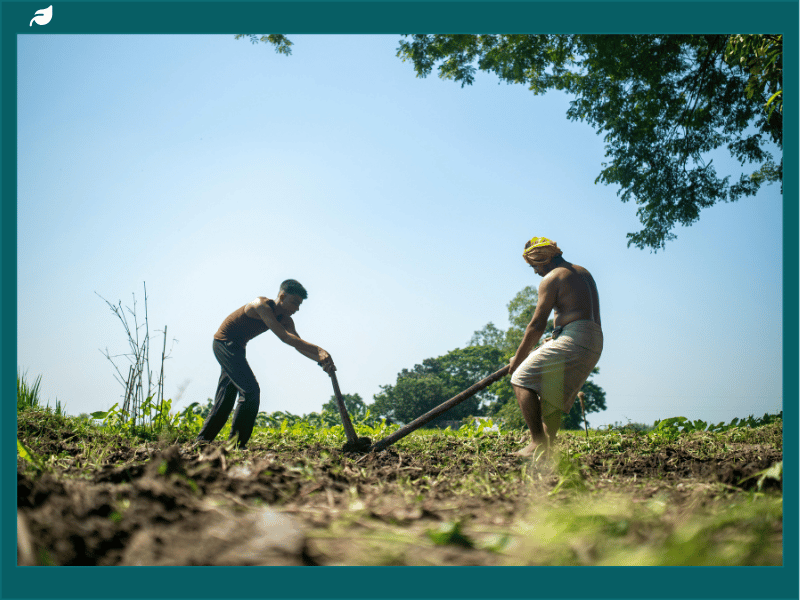
To align commercial food production with current global demand, conversion of forests and other natural ecosystems to farmland has already set back the climate action agenda and continues to do so. Governments are presented with the double challenge of a need for increased agricultural production and the provision of natural carbon sinks. Furthermore, most commercial farming is mechanised and often reliant on fossil fuel-based energy (particularly in the developing regions of the world) , making the reasons that agriculture is so carbon-intensive become clearer. Whilst progress is being made to pivot to less carbon intensive operations, affordability and infrastructure can be barriers to the speed at which this can be achieved.Considering this, any path towards a more climate resilient food system necessitates collaboration, shared responsibility, and collective action.
The first step in achieving this is improving carbon transparency and traceability throughout raw material supply chains. A key challenge, particularly for global companies seeking to set reduction targets, is that their supply chains are so complex that it is challenging to identify exactly where in the chain the most emissions savings can be made. Once emissions hotspots are identified, buyers and traders can incentivise improved transparency by offering favourable opportunities to producers and processors that are able to provide accurate emissions data and demonstrate opportunities for potential carbon reductions. VIVE Climate Action, the initiative I have been leading at CZ, ran a pilot programme in Brazil in 2022. The pilot assessed data and calculation needs at pilot sugar farms to pave the way for developing a scalable methodology for carbon modelling of sugar production. The goal of the pilot was to enable CZ to provide carbon transparency and reduction potential to buyers based on the environmental impact of VIVE sugar and one of the key findings from the pilot was the vast difference between direct land use change (dLUC) and statistical land use change (sLUC) data; dLUC calculation results were < 1% of sLUC calculation results, reducing overall results by roughly 70% across all three geographies. Essentially, when using primary data, GHG emissions were 70% less than when calculated using country level averages. This highlights the importance of accurate data and its centrality to making plans for carbon reductions in the supply chain.
Undoubtedly, investment is needed to translate carbon insights to carbon reductions in real terms
This is a sticking point that challenges many aspects of sustainable development, as those who pay the highest price in terms of the adverse impacts of climate change are often those who cannot afford protections against it. In the case of F&B supply chains, it therefore is important that commercial incentives are provided along the supply chain to facilitate a pivot towards less carbon intensive practices. Buyers can also play their part by adopting sustainable sourcing policies that favour those who have invested in sustainable development, often through verification programmes. The financial sector can also play its role by offering preferential funding terms to those who are endeavouring to act more responsibly, thereby allowing change to happen at a faster pace.
In summary, addressing these challenges requires a combination of technological innovation, changes in agricultural practices, policy support, and international cooperation. Collaboration between governments, industry, research institutions, and civil society will be essential to overcoming these obstacles and achieving significant decarbonisation in the food and agricultural sector. At the risk of seeming obvious, the success of an impactful transition towards a 1.5°C trajectory in the F& B sector is largely dependent on how well engaged all stakeholders in the supply chain are, how well costs are shared, and how consciously they are all pulling in the same direction.