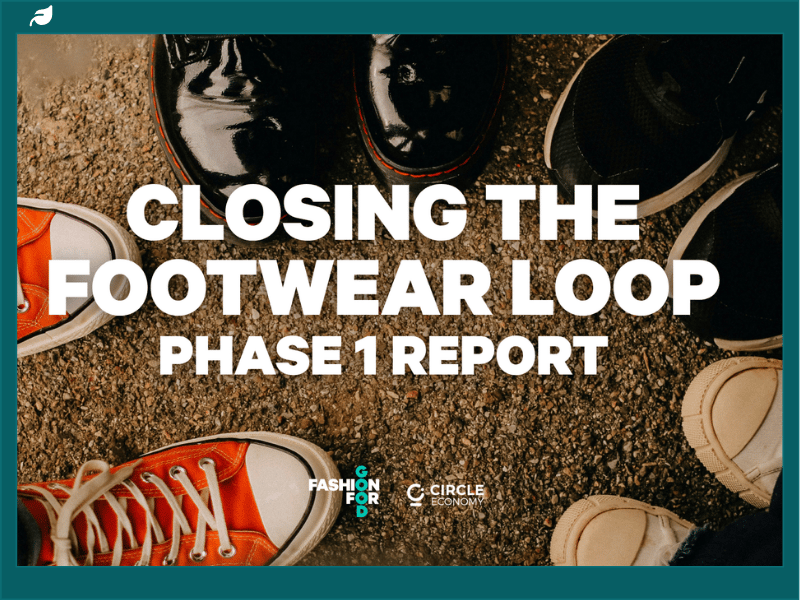
Footwear Loop Phase 1 Lands
Fashion for Good, the Amsterdam-based sustainable fashion innovation platform, has published the first major findings from its Closing the Footwear Loop project, releasing a Phase 1 report developed with Circle Economy that maps the composition, condition and material flows of post-consumer footwear waste across Europe. The report, unveiled on 1 June 2026, translates on-the-ground pilot data into a body of evidence the footwear industry has long lacked.
The timing is consequential. Europe discards close to 1.2 million tonnes of footwear every year, and roughly 80 percent of it is landfilled or incinerated, with only an estimated 5 percent recycled. Until now, brands and recyclers have operated with almost no granular data on what that waste stream actually contains. The Phase 1 report sets out to change that.
What the waste stream actually holds
The findings paint a more nuanced picture than the headline recycling figures suggest. According to the report, 50 percent of post-consumer footwear waste is non-rewearable, while 46 percent is rewearable. The remaining 4 percent is contaminated, a state that hinders both rewearability and recyclability and effectively strands the material outside any circular route.
One of the more striking results concerns how shoes are currently judged at end of life. The report found that 24 percent of shoes classified as non-rewearable had no physical damage, pointing to sorting and grading practices that may be discarding serviceable product. For an industry under growing pressure to extend product lifetimes, that gap between condition and classification represents both a problem and an opportunity.
The data also confirms how heavily the rewearable segment depends on export. Some 90 percent of rewearable footwear is exported, the report states, with the bulk flowing to the United Arab Emirates, China and Pakistan. That concentration raises familiar questions about traceability and the long-term resilience of an export-led reuse model, particularly as importing markets tighten their own waste rules.
Sorting technology meets a stubborn problem
The project also tested the machinery that any scaled circular system will depend on. It piloted what the partners believe to be among the first three dedicated footwear sorting technologies, developed by Matoha, CETIA and Picvisa. Footwear has historically resisted automated sorting because a single shoe can combine more than 60 different materials, making disassembly and identification far harder than for flat textiles.
The pilots exposed the scale of that challenge directly. Near-infrared scanning, a workhorse technology for material identification, could not identify 37.7 percent of non-rewearable sole materials. That figure underlines a recurring theme across the report: the complexity of shoe construction remains the central technical barrier to recycling, and incremental improvements in scanning alone will not close the gap without parallel changes in how shoes are designed.
A policy tailwind from France
The report arrives as European regulation moves decisively toward producer responsibility. The revised Waste Framework Directive, which entered into force in October 2025, requires every EU member state to establish mandatory extended producer responsibility (EPR) schemes for textiles and footwear. France already operates a mature textile EPR scheme under its AGEC Law, run by Refashion, making it the frontrunner for footwear-specific producer responsibility in the bloc.
The project leaned into that lead. Working with The 8 Impact, the partners recycled sports shoes and sneakers using EPR feedstock, demonstrating that closed-loop recycling for these archetypes is technically possible. It is a modest but meaningful proof point: it shows that when feedstock is collected and financed through a functioning EPR system, at least some high-volume footwear categories can be returned to the loop rather than burned or buried.
That link between policy and feasibility matters because the regulatory pressure is intensifying. Under the new framework, footwear producers will pay a fee per item placed on the market, eco-modulated according to circularity and sustainability criteria, and France has signalled that contributions will rise sharply over the decade. Brands that can demonstrate genuine recyclability stand to benefit from lower eco-fees, turning the Phase 1 findings into a commercial as well as an environmental concern.
What comes next
Closing the Footwear Loop brings together a broad coalition of brands and retailers alongside ecosystem partners, and Phase 1 was always intended as a foundation rather than a finished answer. The next stage shifts attention upstream, toward circular design principles being developed with circular.fashion that aim to address the material complexity the report has now quantified. The logic is straightforward: if design-for-recycling thinking is embedded at the drawing board, the sorting and identification failures documented in the pilots become far easier to solve.
For sustainability professionals, the report offers a rare thing in footwear circularity, hard numbers to plan against. It confirms that a large share of discarded shoes are either rewearable or, in the case of damage-free rejects, needlessly written off, and it shows that closed-loop recycling is achievable where policy and feedstock align. The harder work of designing shoes that can actually be recycled, and building the infrastructure to do it at scale, is where the project now turns its attention.
Company website link to verify before publishing: https://www.fashionforgood.com