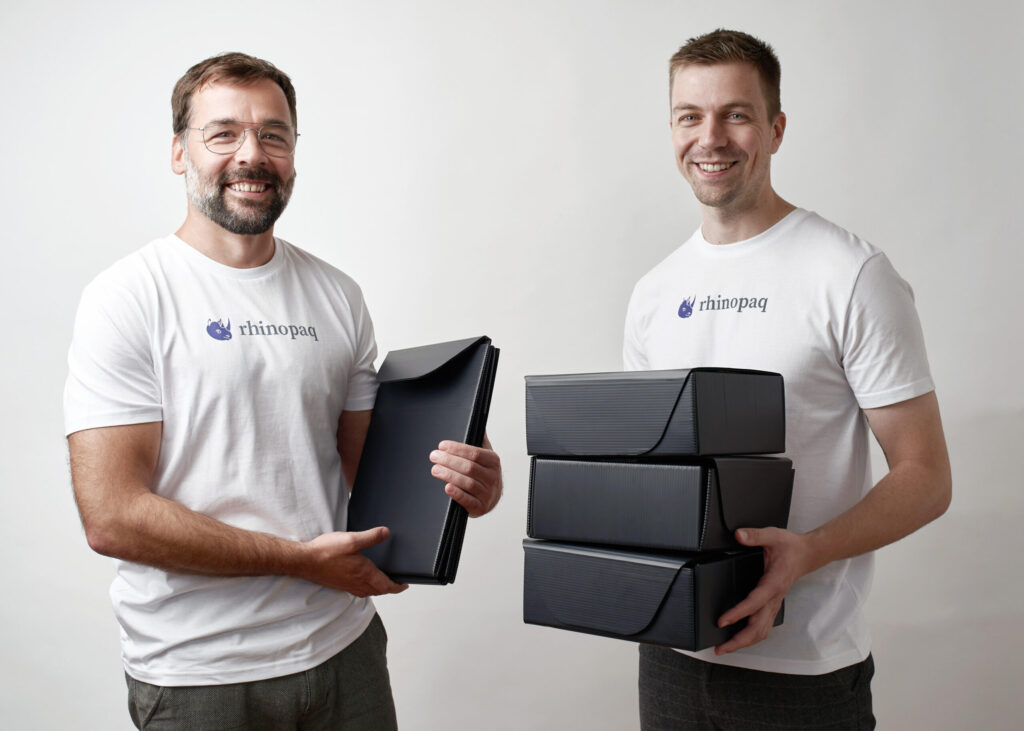
startup that develops reusable envelopes and boxes for online stores.
Circular Valley® is an initiative that aims to establish the German Rhine-Ruhr region as a
Silicon Valley for the circular economy. To this end, it supports startups from all over the
world. The focus of its next funding round of startups beginning now is on ideas with a
“giga-impact.”
For the fourth round of the Accelerator program, the jury of the Circular Valley® Foundation
selected 14 international startups from four continents developing solutions to some of the
world’s most daunting problems. Their business models have a “giga-impact”. Giga impact
relates to material flows that are not measured in kilograms or individual tons but occur on a
scale of billions of tons (gigatons). Examples of these flows are CO 2 , construction waste or
wastewater. “We were impressed by how many young entrepreneurs have specific ideas to
improve renewable energies, water treatment or the sorted collection of waste. This gives us
great hope for our shared planet,” says Dr. Carsten Gerhardt, Chairman of the Circular
Valley® Foundation.
At the same time that this “giga-impact” is a step for the planet, it is also a step for Circular
Valley®. The initiative was launched in the summer of 2021 to promote a truly circular
economy. Following its motto “Grow the economy – protect the environment”, Circular
Valley® strives to become a hotspot for the circular economy in the same way that Silicon
Valley is a hotspot for the digital economy.
The wider Rhine-Ruhr region is the ideal place for this hotspot for a number of reasons: The
region is home to a broad number of industries and is particularly strong in mechanical
engineering and plastics processing. In addition, it accommodates a densely populated
scientific landscape with large research facilities, universities and institutes. Moreover, the
region was the cradle of the industrial revolution on the European mainland.

two are experts in green construction.
Although many of the building blocks for a true circular economy are already in place, the individual areas need to be brought together.
Bridging these gaps is precisely where the Circular-Valley® Foundation sees its task and goal. The foundation pursues its mission by developing a large network, informing the public about what contributions each individual can make, and promoting startups.
The Circular Economy Accelerator differs from most other funding programs in one
important aspect: While other programs are typically oriented locally or regionally, Circular
Valley®’s scope is clearly international. The participating startups are not only from Germany
and Europe but span all other continents as well. The current batch includes companies from
Palestine, Kenya, Singapore and the US.
The founders of the current batch of startups are in the process of further developing their
business models with top-class coaches and mentors and by meeting Circular Valley®
partners from the established industry. The young history of the initiative shows that these
cooperations can, for instance, lead to investments or other substantive collaborations. So
far, around 60 young companies have joined Circular Valley®, many of whom have already
built partnerships with large companies and SMEs.
The current “Giga-Impact” round of the Accelerator focusses on five main topics:
Platform solutions This field is about developing something comparable to Ebay for
industrial waste. In other words, companies that no longer need certain materials, could
offer these on a platform, as they may still be valuable to others. The following startups are
engaged with this topic in the current batch: Clickwaste (Germany), Cyrkl (Czech
Republic/Austria) and MikaCycle (France).
Renewable energy Wind, water and solar energy are abundant sources of energy. However,
they have hardly been considered from a cyclical point of view: For example, how can the
parts of a wind turbine or a solar panel be reused when they are decommissioned? The
following young companies dealing with questions like these: 1s1 Energy (USA) and
CO2NVERT (Italy).
Water treatment and desalination 80 percent of industrial and household wastewater is
released to the environment untreated. This is a huge burden and a waste of potential
resources. The founders of the following startups want to change this: Colea AgriTech
(Palestine), CyFract (Germany), Desolenator (Netherlands), Bio-Recycler (Kenya) and
Hydroleap (Singapore).
Transport and single-stream collection There is also great potential for a true circular
economy on the roads. On the one hand, the packaging waste from online retailers can be
addressed, as this is typically not reused. On the other hand, the potentials from the
transport of goods and waste itself can be leveraged, because these have so far been strictly
separated, resulting in unused and empty capacities. These efficiency losses could be
avoided or greatly reduced if both goods and waste were delivered and picked-up
simultaneously. Business models addressing these issues include LiveLoveRecycle (Lebanon),
Lixo (France) and Rhinopaq (Germany).
Construction materials and waste 4.5 billion tons of cement are produced each year and
account for eight percent of global CO 2 emissions. The impact of this so-called gray energy is
huge. The team at RecycleX (India) knows how to harness this for green construction.