A significant proportion of UK drivers without access to off-street parking are being deterred from switching to electric vehicles due to planning restrictions and limited home charging access, according to new survey data.
Research conducted among EV drivers and prospective buyers with on-street parking shows that 43.7% would only consider purchasing an electric vehicle if they could charge it at home. A further 33% said access to home charging would make them more likely to switch, pointing to the central role of domestic infrastructure in supporting wider adoption.
Despite this demand, planning requirements remain a major obstacle. The survey found that 84% of respondents would be discouraged from buying an EV if planning permission were required to install a home charger. Within this group, 42.8% said it would prevent them from making the switch altogether.
The findings come as the UK Government considers changes to planning regulations. A recent consultation examined whether residents with on-street parking could install chargers without planning permission, provided a cross-pavement channel has already been approved. Until any regulatory changes are enacted, the current system continues to limit access to home charging for many households.
Michael Goulden, CEO of Kerbo Charge, said:
“Charging from home is 5 – 10 x cheaper than public charging and much more convenient, we therefore need to make it easy for all residents to charge from home if we’re going to get mass adoption of EVs in the UK.”
Cost and convenience remain key considerations for drivers. Public charging infrastructure, while expanding, is often seen as less reliable and more expensive than home charging. Respondents highlighted frustrations with both accessibility and pricing, reinforcing the perceived gap between policy ambition and user experience.
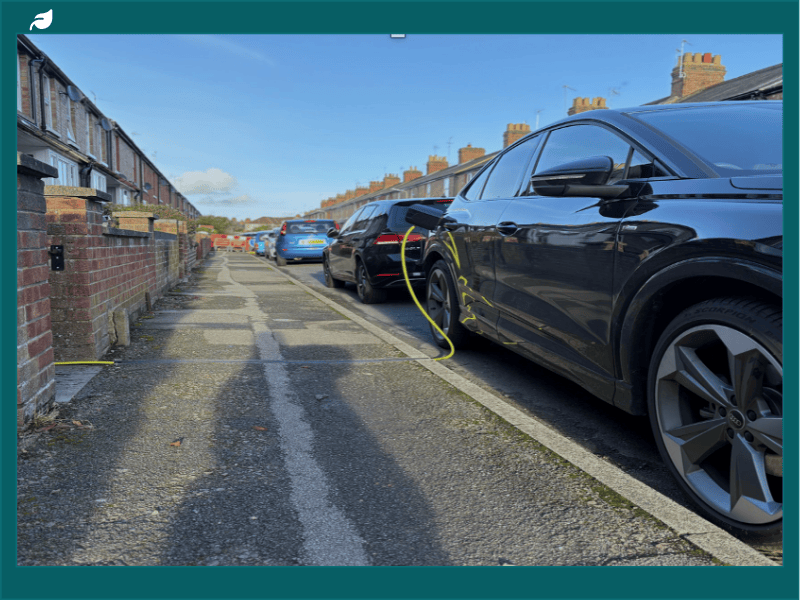
For households without driveways, cross-pavement charging channels have emerged as a potential solution. These systems allow a cable to run safely beneath the pavement from a home to a parked vehicle, with the channel covered when not in use. Drivers who have installed such systems described them as a “game changer”, enabling EV ownership where it would otherwise not be viable.
Support for expanding these solutions is reflected in recent funding commitments. The UK Government has announced £25 million to support cross-pavement charging infrastructure, alongside ongoing discussions about updating permitted development rights.
Deborah Meaden, sustainability advocate and Dragons’ Den investor in Kerbo Charge, said:
“There is a real problem to solve here: how to make EV charging fair and equitable for everyone, not just those with driveways. This research shows the scale of that challenge, and I’m delighted the Government has recently announced £25 million of funding for cross pavement charging, as well as a consultation on changing permitted development rights for home chargers.”
Industry stakeholders point to the broader cost advantages of home charging. Charging overnight at domestic rates can significantly reduce running costs compared to petrol or diesel vehicles, as well as compared to many public charging options. This cost differential is seen as a key driver of EV uptake, particularly during a period of wider cost-of-living pressures.
Fiona Howarth, Founder | Director Octopus Electric Vehicles, said:
“It’s brilliant to see more councils enabling gullies so drivers can charge at home, even when parking on the street. Drivers switching to electric are already saving up to 80% on fuel by charging overnight, so expanding access to home charging is a big step forward.
Innovators like Kerbo Charge are helping open this up to more households, backed by government and council grants. The next step is simple: make planning easier, so more drivers can get their hands on cheaper, convenient home charging.”
Local authorities play a key role in enabling or restricting these installations. While some councils have begun to approve cross-pavement solutions, others have been slower to adopt them, creating an uneven landscape for residents depending on location.
Tanya Sinclair, CEO of EVUK, said:
“Home charging remains the most affordable way to run an electric car. It is simple to manage and allows drivers to start each morning with a full battery.
“Innovations such as gully charging now make this option possible for households without driveways. These are practical, proven solutions that expand access to convenient charging.
“It is unfortunate that some local authorities are reluctant to enable them for residents who would benefit most.”
The issue of equitable access to EV infrastructure has become increasingly prominent as the UK works towards its net zero targets and the planned phase-out of new petrol and diesel vehicles. While early adopters of electric vehicles have often had access to private driveways, a large share of urban households rely on on-street parking.
Campaigners argue that without targeted policy changes, this group risks being left behind in the transition. Simplifying planning processes and removing the requirement for permission in certain cases are seen as necessary steps to accelerate uptake.
The survey findings suggest that demand for electric vehicles remains strong, but practical barriers continue to slow adoption. For many drivers, the ability to charge at home is not a preference but a deciding factor.
As government consultations progress, the outcome of planning reforms is likely to influence the pace of EV adoption across the UK. Expanding access to affordable and convenient charging is widely seen as essential if electric vehicles are to become a viable option for the majority of households.