Sustainable Business Magazine speaks to Mrs. Ann-Sofie Pilgrim, the Quality, Health and Safety Coordinator of Caribbean Aircraft Handling Co. about how the company is pursuing sustainability goals in a country that’s at the start of its greening journey.
Caribbean Aircraft Handling Co. (CAH) operates at the heart of Barbados’ aviation sector and is an exemplar of the intersection between operational excellence and sustainability achievements. Mrs. Ann-Sofie Pilgrim, Quality, Health and Safety Coordinator at CAH, explains the nuance and progress of the company’s sustainability work:
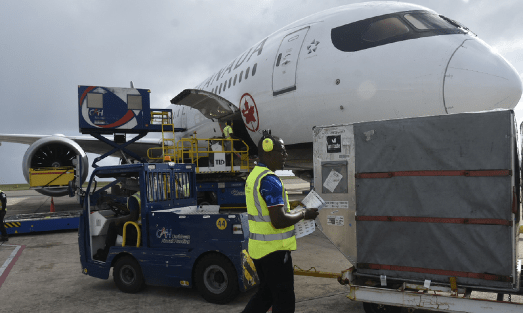
“Caribbean Aircraft Handling was established in 1992 and it was founded to meet the increasing demand for reliable and cost-effective ground handling services at Grantley Adams International Airport in Barbados. Barbados have more activity during the winter season, so for example we are creeping up towards 340 plus right now but during summer we are somewhere around 280.CAH is handling over 300 arrivals and departures monthly at the airport. We provide ramp, passenger security, cargo handling services, operation support and administrative assistance.
“So we have quite a big scope of services that we provide and our mission is to constantly strive to be the top choice for quality aviation services. We make sure we meet international standards and surpass customer expectations while ensuring safety, excellence, productivity and profitability. This is underlined by the values that we instill in all our staff and within our organization: fairness, integrity, respect, service and teamwork.”
Culture Change
Mrs Pilgrim goes on to speak candidly about both the urgent threat of climate change faced by Barbados and the practicalities of implementing sustainability, highlighting the real-world impacts of climate breakdown on small islands:
“As a small island state in the Caribbean, our extreme situation because of climate change has been highlighted by our Prime Minister, the Honorable Mia Amor Mottley. We might not be the big contributors to climate change but we feel the effects of the whole situation most. Therefore it is important for us to not just be at the forefront as much as we can with the little resources that we have compared with larger countries. That is the biggest challenge for small island states, especially in the Caribbean where we also have hurricanes that are likely to increase both in number and intensity due to higher water temperatures. We will be the first country to feel it as we are the ones furthest into the Atlantic.
“It’s really something that is on our minds, especially during hurricane season (1st June -30th November each year). So far, knock-knock on wood, we haven’t felt too much of that. However, we also have a situation with increased amounts of seaweed affecting our coastlines. Tourists who come here look forward to being on the beach and in the beautiful water but it might not be the case at all times because of the influx of seaweed.
“It is very complicated but we are clearly feeling the effects of the changing climate.”
Mrs Pilgrim goes on to explain that there are obstacles at the national scale that have made Barbados’ transition to sustainable infrastructure:
“I’m not Barbadian originally, I’m actually from Sweden, which is a country that is very much at the forefront of sustainability, recycling, ecological efficiency and other sustainable goals. I have seen firsthand how that can develop and how it can change. However, this is a cultural change that needs to happen. It has started here but we’re not as far as we probably would like to.
“The government has set a goal for going fossil-free by 2030. We’re looking at the fact we’re in 2025 and there’s only five years to go. That means a big change has to happen very quickly.”
Nonetheless, that hasn’t prevented CAH from pursuing its own sustainability program.
“As a company, we are replacing any vehicles that need replacing with electric rather than fossil fuel models,” Mrs Pilgrim says. “Electricity is currently the only sustainable fuel available on the island, and we have had a big influx of hybrids and electric vehicles recently due to government incentives that have made those a good option for many people.
“That has been a big development, which we are grateful for, but we still have to look at resilience. What happens if we suddenly don’t have the provisions for electric charging due to a hurricane, for example? Obviously, we have set up our own charging facility, but we need to have resilience in that as well. If we don’t get a current, then how do we charge our equipment? That’s an area we’re working on. It’s a bigger process and project than just the initial installations.
“We’re looking into the solar energy area in that respect. We have a lot of that here – the sun – so why not use it?”
Incremental Changes
The company’s pursuit of sustainability encompasses both simple, daily operational changes and longer-term infrastructural thinking.
“Our plan for the future encompasses everything from small items to large projects,” she continues. “It starts small. We have installed water coolers that take water from the mains and use a filtration system to filter it instead of having these clumsy big plastic containers. We have also stopped using plastic cups, encouraging our staff instead to bring a water bottle with them.
“We’re also trying to minimize paper use. If we don’t need to have to use it then we do the task electronically. We also try to make as little use of the copy machine as possible. Unfortunately, for holding or keeping documents, according to the legislation we need to keep hard copies for seven years so that’s an area we don’t have control over. We still have seven years of paperwork at present but we’re hopeful that once that time is up there will be less need for it going forwards.
“We changed out all the lighting at our offices for LED lights, and we have seen an immediate return on that because our electricity bill is now much cheaper. It also doesn’t get as warm from the light tubes so the air conditioning doesn’t have to work as hard to keep the office cold.
“We have legislation in place when it comes to how to deal with waste as well. That is quite new and the country’s facilities are not quite there yet. However, the environmental department in the government provides information on the best places to send waste now that the regulations are in place. Nonetheless, we don’t have all the facilities on the island that we need so it is still a work in progress in our small state.”
Mrs Pilgrim explains that CAH is trying to have an impact beyond its offices as well.
“We try to make staff more aware of what they could do at home. When we do training speaking about storm water pollution spill prevention, for example, it’s not just in the work area but also how this can be done at home. I think it’s important that we’re not just seeing this as something that you do at work but then you otherwise don’t do it. Our training is part of that cultural change that is needed, so that we all have an understanding that we need to do this everywhere.”
Tough Road Ahead
Looking beyond the organization, involvement in wider outreach and partnerships is still emerging, but the company has plenty of plans as its capacity grows.
“We fall under the purview of the government so we don’t really have any outreach currently,” explains Mrs Pilgrim. “We do have plans for it, though. We will be much more involved with collaborative initiatives for sustainability, carbon footprint, and other important environmental factors. That’s all in the works at present.”
The Quality, Health and Safety Coordinator also points out constraints that come with renting office space and the broader infrastructural efforts happening at the airport itself:
“We’re kind of limited to what we can do at a scale beyond recycling initiatives because we do not own our offices, we are just renting space at the airport. Hence, we cannot just put solar panels on our buildings. I will mention that the airport itself already has a solar farm on the premises and I’m sure that that will not be the last one. As a result of our restrictions, the main thing we’re concentrating on is greening through refleeting, which I talked about earlier.
“Looking towards the future, then, we are staying with the government’s plan for 2030. That’s our big deadline. We believe that we will be able to achieve the government’s goals and are looking forward to a greener future that supports our operations and Barbados as a nation. It’s going to be tough but I’m optimistic.”