By Eddie James
When Hans Pfister talks about luxury, it’s not about gold taps or marble foyers. It’s about feeling connected to nature, to people, and to a sense of purpose. As co-founder of the Cayuga Collection, a group of eight small luxury hotels across Panama, Costa Rica, Nicaragua, and Guatemala, Pfister has spent the last 25 years proving that sustainability and luxury are not opposites but essential partners.
“The luxury we offer isn’t the Dubai kind,” he says with a smile. “It’s not about excess. It’s about experience, great service, incredible food, and beautiful places. But also knowing that by being there, you’re helping conserve ecosystems and support local communities. It’s not an in-your-face sustainability. It’s about inspiration.”
That word inspiration threads through everything the Cayuga Collection does. Each hotel, from the smallest with just eight rooms to the largest with 37, operates independently but shares a philosophy: sustainability should be lived, not lectured. “We don’t want guests to feel guilty or restricted,” Pfister explains. “We want them to recharge, to learn, to enjoy and to leave understanding how their choices make a difference.”
Luxury Rewilded
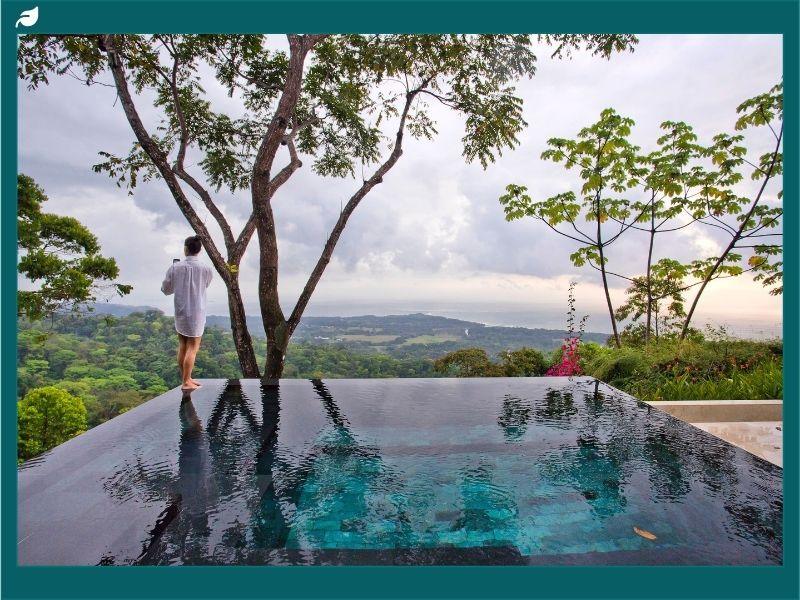
At the heart of Cayuga’s approach lies what Pfister calls Luxury Rewilded. “Whenever we go somewhere, it starts with the land,” he says. “We have to make sure that land is protected or, in many cases, it’s healing.”
Many of the hotels are built on previously impacted land, a former cacao plantation, a goat farm, or a patch of subsistence farmland. Pfister describes how these sites are restored through native planting and habitat restoration: “We try to heal the land, protect it, and then we become stewards. Our employees live there, they work there, they become guardians of the land.”
The results are tangible. Guests often notice how alive Cayuga’s properties feel, the monkeys in the trees, the sloths in the canopy, the coolness of the air under native foliage. “People say, ‘Why is it cooler here than elsewhere?’” Pfister laughs. “It’s because the native plants have come back. They don’t need watering, they support wildlife, and they restore balance. You’re spending your vacation in a natural habitat and it just feels right.”
Beyond Recycling: Refusing and Reusing
While some sustainability programs might stop at recycling bins, Cayuga takes a more radical approach. “If we’re recycling, we’ve already done something wrong,” Pfister says bluntly. “The goal is to reuse, reduce, and refuse before we ever get to recycling.”
That philosophy extends to the hotel’s entire supply chain. “We’ve worked with suppliers on packaging,” he says. “We tell them, ‘Don’t triple-wrap your products in plastic. Give us reusable containers.’” The collection’s hotels use refillable egg crates and returnable beer and soda bottles, while even laundry detergents come in washable jugs.
This attention to detail has had a measurable economic impact too. “We just did a study on leakage,” Pfister says, referring to how much of a guest’s spending stays in the local economy. “Between 92 and 96% of our spending stays within the country. In many tourism destinations, that number’s 30 or 40%. But we do it on purpose, it’s about buying local, supporting the local providers, and showing them how sustainability makes sense.”
Empowering People, Not Just Preserving Places
Pfister’s passion for people is as strong as his commitment to the environment. “You can’t run five-star hotels in one-star communities,” he says. “Tourism has to benefit both the visitor and the visited.”
That means hiring locally at every level and not just for entry-level roles. “We don’t bring in the French chef or the Swiss general manager,” he says. “Every position, from the gardeners to the general managers, is local. That’s what sustainability is about.”
The approach has transformed not just livelihoods but attitudes. “When people see a local person in management, they believe they can do the same. It motivates them to study, to learn, to improve.”
One of Cayuga’s longest-running programs reflects this ethos perfectly: each year, every employee gets to stay at their hotel with their family, treated as guests. “They come with their families, eat in the restaurant, sleep in the rooms just like guests,” Pfister says. “It’s one of the most special programs we do. It opens the hotels to the community. Kids see where their parents work. It builds pride.”
The sense of belonging extends across borders. When Cayuga opens a new property, staff from other hotels travel there to train new teams. “When we opened in Guatemala, employees from our other hotels went to share their knowledge. It makes them feel special and valued and it strengthens the whole collection.”
Innovation from the Ground Up
Sustainability at Cayuga isn’t just a management directive, it often comes from the staff themselves. “Every two years, we hold an innovation contest,” Pfister says. “One idea was a sustainable laundry system using rainwater, which cut water use by 30–40%. Another was installing trap cameras to monitor wildlife. That’s how we discovered we have a puma living on one of our properties.”
These initiatives may seem small, but they add up to big change. As Pfister puts it, “We’re not chasing grand, futuristic ideas. Our goal is to protect what we’ve built and make it last beyond us.”
That long-term thinking drives Cayuga’s current focus: ensuring the model is self-sustaining, resilient, and inspiring for others to replicate. “We’ve been doing this for 25 years,” Pfister says. “Now it’s about defending that model and making sure it survives me.”
Inspiring, Not Preaching
Perhaps what makes the Cayuga Collection stand out most is its tone. Pfister recognises that sustainability messaging can sometimes feel overwhelming, even alienating. “We might be living through what I call ‘sustainability fatigue’,” he says. “That’s why we don’t preach. We inspire.”
Each room at a Cayuga property includes a Sustainability Journal, which is a small, beautifully designed book filled with stories from the land, the staff, and the surrounding community. “It’s not about politics,” he says. “It’s about people, nature, and opportunities. You can read it whether you believe in climate change or not. They’re just good stories.”
That openness defines the Cayuga way. “Someone once told me I shouldn’t let oil executives stay at our hotels,” Pfister recalls. “But those are exactly the people I want to come. I want to inspire them. Bring me the doubters and we’ll show them another way of doing things.”
The Cayuga Way
After three decades in sustainable tourism, Pfister remains humble but firm in his mission. “It’s about community, it’s about people, it’s about nature,” he says simply. “And it’s about doing business the right way.”
In a world where sustainability can feel like a buzzword, the Cayuga Collection reminds us that it’s a lived practice and one rooted in respect, imagination, and optimism. “If you take care of people,” Pfister says, “they’ll take care of the land, the guests, and their communities. And that’s how everything lifts up together.”