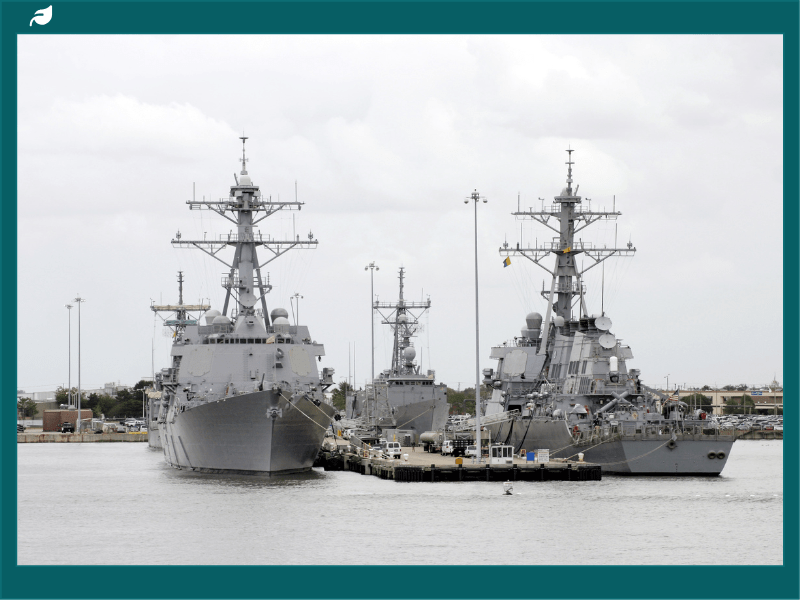
A naval port call compresses an extraordinary amount of logistics activity into a narrow window. Fuel, food, waste handling, maintenance support, and husbanding services all have to come together under strict compliance, security, and time pressure, often with limited notice and no room to renegotiate once a vessel is alongside. Most of the attention in this environment goes to speed and operational readiness. Far less goes to what happens to the waste a port call generates, the resources over-ordered “to be safe,” and the risk that quietly accumulates when planning is rushed instead of deliberate.
Where Waste Enters the Port Support Equation
Waste in port support operations rarely comes from one visible failure. It builds up in smaller, less obvious ways: provisioning that runs ahead of a vessel’s actual needs, packaging with no agreed onward disposal route, fuel-handling procedures that don’t account for a specific port’s restrictions, or waste volumes that outstrip what the local port authority is equipped to process. None of this appears as a single, dramatic line item. It shows up instead as extra cost, extra time, and, in some cases, friction with the very port authority a support provider is meant to be coordinating with, rather than working around. Multiply this across a busy operational schedule, with vessels calling at ports with different regulatory regimes, different disposal infrastructure, and different local capacity, and the pattern becomes a planning problem long before it becomes an environmental one.
Planning as the Foundation, Not the Promise
This is also where sustainability claims in defence logistics tend to split into two very different categories: the ones that are declared, and the ones that are actually designed into how an operation runs. A statement of environmental intent means little if it isn’t reflected in how a port call is provisioned, coordinated, and closed out on the ground. For SCA Group, headed by S.C.A. – Shipping Consultants Associated Ltd., that distinction is built into how naval husbanding and port support operations are structured from the outset.
Jacopo Landi, one of the two Directors of SCA Group, frames the approach this way: “Sustainability in port support only means something if it is built into the planning stage – how a call is provisioned, how waste is handled, how disposal is coordinated with the port authority before the vessel arrives. Promises made afterwards don’t reduce risk. Planning done properly does.”
Reducing Risk Through Operational Discipline
Waste and risk are more closely linked than they might first appear. Over-ordering supplies doesn’t just create a disposal problem later – it ties up storage and handling capacity that could otherwise absorb the unexpected. Waste disposal that hasn’t been agreed with local authorities in advance can put a support provider at odds with regulatory requirements it didn’t anticipate, creating exactly the kind of delay a port call is designed to avoid in the first place. Treating waste reduction as a planning discipline rather than an afterthought therefore does double duty. It lowers environmental impact, and it closes off some of the most common sources of operational risk before they have a chance to materialise.
Michael J. Harrison, one of the Directors of S.C.A. – Shipping Consultants Associated Ltd., reflects the same standard: Consistency in planning that matters more than the scale of any individual visit. In practice, that means giving the same answer on waste handling and disposal coordination whether a call is routine or exceptional, rather than treating sustainability as something reserved for the visits that attract attention. It also gives institutional clients something more useful than a policy document – A track record they can check a provider’s claims against.
A Broader Commitment to Responsible Logistics
Regulatory expectations already point in this direction. Under the IMO’s MARPOL Annex V framework, governments are obliged to ensure adequate port reception facilities for ship-generated garbage, without causing undue delay to the ships using them, which places the planning burden on operators and port authorities well before a vessel calls, not after. Institutional buyers, including navies, procurement teams, and contracting authorities, are applying a comparable standard when assessing providers, not simply whether a sustainability policy exists, but whether it holds up in day-to-day execution – provisioning accuracy, waste segregation, fuel-handling discipline, and coordination with local port infrastructure. Because port support depends on that behaviour holding up across many calls in many regulatory environments, not just the one being evaluated during procurement, providers able to answer with specifics rather than general commitments are the ones building lasting institutional trust rather than short-lived reassurance.
That distinction is only likely to sharpen as port support requirements grow in scale and complexity, and as waste and disposal planning move further from an afterthought to a starting condition of how a port call is run.