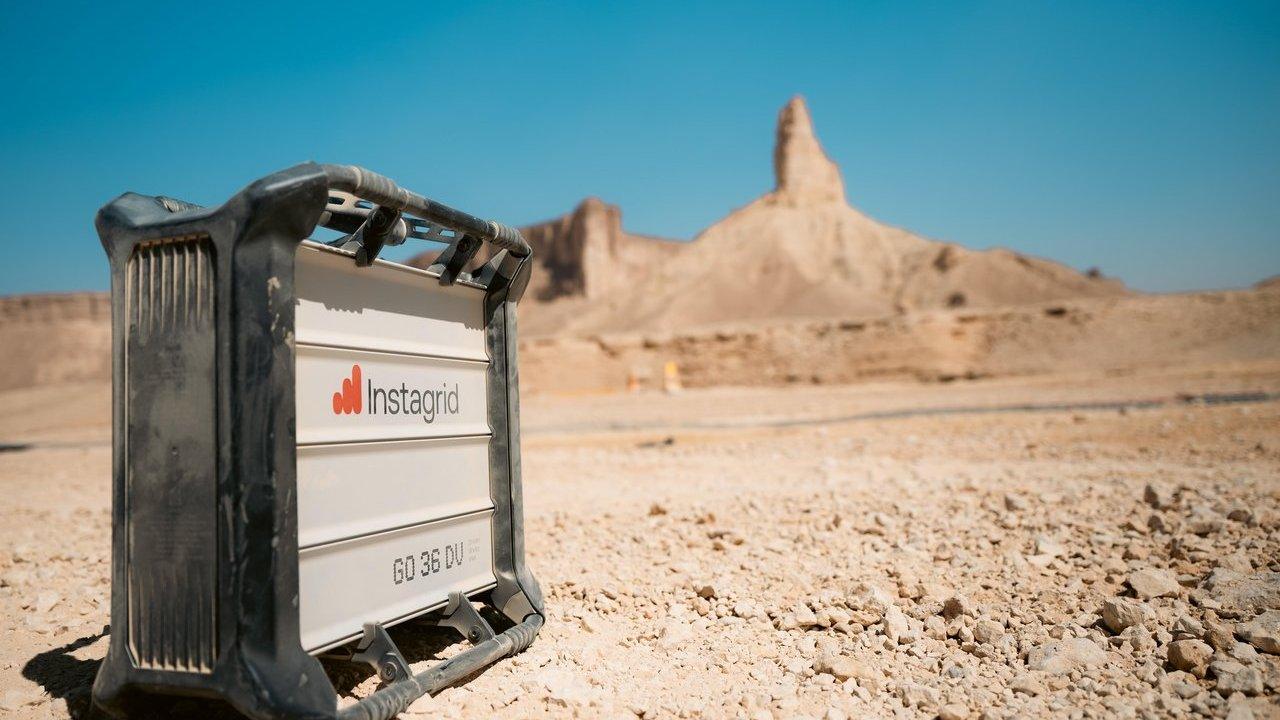
Instagrid, the German manufacturer of portable power supply units, has confirmed its return as power support partner for the second FIA Extreme H World Cup, due to be staged in Qiddiya City, Saudi Arabia, this October. Up to 12 Instagrid ONE (230 V) units and Instagrid LINK systems will be deployed across the site to support broadcast cameras, hospitality, team garages and start gantry infrastructure, alongside additional remote power needs. The deployment builds directly on the company’s role at the inaugural FIA Extreme H World Cup in 2025, where its equipment ran entirely off-grid in one of motorsport’s harshest environments. For 2026, the setup expands to 12 Instagrid ONE units and four Instagrid LINK systems, organised across fixed and flexible operational modes. Al Masaood, Instagrid’s distribution partner in the United Arab Emirates, will manage supply and delivery, with Instagrid providing on-site servicing throughout the event.
Proven In The Desert
Extreme H first partnered with Instagrid at the inaugural World Cup in 2025, staged on a desert plain at the base of the Tuwaiq Mountains, an entirely off-grid location facing high winds, dust and temperatures reaching nearly 40°C. Four Instagrid ONE units and two Instagrid LINK systems ran as two paired power supplies, with each pair delivering continuous AC power to one of the two start gantries on the course. Units were recharged each evening directly from the Tamgo hydrogen fuel cell and Altaaqa Alternative Solutions battery storage system, forming an entirely self-sustaining power setup under testing conditions.
That deployment served as a proving ground for the technology beyond the World Cup itself, and the October return is designed to build on that foundation while scaling the system’s capabilities on a global stage.
Scaling Up For Qiddiya
The 2026 configuration organises equipment across two operational modes. Paired units, comprising two Instagrid ONE units connected via Instagrid LINK, will serve fixed, high-demand positions including the remote start gantry and remote camera positions on the course. Single Instagrid ONE units will cover flexible and contingency roles, including remote drone charging, emergency response team support for tools and lighting, general tool power and lighting during the event build, and remote power for the car quarantine area if required.
As in 2025, every unit will be recharged from the event’s self-sufficient energy hub, meaning no emissions are generated on site throughout their use.
A Proof Point For Portable Power
For Instagrid, the scale of this year’s deployment stands as evidence of what portable, renewable-integrated power systems can achieve when tested against demanding operational conditions.

Muhanad Khayal, Market Development Lead for the Middle East at Instagrid, said:
“Extreme H is one of the most demanding environments we operate in. Twelve units across multiple functions at a FIA World Cup event is a strong proof point for what portable power supply can do when it is properly integrated into a renewable energy setup.”
Building On Last Year’s Success
Extreme H’s own team sees the partnership as central to delivering a race weekend that operates entirely without grid connection, in one of the world’s most demanding motorsport environments.
Andy Welch, Extreme H’s Global Hydrogen Development Manager, said:
“We’re delighted to be partnering with Instagrid for the second FIA Extreme H World Cup. Their innovative power systems will continue to play a vital role in the delivery of an entirely off-grid, world-class motorsports event. We look forward to together building upon the success of last year’s inaugural race”.
Power At The Operational Edge
Extreme H bills itself as the world’s first hydrogen-powered off-road motorsport, with each event designed to draw energy from hydrogen fuel cell generation and solar arrays, combined with battery storage and portable power for smaller, remote requirements. Instagrid’s role in Qiddiya City extends that principle to what the organisers describe as the operational edge of the event: the places a cable cannot reach, where reliable, instant power is critical to running the race. The 2025 season opener demonstrated that with the right technology, large-scale events of this kind can be operated in remote and testing locations, and October’s expanded deployment is intended to carry that demonstration further, showing what an off-grid, zero-emission power system can support as the event grows.