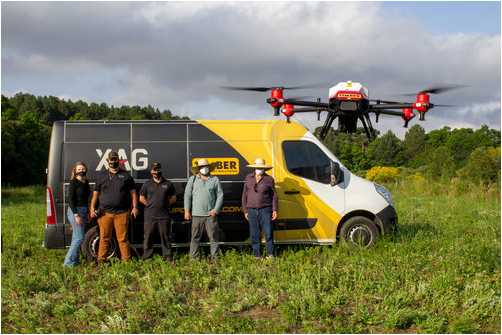
A forest restoration project has been introduced in Brazil as part of the Arboreto Project, carried out by the Federal University of Paraná (UFPR), the oldest university in Brazil.
The project is expected to demonstrate the effectiveness of drones to drive forest growth and will mark a new way for autonomous technologies to be used in large-scale planting of Brazilian forests, accelerating the process of forest restoration.
During the field experiment, different amounts of seeds were weighed and placed in the smart container on board the drone.
Waypoints were then set by the pilot in the mobile application as well as flight speed and spray volume.
The agricultural drone, which houses an on-board spray attachment, was programmed to run through target lines, evenly distributing seeds of native forests in the region.
We know how difficult it is to carry out work like this of planting native trees,” states Professor Alessandro Camargo Angelo of Federal University of Paraná (UFPR).
“So, when we can count on technology that has control and that we manage to define the rigor, this is welcome.”
As a leading agro-technology company, XAG, the developer of the drones used in the project, have already introduced their technology to 42 countries and regions.
The company’s agricultural drones are widely used to sow seeds, spread fertilizer, spray pesticides, and perform digital field mapping.
Compared with manual tree planting, a drone with full automation can improve the productivity of re-planting trees, especially in hard-to-reach terrain.
It is anticipated that the agricultural drone can serve as a cost-effective tool to enable the replanting of native trees by governments and businesses.