In the dense forests of Finland, something quite unconventional is happening – not in the trees themselves, but in what’s left behind. In what many see as waste, Finnish startup Boreal Bioproducts sees potential. The company was founded on a simple but powerful idea: that the overlooked byproducts of the forestry industry could play a central role in replacing fossil-derived chemicals in everyday products.
Rethinking Raw Materials
Every product starts with a material. And for much of the chemical industry, those materials still come from fossil fuels. But as pressure grows to reduce emissions and build more sustainable supply chains, it’s clear that the ingredients going into the system need to change.
That’s where forestry side streams come in. Boreal Bioproducts works with what’s usually left behind – things like sawdust and bark from certified forestry operations – and turns them into clean, bio-based raw materials that can replace fossil-derived ingredients in everyday products. The process is simple, but smart. Using only water, pressure, and heat, Boreal Bioproducts extract valuable compounds from Norway spruce that can be used in coatings, adhesives, packaging, and more.
A Functional Showcase: LigNoFog®
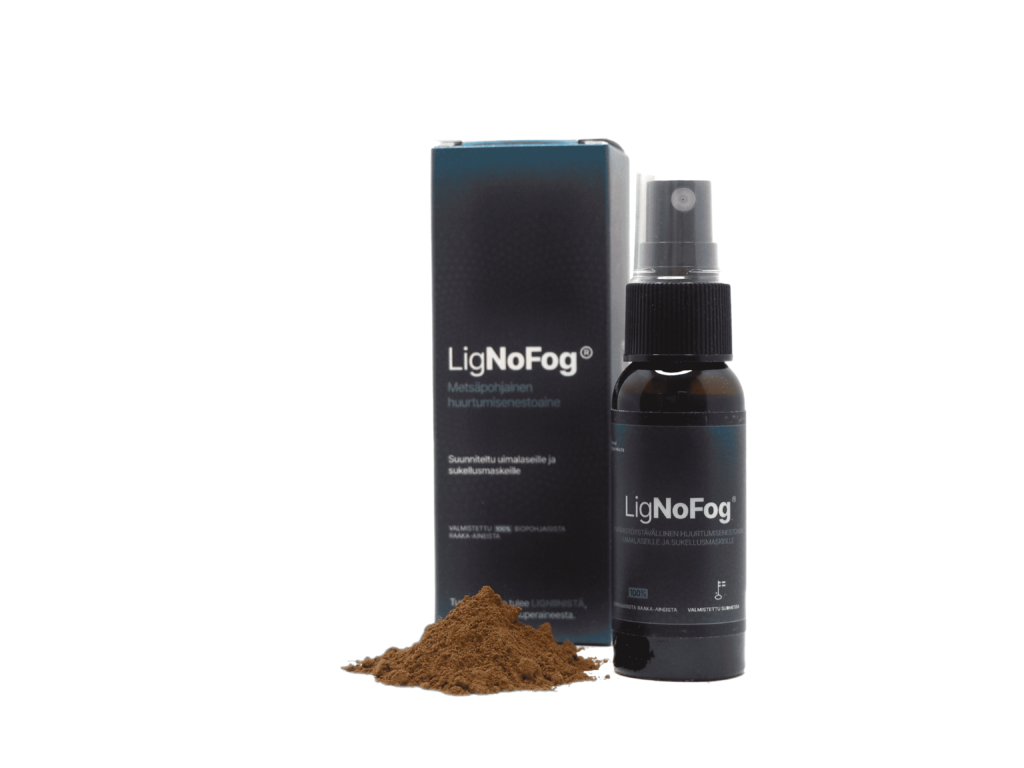
Among Boreal Bioproduct’s innovative products is LigNoFog®, marking the first known use of lignin as the main ingredient of a consumer product. LigNoFog® is a 100% bio-based anti-fog coating, designed to keep swim goggles and diving masks clear. The product is powered by SOLV™ technology, a method invented by Dr Alexander Henn, R&D Manager at Boreal Bioproducts. This allows lignin to mix well with water while maintaining its natural ability to block UV rays and act as an antioxidant.
What makes this breakthrough so important is how it reimagines something once discarded as something genuinely useful. Lignin is what helps hold a tree together. It’s like nature’s glue, giving wood its strength and structure. But when trees are processed in the timber or paper industry, lignin is often removed and discarded or burned. By finding a new way to use it in everyday products, Boreal Bioproducts is showing that waste from the forest can actually replace fossil-based chemicals in a way that works, feels familiar, and does the job just as well.
A Versatile Line-Up
Behind the scenes, Boreal Bioproducts is building a materials revolution, developing a family of forestry-based ingredients that power everything from packaging to plant health. Each of these are made to replace fossil-based chemicals in a way that feels seamless to the industries using them.
- SpruceSugar™: A naturally derived extract used in coatings and packaging, offering a plant-based barrier that can help reduce reliance on plastics.
- SpruceTannin™: A bark-derived ingredient used in leather tanning and animal health, offering a plant-based alternative to traditional chemical treatments.
- SpruceLigno™ SOFT: A patent-pending, sulfur-free lignin solution designed to blend easily into different formulations. It matches the antioxidant, UV-absorbing, and SPF-boosting properties of conventional lignin, while opening the door to new applications, including those in personal care.
Each material is made to work with the systems manufacturers already use. That way, switching to a more sustainable option doesn’t mean starting over; it just means choosing better building blocks.
Evolution, Not Disruption
The chemical industry is built on complexity – deep-rooted systems, global supply chains, and products that touch nearly every part of our daily lives. However, lasting change in the chemical industry won’t come from tearing things down, but from building on what’s already there.
Evolution, not disruption, is what will move the industry forward. That means working with existing infrastructure instead of replacing it. It means designing alternatives that can be adopted without rewriting entire manufacturing processes. It means shifting the system from within – quietly, practically, and at scale. By focusing on side streams already flowing through the industry, Boreal Bioproducts reflects this philosophy – not breaking the system but helping it bend in a better direction.
The Road Ahead
The chemical industry is already taking meaningful steps toward a lower-emissions future. Today, 66% of the largest chemical end users have committed to reducing emissions by 2030, and 37% have pledged net-zero targets by 2050 (McKinsey, 2023). But ambition alone won’t get the industry there. The challenge now lies in scale – finding alternatives that don’t just work in the lab, but can meet the volume, cost, and performance expectations of a global market.
Boreal Bioproducts is part of that shift. With a pilot facility already in place and plans to scale to industrial production by 2028–2029, the company is demonstrating what a lower-emissions supply chain could look like in practice. The transition is already in motion. What happens next depends on how effectively we can keep building on that momentum.