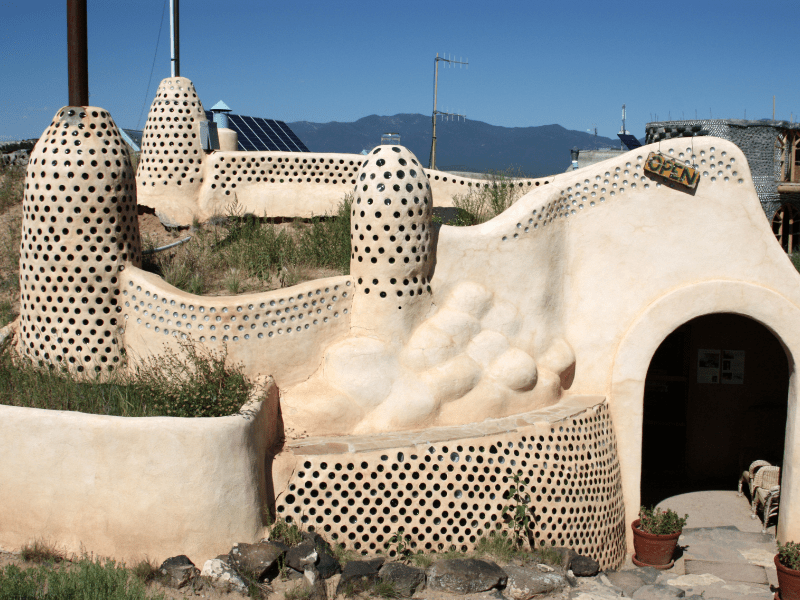
Picture a house with no power bill, no water bill, and no landfill trip for the tires that built its walls. That’s not a fantasy. It’s a real, working structure called an Earthship, and people have been building them by hand for decades. You don’t need a factory, a mortgage the size of a small country, or a crew of specialists. A peer-reviewed survey of 139 Earthship occupants published in Sustainability found overall life satisfaction to be high among residents, who valued the lifestyle for social and environmental reasons alike, though public perception and building-code hurdles remain real barriers to wider adoption.
Why People Are Building Homes Out of Tires and Bottles
An Earthship is a home that runs on what the earth already gives you: sun, rain, and the ground beneath your feet. Architect Michael Reynolds developed the concept, and his goal was blunt. Build homes that don’t need the grid at all. Not homes that use less power.
Homes that don’t ask for it in the first place.
That idea has since spread far beyond wherever it started. Earthship Brighton and Earthship Fife show the same principles working on UK soil, proof this isn’t a one-climate trick. These aren’t showpieces. People live in them, cook in them, grow food in them, year round. A 2024 BBC Travel feature described Earthships as increasingly recognized net-zero residences, noting that most run entirely on solar power, with some adding wind turbines or a wood-burning stove as backup.
Call them passive solar houses if you want the technical term. They’re built to catch sunlight, rainwater, and the earth’s own steady temperature, and to waste as little of it as possible. Earthships like these are proof the concept travels.
The Big Ideas Behind an Earthship
Strip an Earthship down to its bones and you’ll find a handful of ideas doing all the work. The home behaves like a small, self-sustaining ecosystem, and that alone slashes its carbon footprint against a conventional build. Recycled materials, tires and bottles most of all, get repurposed into the very walls holding the roof up, so waste becomes structure instead of landfill. Thick, dense walls act as thermal mass, holding the day’s heat and releasing it slowly overnight so the house barely needs heating or cooling.
Rain gets caught, filtered, and reused before it ever reaches a drain. And food gets grown right there, inside and outside the building, so a resident isn’t relying on a supermarket supply chain for dinner.
How Thermal Mass Keeps the Temperature Steady

Thermal mass sounds technical. It isn’t complicated. Pack earth into old tires, or build with rammed earth, and you’ve got walls dense enough to soak up heat like a stone left in the sun. During the day, big south-facing windows let sunlight flood in and warm those walls, the same way a greenhouse traps heat.
Once night falls and the air outside cools fast, the walls give that stored warmth back, slowly, so the inside of the home doesn’t swing wildly in temperature. No furnace working overtime. No air conditioner fighting the afternoon sun. Just a wall doing the job a power grid usually does, and doing it for free once it’s built.
That’s the whole trick behind an Earthship’s climate control, and it’s why people who’ve never touched a thermostat in one of these homes say they barely notice the seasons changing indoors.
Turning Tires and Bottles Into Walls
Here’s the part that surprises most people. An Earthship’s walls are, quite literally, garbage. Old tires get packed tight with compacted earth, tamped down by hand or machine until they’re as solid as concrete block, and stacked to form load bearing walls. Glass bottles and aluminum cans go into the gaps and the interior partitions, laid so light passes through them and throws colour across a room instead of hiding behind drywall.
It’s structural. It’s insulating. And it keeps a genuinely enormous amount of material out of a landfill. Builders aren’t chasing an aesthetic here, though the bottle walls do look striking.

They’re chasing a simple equation: less waste, less demand on new resources, more home for what’s already lying around. Every recycled material that goes into an Earthship is one less thing burned, buried, or shipped somewhere else to become someone else’s problem.
Where the Water and the Food Come From
Water and food are where an Earthship stops being a clever building and starts being a genuinely independent home. Rain lands on the roof, runs down into cisterns built into the structure, and gets filtered until it’s clean enough to drink, cook with, and wash in. That single system can cut a household’s reliance on a municipal water line down to almost nothing. Plenty of Earthship communities run workshops teaching new residents how to keep that system running, because a cistern only works if someone understands it.
Then that same water gets a second life. Greywater from sinks and showers doesn’t go straight down the drain. It runs through indoor planter beds first, filtering naturally as it feeds vegetables and herbs, before whatever’s left moves on to outdoor irrigation. So one drop of water can end up doing three jobs before it’s finished.
Combine that with compost from household waste, and you’ve got a food system that keeps a family eating fresh produce through the year without leaning on a grocery store’s supply chain. Earthships handle that whole cycle without a utility bill in sight. It’s not a gimmick. It’s just smarter plumbing, applied with intent.
Building your own Earthship isn’t a weekend project, and nobody should pretend otherwise. But the reward isn’t just a house. It’s a working demonstration that a home can look after itself, using recycled materials, its own water, and its own food, without handing that responsibility to a utility company. You’ll come out the other side with new skills, a smaller footprint, and a home that actually earns the word sustainable.
That’s worth the dirt under your fingernails.