Untangling Giraffe Tongue Myths From the Facts
A giraffe tongue can stretch out 18 to 20 inches, about the length of your forearm, and the tip of it is stained a deep bluish black. That alone tells you this isn’t an ordinary tongue. A microscopic study published on PubMed found specialised lingual papillae covering different parts of the tongue, including lenticular papillae concentrated on the lingual prominence and flattened-oval vallate papillae surrounded by a semicircular trench on the posterolateral aspects, a level of anatomical detail far beyond the usual “rough tongue” description. So let’s settle the two questions people actually ask: can it grip like a hand, and why does the colour look almost bruised?
Start with the grip. A giraffe’s tongue is prehensile, meaning it can curl, wrap and pull the way your fingers do. It reaches 18 to 20 inches out of the mouth, long enough to hook a mouthful of acacia leaves and draw the branch in close. That length does double duty: it protects giraffes’ tongues from the same UV rays that would otherwise scorch them during hours spent feeding in direct sun, and it lets the animal reach food that shorter browsers simply can’t touch.
None of this is a parlour trick. It’s a feeding tool shaped by a habitat that punishes anything less specialised, and giraffes’ tongues carry evolutionary fingerprints that go back to the pressure of finding enough food, fast, without getting hurt. Every part of the design, the length, the muscle, the dark tip, exists because the savannah never once made feeding convenient. The same PubMed research found that the connective tissue core inside several of these papillae had distinct shapes, including flower-bud-like filiform papillae at the apex, rose-like fungiform papillae on the body, and triangular filiform papillae on the lingual prominence, a histological signature of just how purpose-built this organ really is.
Can a Giraffe Really Grip With Its Tongue?
Yes, and it does more than reach. The tongue curls around a cluster of leaves, locks on and strips the branch in one motion, much the way an elephant uses its trunk rather than its mouth to do the heavy lifting. That grip matters because giraffes are competing with kudu, eland and every other high browser on the savannah for the same trees. Whoever can reach the tallest, thorniest branches without shredding their mouth wins the meal.
A giraffe’s tongue, tough, flexible and dexterous, is exactly that advantage. It grasps twigs and buds the same way it grasps whole clusters of acacia leaves, and it does this fast enough that giraffes spend less time exposed while feeding than you might expect from an animal that size. Every extra second spent with the head down in the foliage is a second a predator could close the distance, so a tongue that works fast is as much about safety as it is about appetite.
What Colour Are Giraffe Tongues, and Why?
Here’s the part that surprises people every time: giraffe tongues run dark blue to almost black at the tip, then fade to pink further back toward the throat. That isn’t pigment for show. The dark tip sits under near constant sun during feeding, sometimes for more than 12 hours a day, and the deep pigmentation works as a natural shield against UV damage, the same job melanin does in your own skin. Move down the tongue, away from direct sun exposure, and the colour lightens to pink because there’s simply less need for protection there.
It’s a built in sunscreen, positioned exactly where the sun hits hardest. A giraffe doesn’t retract its tongue after every bite the way you might tuck your hand back after touching something hot. It leaves that tongue extended, out in the open air, for hours on end, which is precisely why the pigment had to evolve to be this thorough.
The Role of Tongue Length in Giraffe Survival
Ask why giraffes evolved a tongue this long and the answer comes back to competition. The savannah is crowded with browsers, and the trees that survive there fight back with thorns. A giraffe’s 18 to 20 inch reach lets it pull leaves from branches that would tear apart a shorter, less careful mouth, and it does this while barely slowing down. Giraffes use their tongues almost like a second hand, wrapping around a branch, stripping it clean, then moving to the next one.
Watch that happen and you start to see the tongue less as an oddity and more as the single adaptation that lets giraffes eat where nothing else their size can. A giraffe’s height alone doesn’t solve the eating problem. Plenty of animals can look up at a tall tree. Almost none of them can actually get a clean, safe mouthful out of it, and that’s the gap the tongue fills.
There’s a wider payoff too. Because giraffes can reach so much higher than kudu, eland or impala, they aren’t fighting those animals for the same low branches. That reduces pressure on the vegetation nearer the ground, which in turn keeps the whole feeding hierarchy of the savannah in balance. Fewer animals competing for the same leaves means less overgrazing at ground level, and less overgrazing means the habitat stays sustainable for species that never go near the tallest branches at all.
A giraffe’s tongue is quietly propping up an entire feeding structure that other species depend on, from the smallest grazers right up to the trees themselves.
How a Long Tongue Shapes Life in the Habitat
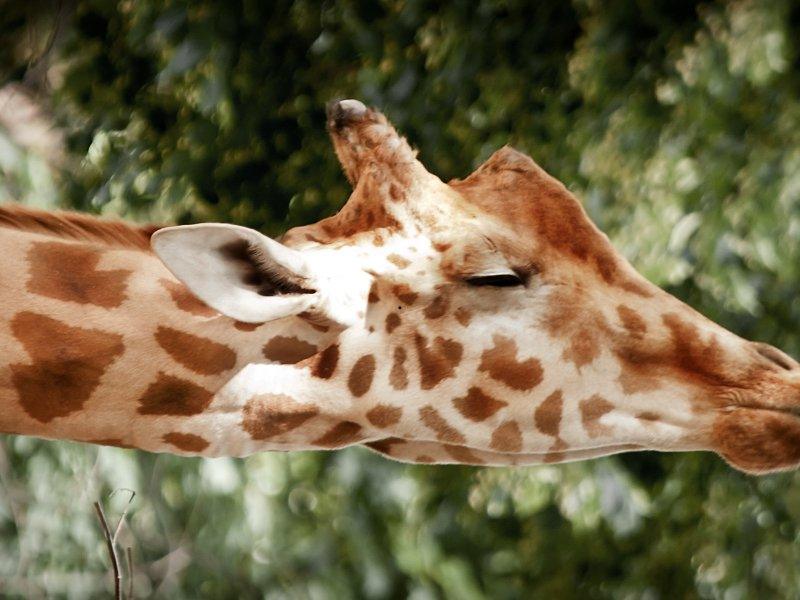
Picture the acacia tree: thorny, tall and stubborn. A giraffe walks up, wraps its tongue around a cluster of leaves well above the thorns’ worst density, and pulls the branch toward its mouth without ever needing to force its face into the spikes. That’s the entire trick. The tongue does the dangerous work so the giraffe’s face doesn’t have to.
Slippery saliva helps too, letting the tongue slide past bark and thorn alike while gripping only the leaves, and likely guarding the mouth’s soft tissue against the small cuts that would otherwise add up across a full day of feeding. Because giraffes can feed this efficiently, they gather more food per minute than animals without that reach, and that efficiency buys them time for the other things that keep a herd alive: watching for predators, moving to water and simply resting.
Unique Adaptations of the Giraffe’s Tongue
Height gets all the attention, but the tongue is doing just as much work behind the scenes. It’s the reason a giraffe can access food that no other browser in the same habitat can reach, and it’s the reason that food doesn’t tear the animal apart on the way in. Between the length, the grip and the colour, you’re looking at three separate adaptations solving three separate problems with one organ. Take away any one of the three and the whole system falters: length without grip would just be an awkward reach, and grip without protective pigment would mean sun damage after every long feeding session.
Why the Tongue’s Colour Protects Against the Sun
The dark tip absorbs and blocks UV rays rather than letting them damage the tissue underneath, which matters enormously given how many hours a day a giraffe’s tongue spends exposed while it feeds high in direct sunlight. That pigmentation is heaviest exactly where the sun hits hardest, at the very tip, and thins out toward the throat where exposure drops off. Beyond sun protection, the darker colouring may also help the tongue manage heat, since darker surfaces can shed warmth differently than pale ones do in a hot climate. Either way, the colour isn’t cosmetic.
Giraffes evolved with this pigmentation because tongues without it would burn during the sheer volume of feeding time these animals put in, day after day, season after season, on a savannah that offers almost no shade at the height where a giraffe actually eats.
Put the pieces together and giraffes’ tongues start to look less like a curiosity and more like a small masterpiece of pressure and adaptation: long enough to out reach the competition, strong enough to strip a thorny branch clean, and pigmented specifically to survive the one thing that reach demands, hours of unbroken sun.
Engaging With Giraffe Tongue Facts: A Closer Look
Once you know what to look for, giraffes feeding is genuinely worth watching closely. The tongue does most of the storytelling. Watch it wrap around a branch, hold, then pull, and you’re seeing 18 to 20 inches of muscle solve a problem that height alone never could. The dark tip catching the light is the same tissue doing sun defence duty in real time.
What the Tongue’s Behaviour Tells You About the Animal
A feeding giraffe rarely rushes, and that’s not laziness. Because the tongue grips so precisely, the animal doesn’t need frantic movement to get a meal; it needs accuracy. You’ll see the tongue extend, curl once around a cluster of leaves, then retract with the leaves stripped clean and the thorns left behind. Do that a few hundred times a day and you understand why giraffes can spend well over 12 hours feeding without exhausting themselves on wasted effort.
The tongue is doing the efficient part so the rest of the animal doesn’t have to work harder than necessary. An animal that fumbles its food, that has to make three attempts where one would do, spends more time with its head down and its guard lowered, and on an open savannah that’s exactly when a predator gets its chance.
Zoos and wildlife reserves give you the closest look most people ever get, and it’s worth taking. Seeing a giraffe’s tongue at work, dark tipped, muscular, impossibly long, does more to explain the animal than any measurement on a page. You start to notice how deliberate every movement is, how the tongue seems to know exactly where the thorns are before it commits to a grip. That’s not instinct alone.
It’s tens of thousands of years of a savannah that never made feeding easy, and a tongue that answered back.
So next time someone asks whether a giraffe’s tongue can really grip like a hand, you’ve got the answer, and the reason behind it. It’s prehensile because reaching thorny, competitive trees demanded it. It’s dark at the tip because hours of sun exposure demanded that too. Two separate problems, one long, strange, remarkably effective answer, stretching 18 to 20 inches out of an animal that had to solve both at once or go hungry.