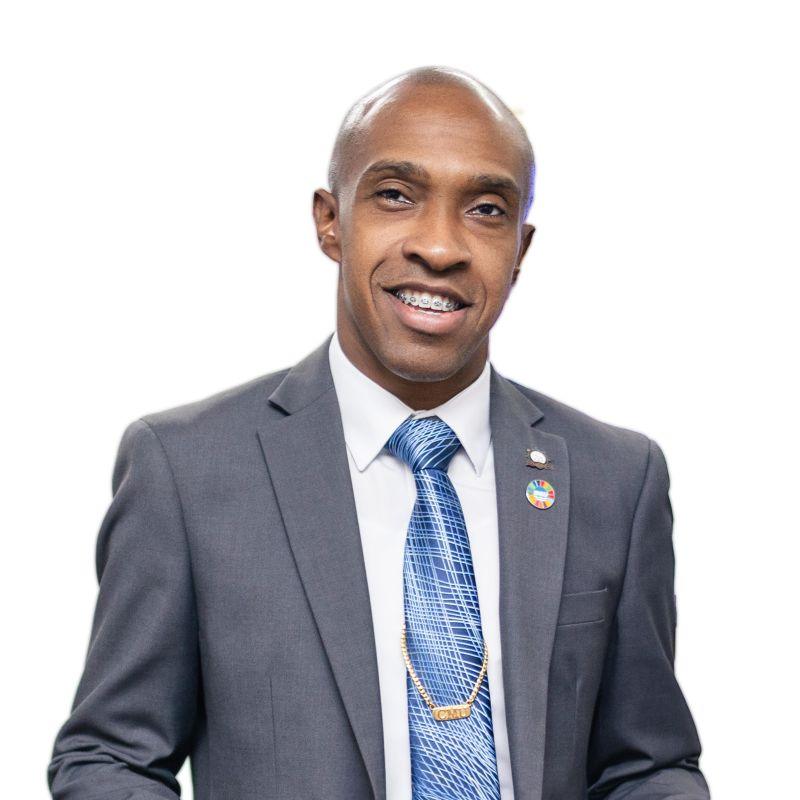
I had the honour of speaking to Andrew Spencer, President of the CMU, about the acute threat of climate change in the Caribbean. Written by Jennifer Withers.
The mission of the CMU reads: ‘redefining maritime excellence through education, research and innovation’. Since his appointment as President in 2022, Professor Andrew Spencer has driven forward pursuit of this mission with the implementation of the Stability, Growth and Innovation (SGI) strategic plan. Andrew’s good humour and determination are present throughout our interview, but he does not shy away from emphasising the serious threats that a warming climate poses for Jamaica and the Caribbean.
The Growth of the Caribbean Maritime University
It is no coincidence that in Andrew Spencer’s first year as President the student body of the CMU grew by 42%. Since then, neither a global pandemic nor catastrophic hurricane could prevent a steady annual growth rate of 15%. This is a testament to the strong leadership of a president who puts his students first with a clear strategy for growth and innovation, and who understands the importance of strong links with the political decision makers in Jamaica: ‘I provide strategic direction and institutional stewardship. In all areas, we report to the Ministry of Education, Skills, Youth, and Information, and have a good relationship with our parent ministry’.
Andrew shows a lot of pride in the internal reforms and positive global image his team have established: ‘We’ve written some 20-plus policies and had them implemented over the last 3 years. These policies range from academic promotion, to the HR manual, the physical development plan, marketing strategy, among other key areas such as sexual harassment policies. Also, I think a big part of what we’ve been able to do is establish a number of international partnerships, and those partnerships have been very telling, because the kinds of partnerships you’re able to get is usually a reflection of how people perceive your brand.’
Global Partnerships Established by the CMU
Andrew proudly describes how the University has established over 20 new partnerships in his three years as President. These partnerships bring in funds and encourage collaboration on some of the Caribbean’s most urgent sustainability issues. Andrew gives particular mention to the Our Shared Ocean program by Irish Aid, which is providing £150,000 of funding for an 18-month research project on the Sargassum seaweed choking the waters of the Caribbean Sea. Andrew says: ‘We also have partnerships with the NSEM, who are brokering a relationship with the government of the UAE for full solarisation of our campus. That will also include as well the installation and commissioning of electric vehicle charging stations.’
I ask Andrew if the CMU students have the opportunity to get involved with any of these collaborations, and the answer is an emphatic yes: ‘Oh absolutely, in fact, one of the things we do is infuse in our curriculum elements of this. We have our Festo Authorized and Certified Training (FACT) Centre, a partnership with the German government years ago to set up really high-tech laboratories in pneumatics, hydraulics, mechatronics and electric vehicles. Students doing engineering are mandated to pass through these spaces and gain this experience as well.’ Andrew also mentions student involvement in beach cleanup and recycling initiatives in Port Royal in partnership with the National Environment and Planning Agency.
Environmental Collaboration Across the Caribbean
Andrew is committed to ensuring the CMU leads by example: ‘We want the environmentally responsible way we operate as a university to filter into our society, into the everyday behaviour of Jamaicans.’ Andrew explains that renewable energy is central to the ethos of the university. As well as working towards fully solarised campuses, the CMU is ISO certified, and held to the seafarer training and certification of the IMO White List. Andrew adds further: ‘A lot of what we do has the environment baked into it. We have a partnership with ECO Canada and we are the only ones certified to deliver the Sustainable Blue Economy Professional (SBEP) certification across the Caribbean.’
The collaboration with ECO Canada on the SBEP certification facilitates the provision of training and certification for employment in blue and green economy sectors. This involves skilling a workforce in roles such as technology, policy and operations: ‘We are the ones who are delivering this certification across the Caribbean and it is embedded in our programs. We just recently trained 40 individuals in Suriname, and that included an environmental component.’ Andrew also mentions more locally focused partnerships. The CMU partners with the Fisheries Authority and the National Environment and Planning Agency to maintain coastline integrity and provide training to fishing communities in Harbour view.
Unique Challenges Faced By the CMU
The main campus for students of the CMU is the Palisadoes campus, overlooking Kingston Harbour, which Andrew tells me is the seventh largest natural harbour in the world. The CMU also has secondary campus locations in Port Royal and Montego Bay, and Andrew is exploring the opportunity for expansion in Suriname. The nature of this location in the Caribbean means greater exposure to natural disasters, such as Hurricane Melissa which hit Jamaica with wind speeds as high as 185mph in October last year. Andrew describes matter of factly the damage to the Montego Bay campus but animatedly details the work of the University to ensure student and staff safety across the Island.
Andrew makes it clear that his top priority after the hurricane was student safety: ‘For the students we were not able to account for we dispatched teams. We had our University Counsellor and the director of the western campus doing door-to-door calls. Secondly, we gave access to the campus for students without electricity. We deployed Starlink devices so they could have connectivity, and very importantly, we established a relief fund approved by the council to assist students and staff in the worst affected parishes.’ Andrew tells me with clear relief that every student was accounted for, and showed up for their exams, which were only a month later than anticipated.
Essential Research Guiding Sustainability Policy
Throughout this interview it becomes clear that for Andrew Spencer and the CMU, the spectre of climate change is an immediate, present threat. Hurricane Melissa was a deadly cyclone responsible for the deaths of at least 95 people, and the well-established link between warmer seas and higher maximum wind speeds increases the likelihood of seeing more Category 5 storms. For Andrew the consequences of climate change threaten his students and staff, campus facilities, and the natural balance of the ecosystems that sustain Jamaican livelihoods. Andrew reiterates the important role of the CMU to provide the government with the most up to date research for informing policy decisions.
Andrew repeatedly mentions Sargassum Seaweed as an important research area for the CMU. Sargassum floats as a mat in the open ocean, where it provides food, shelter and habitat for marine life. However, Sargassum blooms have dramatically increased due to warming oceans and nutrient rich pollution. Once on shore these seaweed mats decompose, giving off a foul smell that dissuades beach activity, and starving shallow waters of the oxygen needed to maintain biodiversity. The funding provided by Irish Aid through Our Shared Ocean supports CMU research to address the socio-economic and environmental impact of the overgrowth. Andrew describes the research as: ‘The next wave of our contribution to the dialogue and impact of sustainability.’
Future Sustainability Research at the CMU
Andrew’s future goals are very research orientated: ‘Our focus is going to be heavily on the strength of our researchers. We have award winning researchers in our faculties. We have a very exciting marine biotechnology program, the only one in the region. Others offer marine biology, but we’re focused on the tech solutions related to that. Our researchers are working right now on a project known as the Caribbean Shipping Lanes (CSL) Project on responsible shipping.’ The CSL project analyzes regional shipping routes, maritime security and decarbonisation strategies in order to protect Caribbean shipping interests and keep ahead of evolving environmental regulations.
As our conversation comes to an end Andrew reiterates how important the research of the CMU is to ensure a seat at the table in national and international policy decisions. One of the great injustices of climate change is that some of the smallest contributors feel the greatest immediate impacts: ‘Six months out of every year, we are worried, and it’s the warming of the very waters we are so interested in as a maritime university that have led to this. We must ensure our voice is heard, that we contribute our very objective approach to these issues and that the governments in Jamaica and of the region are supplied with the best possible research data to inform policy.’