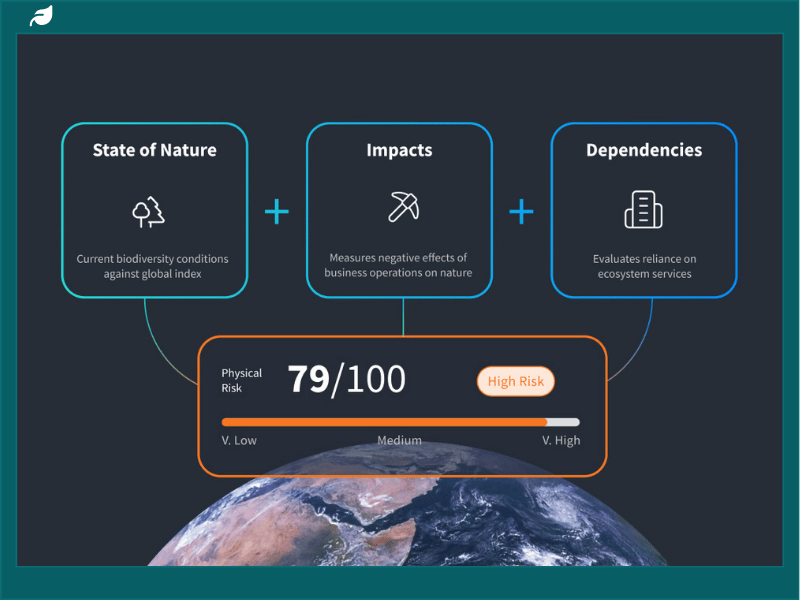
NatureMetrics has launched its Global Nature Risk tool, a portfolio-wide screening solution designed to help businesses move beyond disclosure compliance and start actively managing nature-related risk across their operations. Unveiled in London on 16 June 2026, the tool gives organisations a dynamic, quarterly-updated view of nature risk across every site, asset, or geography they operate in.
From Reporting Obligation to Business Decision
Nature-related risk assessment has, until now, largely developed as a reporting exercise, built to satisfy voluntary disclosure frameworks rather than to inform day-to-day decisions. That picture is shifting fast. As of late 2025, 733 organisations representing more than US$22.4 trillion in assets under management had committed to TNFD-aligned disclosures, up sharply from 416 organisations a year earlier. In April 2026, the International Sustainability Standards Board confirmed it will build a nature-related Practice Statement directly on TNFD foundations, with an exposure draft expected at CBD COP17 in October 2026, signalling that voluntary nature reporting is on a clear path toward harder regulatory requirements.
Against that backdrop, NatureMetrics’ new tool is built to align with the TNFD framework while pushing further than typical disclosure-support products. Global Nature Risk combines three layers of data, a business’s impacts on nature, its dependencies on nature, and the underlying integrity and sensitivity of nature itself, into a single decision-grade signal: a 0–1 risk score calculated for every site, asset, or geography in a company’s portfolio.
Because every score sits on a common scale, results can be aggregated upward for fast portfolio-level prioritisation, or broken down to reveal the specific drivers behind any individual site’s risk profile. The tool also supports double materiality assessments, the increasingly standard requirement for companies to report both the financial risks nature poses to their business and the impact their business has on nature in return.
A Costly Blind Spot
The stakes behind this shift are substantial. The World Bank has estimated that the collapse of selected ecosystem services could cost the global economy up to US$2.7 trillion annually by 2030. That figure has pushed nature considerations beyond the sustainability function and into enterprise risk, procurement, operations, and investment decision-making more broadly.
Dimple Patel, CEO at NatureMetrics, frames the gap the tool is designed to close: “Businesses increasingly recognise that their dependencies and impacts on nature can have a direct effect on long-term business resilience and success. The challenge now is turning that understanding into action.” Patel adds that many nature risk teams remain stuck at the assessment stage of geographic data gathering and analytics, rather than translating that work into active risk management. “By bringing together impacts, dependencies and the state-of-nature, our approach provides a more dynamic picture of nature-related risk. This helps businesses move beyond disclosure and embed nature into decision-making across strategy, risk management and operations.”
Built for Continuous Monitoring, Not One-Off Reporting
Global Nature Risk sits inside the broader NatureMetrics Nature Intelligence Platform, meaning that the moment a high-risk site surfaces, organisations can move directly into action without switching tools or rebuilding analysis from scratch. The underlying data is ground-truthed using habitat and species information, allowing companies to pinpoint exactly where exposure is concentrated and where mitigation investment will have the greatest effect.
Because the data refreshes regularly rather than sitting static between annual reporting cycles, organisations can track whether interventions are actually working over time, a capability that has been largely absent from first-generation nature disclosure tools.
NatureMetrics points to existing client work in mining and renewable energy as evidence the approach holds up in practice, with nature-risk assessments in those sectors producing TNFD-aligned outputs that translated directly into corporate commitments, strategies, and action plans. The company is also positioning the tool for financial services, a sector it says has historically lacked robust nature-risk monitoring capabilities despite growing investor and regulatory pressure to account for nature exposure across lending and investment portfolios.
Investor Backing Signals Market Confidence
The launch carries the backing of Just Climate, an investor in NatureMetrics. Spencer Powell, Managing Director of Climate Finance at Just Climate, points to a specific gap the tool addresses: “Nature-related risks are already present in most investment portfolios. The barrier to acting on them has not been awareness, it has been access to data that is current, comparable across sites, and available at the speed investment decisions require. That is what Global Nature Risk unlocks: portfolio-wide visibility that is dynamic and decision-ready, so companies can identify where nature risk is concentrated and prioritise intervention before it hits the balance sheet.”
A Maturing Market
NatureMetrics’ launch lands at a moment when the regulatory environment around nature disclosure is, paradoxically, both tightening and loosening depending on jurisdiction. The EU’s Omnibus simplification package has allowed Wave-1 CSRD reporters to skip biodiversity datapoints for the 2025 and 2026 financial years, easing near-term compliance pressure in Europe. At the same time, market expectations are hardening through other channels, including increased scrutiny from the European Central Bank’s supervisory function and continued investor demand for credible nature data.
That combination, weaker regulatory mandate in the short term but stronger market-driven expectation, suggests tools like Global Nature Risk may find their strongest pull not from compliance teams racing to meet a filing deadline, but from risk and investment functions that have already concluded nature exposure is a financial issue rather than a reporting one.