Understanding the Lionfish Invasion
Picture a fish so bold it will hover in open water, stare down a diver, and not flinch. That’s a lionfish, and it has turned the Atlantic coast into its personal buffet. According to NOAA Fisheries, a single lionfish residing on a coral reefs can reduce the recruitment of native reef fish by 79 percent, a figure that makes clear just how outsized the damage from even one individual can be. The lionfish invasion involves two invasive species doing the damage: the red lionfish, Pterois volitans, and its close relative Pterois miles. Both are native to the Indo-Pacific, both carry venomous spines, and neither has met a meaningful predator since arriving in the western Atlantic.
Origins of the Indo-Pacific Lionfish
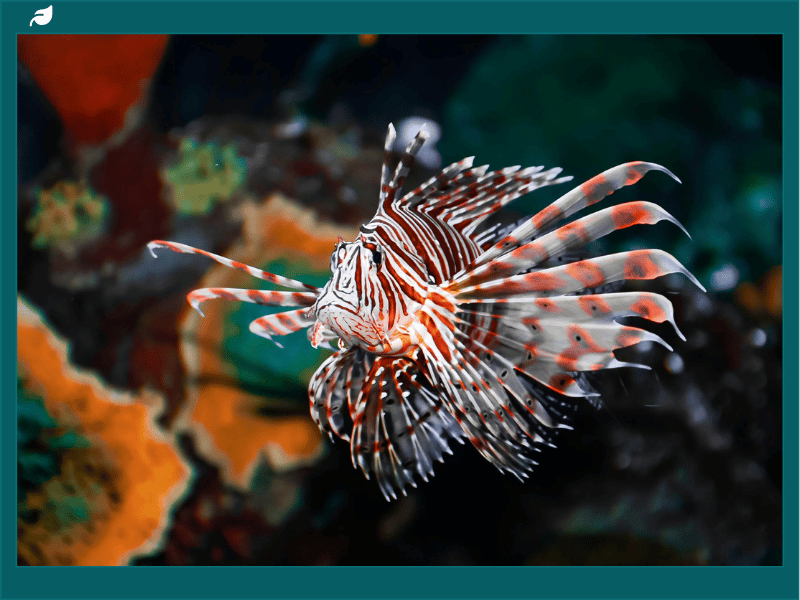
In their home waters of the Indian and Pacific Oceans, lionfish are simply part of the scenery. Pterois volitans and Pterois miles evolved alongside prey that learned to avoid them and predators that kept their numbers honest. They’re striking animals: bold red and white stripes, a fan of needle-sharp spines, and a hunting patience that borders on arrogance. They drift toward small reef fish, corner them, and inhale.
It works every time.
The best current evidence points to the aquarium trade as the source of their Atlantic foothold. Someone, probably more than one someone, released pet lionfish into coastal waters. From there, the math got brutal fast. No natural predators.
Rapid reproduction. A body plan adapted to almost any reef environment. Invasive lionfish didn’t just survive. They exploded.
And because the Atlantic coast offered conditions close enough to home, dense populations established themselves in years rather than decades. Understanding that origin matters because it tells you what you’re dealing with: not an accident of nature, but a consequence of human choices, which means human choices can push back.
Impact of Invasive Species on Marine Environments
Here’s the number that stops people cold. Lionfish are documented predators of more than 50 species of fish, including the small reef fish that graze algae and keep coral healthy. When invasive lionfish move into a reef system, native fish populations drop. The grazing stops.
Algae blooms. Coral suffers. The whole system bends under the pressure of one efficient, unchecked predator.
According to ScienceDirect (Elsevier), lionfish have successfully invaded at least 18 Marine Protected Areas in the southwestern Atlantic between 2020 and 2024, demonstrating that even zones established specifically to shelter marine ecosystems are no longer a reliable barrier against their spread. That finding underscores how urgently management strategies need to extend beyond conventional boundaries.
That’s what invasive species do at their worst. They don’t just add themselves to an ecosystem; they reorganize it around their own needs. Lionfish compete with native predators for food, shrink the prey base those predators depend on, and alter food webs in ways that ripple outward for years. Reef degradation follows.
Fisheries feel it. Communities that depend on healthy reefs feel it. The lionfish invasion isn’t a single-species problem. It’s a systems problem, and managing it requires coordinated removals, sustained public awareness, and tools that didn’t exist a decade ago.
The Role of Conservation Derbies
Conservation derbies have become one of the sharpest tools available for managing invasive lionfish populations along the Atlantic and Gulf coasts. NOAA has been central to pushing these events forward, and for good reason: derbies combine direct ecological impact with something a policy memo never achieves, which is genuine community enthusiasm. Participants compete to catch the most lionfish, the biggest, the smallest. Boats go out, spears go in, and lionfish come off the reef in numbers that add up fast.
Each one removed is one less predator thinning native fish stocks and stressing coral.
What are Lionfish Derbies?
A lionfish derby is a structured removal event built around competition. Divers register, head out to reef sites, and harvest as many lionfish as they can within the event window. Winners are recognized for volume, size, or both. The format sounds simple, and it is, but that simplicity is the point.

Led by organizations including NOAA, these events focus removals on the areas where lionfish are doing the most damage. Pterois volitans makes up the majority of what participants pull off the reef, though Pterois miles turns up regularly in some zones. Beyond the catch count, derbies function as field classrooms. Participants learn to identify lionfish, understand why the species is so destructive, and practice safe handling of venomous fish.
That education doesn’t stay on the boat. Divers go home and talk about what they saw. Kids who attend shoreside weigh-ins ask questions. Awareness spreads in ways that a brochure never quite manages.
So the derby isn’t just a removal event. It’s a culture-building exercise, and the culture it builds is one of active, hands-on conservation. That matters for the long game. Every diver who leaves a derby knowing how to find, catch, and safely handle a lionfish is a year-round asset to the management effort, not just a one-weekend participant.
Why Derbies are Crucial for Control Efforts
In their invaded range, lionfish have no natural predators willing to take them on consistently. The Gulf of Mexico, the Caribbean, the Atlantic coast from Florida northward: in all of these waters, lionfish populations grow unless humans intervene directly. Derbies are one of the few mechanisms that intervene at scale.
The math is straightforward. Each lionfish removed from a reef reduces predation pressure on native fish. Enough removals in the right locations can give native populations breathing room to recover. Several study sites near regularly held derbies have shown measurable improvements in native fish density after sustained removal events.
That’s not a miracle. It’s just subtraction applied consistently. Lionfish are highly efficient hunters, so removing even a modest number from a targeted reef site produces a disproportionate improvement in the survival rates of smaller reef fish that would otherwise be eaten.
But derbies also prove something less obvious. Public engagement works. Community-led removal initiatives, when well-organized, can produce ecological outcomes that rival more expensive, top-down interventions. That’s a genuinely useful finding for conservation managers who are always working with limited budgets.

Lionfish derbies show that targeted removal, powered by people who actually want to be there, can make a real difference to reef recovery and to the sustained effort needed to manage this invasive species over the years ahead.
Pioneering Control Methods
Derbies are high-profile, but they’re one piece of a broader toolkit. The rise of invasive lionfish along the Atlantic coast has pushed researchers, divers, and technology developers to get creative. Some of the most promising work focuses on the biology of Pterois volitans and Pterois miles directly, using what these fish do naturally as leverage against them. Lionfish are adaptable, hardy, and reproductively prolific, which means no single control method is going to solve the problem on its own.
You need multiple approaches working in parallel.
Utilizing the Carnivorous Fish Native Instinct for Management
Lionfish are ambush predators. They hold position, read their environment, and move toward prey with deliberate precision. That behavioral consistency is actually useful if you’re designing a control strategy. Researchers and field managers have explored traps and enclosure systems that exploit predictable hunting behaviors, drawing lionfish toward a confined space where they can be removed efficiently and in volume without disturbing surrounding reef inhabitants.
The approach requires real knowledge of how these fish move and respond to stimuli, but that knowledge is building fast. Understanding Pterois volitans and Pterois miles at the behavioral level means control measures can be increasingly precise. You’re not dragging a net through a reef and hoping for the best. You’re directing a specific predator toward a specific outcome.
That precision matters for reef health, since collateral disruption to other marine life undermines the conservation goal you’re trying to reach. It also matters for efficiency, since resources spent on lionfish management are always finite and need to produce the best possible return. Educating participants and field teams about these instincts adds another layer of value, building a community that understands the species rather than just reacting to it. Lionfish respond to bait and enclosure designs in consistent, predictable ways, and that predictability is exactly the kind of behavioral handle that good management strategies are built on.
Exploring Pterois Specific Approaches
Off the coast of Mexico and throughout the broader Gulf region, Pterois volitans and Pterois miles have established populations dense enough to require dedicated, species-specific removal strategies. Generalist fishing pressure won’t cut it. These fish need targeted methods, and the field is developing them.
Spear hunting remains the most direct and widely used approach, practiced by trained divers who can take individual lionfish without disturbing the reef structure around them. Alongside spearing, specialized trap designs are being tested and refined, built to attract lionfish specifically rather than scooping up whatever happens to pass by. NOAA and partner organizations have contributed critical data on predator-prey dynamics in invaded systems, helping conservationists understand where lionfish concentrate, when they’re most active, and which removal methods produce the best results per hour of effort.
The Mexico coast work is particularly instructive because populations there interact with reef systems under additional stress from warming and runoff. Managing invasive lionfish in that context means coordinating with local fishing communities, environmental agencies, and research institutions simultaneously. It’s complicated, but it’s also where some of the most innovative thinking is happening. Collaborative, research-backed, community-involved approaches give the best chance of long-term success in restoring reef biodiversity to waters that, not long ago, these fish had no business being in at all.