The evolution of inkjet printing continues to redefine possibilities across industrial sectors. With the recent research collaboration between Xaar, Nazdar, and the Welsh Centre for Printing and Coating at Swansea University, a transformative step forward has been achieved. Published in the Journal of Coatings Technology and Research, this independent study highlights how high-viscosity water-based inks, powered by Xaar’s Aquinox printhead and Ultra High Viscosity Technology, are set to revolutionise printing for packaging, textiles, and beyond.
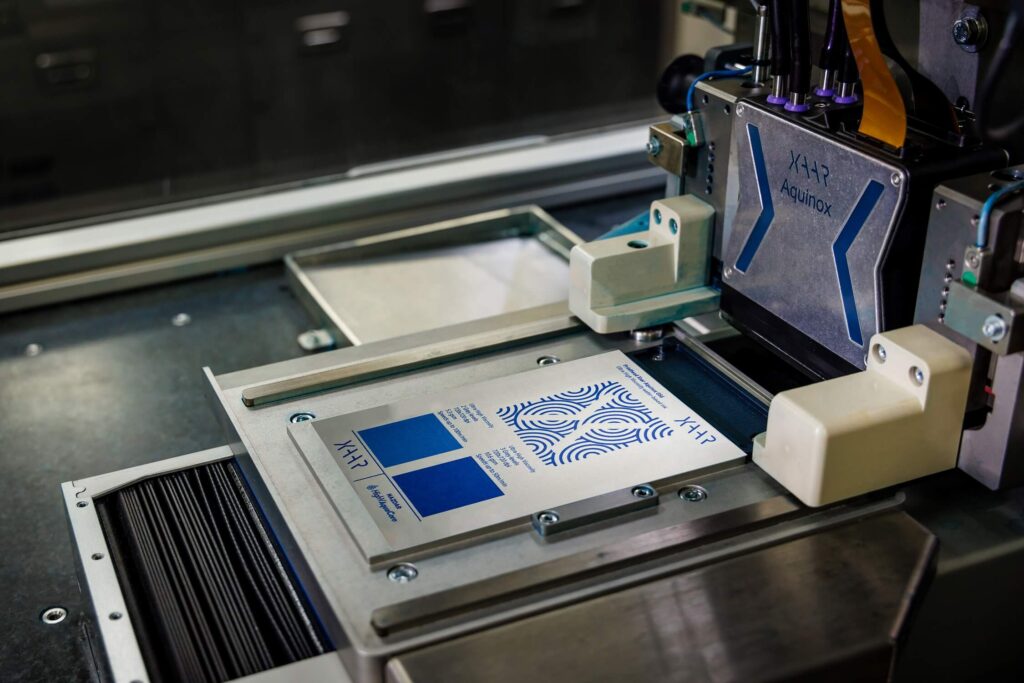
The research demonstrates how high-viscosity aqueous inks deliver significant advancements in printing quality, sustainability, and cost-efficiency. The findings bring to light how Xaar’s technology achieves higher colour density with reduced ink consumption, enabling vibrant and impactful printing outcomes. This article delves into the key aspects of the research, its implications for industrial printing, and its alignment with circular economy principles.
The Research Findings
The study was conducted by Dr Chris Phillips and Professor Davide Deganello at Swansea University and compared high-viscosity water-based inks with conventional ink formulations. It evaluated their performance using Xaar’s Aquinox printheads on a variety of corrugated substrates.
One of the most striking results was the significant increase in colour density. On uncoated corrugated boards, colour density improved by up to 13%, while on coated white substrates, the improvement soared to 67%. This enhancement is attributed to the high-viscosity inks’ ability to remain on the surface of the substrate rather than being absorbed, which is a common issue with conventional inks.
Moreover, high-viscosity inks were found to use less fluid to achieve the same colour intensity. This efficiency translates into lower material costs, faster drying times, and reduced energy usage. The ability to minimise drying energy is particularly relevant for corrugated packaging, where sustainability and cost-efficiency are critical concerns.
The study also demonstrated how high-viscosity technology enables printing on uncoated substrates without primers. This simplification of the printing process not only reduces production complexity but also minimises environmental impact by eliminating the need for additional chemicals.
Sustainability in Industrial Printing
Xaar’s innovations align with the broader goals of sustainable manufacturing and the circular economy. By reducing ink consumption and energy requirements, high-viscosity inks offer a greener alternative to traditional printing methods. The reduction in material waste and energy use reflects a commitment to more responsible industrial practices.
The circular economy focuses on minimising resource waste while maximising the efficiency and lifespan of materials. Xaar’s Ultra High Viscosity Technology supports this vision by enabling high-quality printing outcomes with fewer inputs. Additionally, the elimination of primers reduces chemical usage, further enhancing the environmental benefits.
These advancements address a growing demand for sustainable solutions in industries such as packaging and textiles. Businesses are increasingly seeking ways to reduce their carbon footprint while maintaining high production standards, and Xaar’s technology provides a compelling solution.
Implications for Industry
The applications of high-viscosity inks extend beyond corrugated packaging. At the FuturePrint Tech Conference, Xaar’s Group R&D Director Karl Forbes and Business Development Manager Neil Cook outlined how this technology is reshaping industries such as textiles and advanced manufacturing.
“The ability to achieve high pigment loads without primers simplifies the process and reduces costs, making it an attractive option for manufacturers seeking efficiency and sustainability “.
For advanced manufacturing, the precision and reliability of Xaar’s printheads open up possibilities for printing with specialist functional fluids. This capability is critical for industries such as electronics and 3D printing, where exacting standards are required.
The research underscores how high-viscosity inks are not only meeting but exceeding these demands, paving the way for broader adoption across diverse applications.
The Importance of Collaboration
Xaar’s success in developing high-viscosity inkjet solutions is a testament to its collaborative approach. By partnering with organisations such as Nazdar and Swansea University, Xaar has been able to combine expertise in printhead technology and ink formulation to deliver groundbreaking results.
The research findings have already been translated into commercially available products, with high-viscosity ink sets now on the market for corrugated and textile printing. These developments highlight the importance of industry collaboration in driving innovation and addressing complex challenges.
Xaar’s commitment to research and development is evident in its extensive patent portfolio and ongoing investment in new technologies. This focus on innovation ensures that Xaar remains at the forefront of industrial printing, delivering solutions that meet the evolving needs of its customers.
A Step Forward for Digital Printing
The publication of this research marks a significant milestone for Xaar and the wider printing industry. With proven benefits in print quality, sustainability, and efficiency, high-viscosity inks represent a step change in what is possible with digital printing.
By enabling more sustainable production processes and reducing resource consumption, Xaar’s Ultra High Viscosity Technology is helping to reshape the future of industrial printing. The combination of high performance and environmental benefits makes it a compelling choice for businesses seeking to balance quality and sustainability.
As the industry continues to evolve, the role of innovation will be critical in addressing emerging challenges and opportunities. Xaar’s achievements in high-viscosity inkjet technology demonstrate how collaboration, research, and a commitment to sustainability can drive progress and unlock new possibilities.For more information on Xaar’s technology and the Swansea University research, visit Xaar’s website.