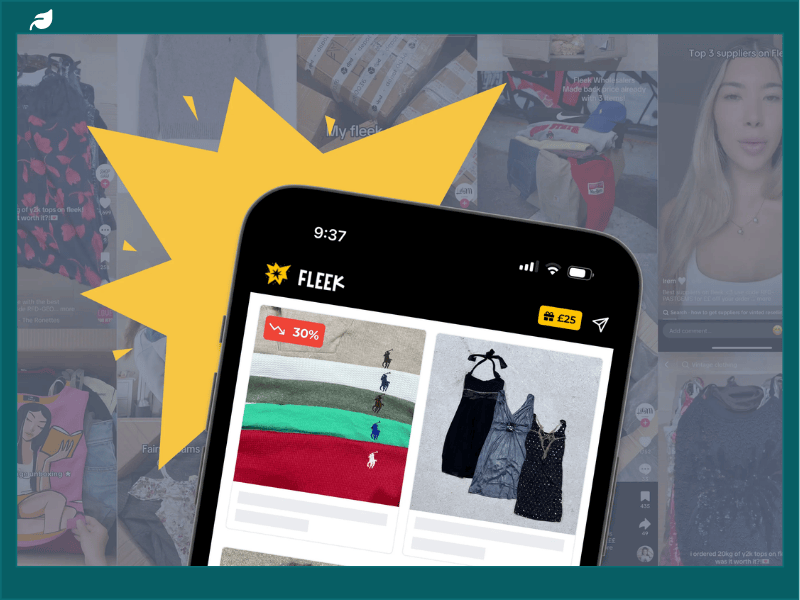
Founded in 2021, Fleek was created to address what its founders identified as one of resale’s biggest constraints: sourcing inventory at scale. What had traditionally been a fragmented and largely offline wholesale market has been rebuilt into a global digital marketplace, connecting more than 10,000 resellers across 70 countries with over 1,000 verified suppliers.
The growth of the second-hand sector has accelerated in recent years, attracting increasing attention from major players. News that eBay is acquiring second-hand fashion platform Depop for approximately $1.2 billion underscores the scale and strategic value of resale. With Depop generating roughly $1 billion in annual merchandise sales and attracting millions of active buyers, primarily under the age of 34, the deal signals how recommerce has moved firmly into the mainstream.
While consumer platforms such as Depop and eBay focus on connecting buyers and sellers, Fleek operates further upstream. The company provides the digital infrastructure that enables vintage resellers, small businesses and entrepreneurs to source stock efficiently and in volume. By digitising wholesale relationships, Fleek supports thousands of independent sellers in building consistent supply chains and scaling their operations.
Scaling the Circular Fashion Supply Chain
Fleek’s marketplace was designed to professionalise sourcing within the resale sector. Historically, many resellers relied on in-person warehouse visits, word-of-mouth networks and fragmented supplier relationships. By moving wholesale online, Fleek has created a more transparent and accessible sourcing model for businesses operating in the circular fashion economy.
Since being accepted into Y Combinator’s W22 batch, the company has raised $20.4 million. The investment positions Fleek within a second-hand apparel market forecast to reach $350 billion by 2028, as demand for pre-owned fashion continues to rise globally.
The company’s data reflects accelerating demand across multiple brand categories. Comparing 2025 orders with 2024, menswear and unisex brands have seen notable increases, including Ralph Lauren up 73%, Tommy Hilfiger up 86%, Patagonia up 70%, Nike up 67%, Harley-Davidson up 90% and Montbell up 100%.
Womenswear has also recorded significant growth. Orders for Coach and Guess bags have increased by 85%, Lululemon by 80%, and Victoria’s Secret by 86%. These figures point to sustained interest across heritage, luxury, sportswear and outdoor brands within the resale channel.
From Side Hustle to Structured Business
The expansion of resale is increasingly characterised by professionalised operations rather than informal activity. What was once considered a side income for many sellers is evolving into a scalable business model supported by global digital infrastructure. Platforms such as Fleek provide the supply chain tools required for consistency, inventory planning and international sourcing.
Since 2022, more than 9 million garments sourced through Fleek have been diverted from landfill. By facilitating the redistribution of existing clothing stock, the company contributes to extending product lifecycles within the fashion industry.
At the same time, the marketplace has enabled thousands of independent sellers to turn resale into full-time income. By connecting verified suppliers with entrepreneurs worldwide, Fleek supports both economic activity and the continued expansion of the circular fashion ecosystem.
As major acquisitions signal confidence in resale’s commercial future, supply chain infrastructure is becoming an essential component of the sector’s continued growth. Fleek’s model reflects the structural shift taking place across fashion retail, where second-hand clothing is no longer viewed as niche but as a core part of the global apparel market.Founded in 2021, Fleek was created to address what its founders identified as one of resale’s biggest constraints: sourcing inventory at scale. What had traditionally been a fragmented and largely offline wholesale market has been rebuilt into a global digital marketplace, connecting more than 10,000 resellers across 70 countries with over 1,000 verified suppliers.
The growth of the second-hand sector has accelerated in recent years, attracting increasing attention from major players. News that eBay is acquiring second-hand fashion platform Depop for approximately $1.2 billion underscores the scale and strategic value of resale. With Depop generating roughly $1 billion in annual merchandise sales and attracting millions of active buyers, primarily under the age of 34, the deal signals how recommerce has moved firmly into the mainstream.
While consumer platforms such as Depop and eBay focus on connecting buyers and sellers, Fleek operates further upstream. The company provides the digital infrastructure that enables vintage resellers, small businesses and entrepreneurs to source stock efficiently and in volume. By digitising wholesale relationships, Fleek supports thousands of independent sellers in building consistent supply chains and scaling their operations.
Scaling the Circular Fashion Supply Chain
Fleek’s marketplace was designed to professionalise sourcing within the resale sector. Historically, many resellers relied on in-person warehouse visits, word-of-mouth networks and fragmented supplier relationships. By moving wholesale online, Fleek has created a more transparent and accessible sourcing model for businesses operating in the circular fashion economy.
Since being accepted into Y Combinator’s W22 batch, the company has raised $20.4 million. The investment positions Fleek within a second-hand apparel market forecast to reach $350 billion by 2028, as demand for pre-owned fashion continues to rise globally.
The company’s data reflects accelerating demand across multiple brand categories. Comparing 2025 orders with 2024, menswear and unisex brands have seen notable increases, including Ralph Lauren up 73%, Tommy Hilfiger up 86%, Patagonia up 70%, Nike up 67%, Harley-Davidson up 90% and Montbell up 100%.
Womenswear has also recorded significant growth. Orders for Coach and Guess bags have increased by 85%, Lululemon by 80%, and Victoria’s Secret by 86%. These figures point to sustained interest across heritage, luxury, sportswear and outdoor brands within the resale channel.
From Side Hustle to Structured Business
The expansion of resale is increasingly characterised by professionalised operations rather than informal activity. What was once considered a side income for many sellers is evolving into a scalable business model supported by global digital infrastructure. Platforms such as Fleek provide the supply chain tools required for consistency, inventory planning and international sourcing.
Since 2022, more than 9 million garments sourced through Fleek have been diverted from landfill. By facilitating the redistribution of existing clothing stock, the company contributes to extending product lifecycles within the fashion industry.
At the same time, the marketplace has enabled thousands of independent sellers to turn resale into full-time income. By connecting verified suppliers with entrepreneurs worldwide, Fleek supports both economic activity and the continued expansion of the circular fashion ecosystem.
As major acquisitions signal confidence in resale’s commercial future, supply chain infrastructure is becoming an essential component of the sector’s continued growth. Fleek’s model reflects the structural shift taking place across fashion retail, where second-hand clothing is no longer viewed as niche but as a core part of the global apparel market.